

Compare
Cloudflare vs Akamai: Which CDN Is Better for Enterprise?
Cloudflare vs Akamai for enterprise usually comes down to operating model. As of October 2026, Akamai publishes no CDN ...
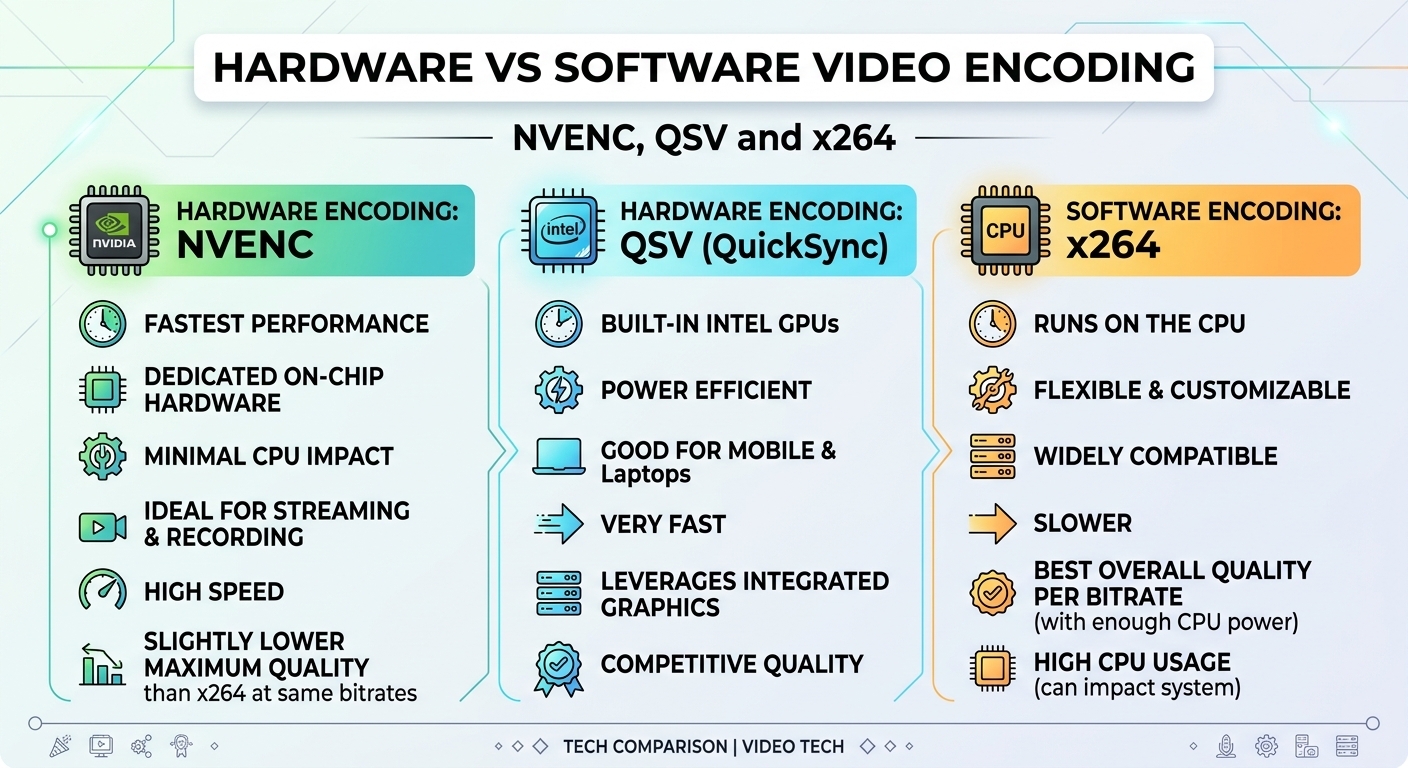
Evaluated October 2026: for live video, a modern GPU hardware encoder (NVIDIA NVENC on Turing or newer, Intel Quick Sync Video on Arc) beats x264 on cost per channel by roughly 3 to 4 times at equal or better quality than x264 veryfast. For popular on-demand titles, a slow software HEVC encoder such as x265, or SVT-AV1, still wins because its 10 to 25 percent bitrate saving is paid back on every view. Pick hardware for live and long-tail VOD, and software for anything encoded once and watched thousands of times.
Public VMAF comparisons published between 2023 and 2025 typically show NVENC H.264 on Ada-generation GPUs landing within about 5 to 10 percent of x264 medium bitrate at equal quality, while NVENC HEVC needs roughly 15 to 25 percent more bits than x265 slow. Hardware AV1 on NVENC or Intel Arc usually needs 30 to 40 percent fewer bits than x264 medium, which makes a hardware AV1 encoder the strongest per-dollar option for live ladders in 2026.
Encoder choice moves two bills at once: compute for encoding and egress for every byte delivered. A fair evaluation scores both, plus the operational limits that only show up at density. These are the criteria used in the rest of this article.
| Encoder | Cost per live 1080p30 ladder (estimate, 2025 list) | Billing model | Bitrate vs x264 medium at equal VMAF (typical range) | Codecs |
|---|---|---|---|---|
| NVENC (Ada, Blackwell) | about $0.13 per hour | GPU instance per hour | H.264: plus 5 to 10 percent; AV1: minus 30 to 40 percent | H.264, HEVC, AV1 |
| Intel QSV (Arc, recent iGPUs) | low, mostly on-prem or bare metal | hardware capex, few cloud SKUs | H.264: plus 5 to 15 percent; AV1: close to NVENC AV1 | H.264, HEVC, AV1 |
| x264 veryfast | about $0.19 per hour | CPU instance per hour | plus 15 to 25 percent | H.264 |
| x264 medium | about $0.54 per hour | CPU instance per hour | baseline | H.264 |
| x265 slow / SVT-AV1 preset 4 to 6 | not practical for live 1080p ladders on one server | CPU instance per hour | HEVC: minus 25 to 35 percent; AV1: minus 40 to 50 percent | HEVC, AV1 |
Hardware encoders win cost per live channel by a wide margin, while slow software encoders still own the best bits per quality point.
All ranges above are this blog's estimates built from public VMAF comparisons and approximate on-demand instance prices from 2025; your content will move them by several points either way.
NVENC on Turing and later GPUs matches or beats x264 veryfast and fast at streaming bitrates, and trails x264 medium by roughly 5 to 10 percent in bitrate for equal VMAF when run at preset p7 with lookahead and spatial adaptive quantization enabled. The gap widens on grainy film content and narrows on clean sports and gaming footage.
The defaults matter more than the silicon. Running h264_nvenc at a fast preset with no lookahead gives up most of that ground; the high-quality configuration (preset p7, tune hq, VBR rate control, full-resolution multipass, a lookahead of 20 to 32 frames, spatial and temporal AQ) costs some throughput but keeps the engine well inside real-time. On the x264 side, live operators almost always run veryfast or faster, because medium needs roughly three times the CPU. In practice the honest comparison for live is NVENC p7 against x264 veryfast, and NVENC wins it on both quality and cost.
NVENC is a fixed-function block on NVIDIA GPUs; Ada Lovelace (2022) added AV1 encode, and data center parts such as the L4 carry two NVENC engines alongside dedicated decoders, so a full decode, scale and encode pipeline never touches the CPU. Its strength is predictable density in any major cloud. Limitation: GeForce cards enforce a driver-level cap on concurrent sessions, so production density requires data center SKUs, and GPU instance availability varies sharply by region.
Quick Sync Video on Arc GPUs and recent integrated graphics offers hardware AV1 encode at very low power and hardware cost, and its AV1 output lands close to NVENC AV1 in public comparisons. It suits on-prem encoder racks and edge appliances. Limitation: cloud providers offer few QSV-capable instance types, so it is mainly a bare-metal or colocation choice, and H.264 quality typically trails NVENC slightly.
x264 remains the reference H.264 encoder with the deepest tuning surface, and x265 at slow or slower is still one of the most bit-efficient HEVC encoders available. Both scale on commodity CPUs anywhere. Limitation: quality costs CPU almost linearly, so the presets that beat hardware are too slow for dense live ladders.
For live HEVC, NVENC wins on density and cost; for VOD HEVC, x265 slow wins on bitrate, typically saving 15 to 25 percent against NVENC HEVC at equal VMAF. QSV HEVC sits close to NVENC and makes sense where Intel hardware is already deployed. The deciding variable is how many times each encoded byte gets delivered.
HEVC also brings a delivery constraint independent of the encoder: device support and licensing make it a second ladder beside H.264 for most services, which doubles storage and halves cache efficiency per rendition. That cost belongs in the decision before any VMAF chart.
A hardware AV1 encoder on NVENC or Intel Arc produces live AV1 at a fraction of the CPU cost of SVT-AV1, and typically needs 30 to 40 percent fewer bits than x264 medium. SVT-AV1 at presets 4 to 6 still beats hardware AV1 by roughly 15 to 30 percent in bitrate, which justifies it for high-view VOD.
SVT-AV1 at presets 8 to 10 is viable for live on large CPU servers, but at the density of a GPU it rarely wins on cost. Decoder coverage is the real gate: AV1 hardware decode is now common on recent phones, TVs and laptops, yet most services still keep H.264 as the fallback rung.
Assumptions, all labeled estimates: 100 concurrent live channels, each a four-rung 1080p30 ladder (6, 3, 1.5 and 0.8 Mb/s), 730 hours a month. CPU instances with 32 vCPUs at about $1.43 per hour on demand; L4 GPU instances at about $0.80 per hour (approximate 2025 list prices). x264 veryfast needs about 4 vCPUs per ladder, x264 medium about 12, and one L4 carries about 6 ladders with decode and scaling on the GPU.
| Option | Monthly compute (estimate) | Arithmetic | Quality vs x264 medium |
|---|---|---|---|
| NVENC on L4 | $9,928 | 17 instances x $0.80 x 730 | about 8 percent more bits |
| x264 veryfast | $13,571 | 13 instances x $1.43 x 730 | about 20 percent more bits |
| x264 medium | $39,668 | 38 instances x $1.43 x 730 | baseline |
Against x264 veryfast, NVENC is both cheaper and better, so for live H.264 there is no trade-off left to argue.
GPU encoding beats a slower software preset whenever the monthly compute saving is greater than the bitrate penalty times delivered terabytes times your delivery price per terabyte. Written out: hardware wins while compute saving exceeds penalty fraction x delivered TB x price per TB.
Live case: NVENC saves $29,740 a month against x264 medium ($39,668 minus $9,928) at an 8 percent penalty. At $4 per TB delivery, break-even is 29,740 divided by 0.32, about 93,000 TB a month for 100 channels. At $20 per TB it is about 18,600 TB. Very few 100-channel services deliver that much, so hardware wins live almost everywhere.
VOD case: a two-hour 1080p title at an average 6 Mb/s is 5.4 GB per full view. Encoding its ladder with x265 slow costs roughly $1.80 in CPU time (about 40 vCPU-hours at $0.045, an estimate) against about $0.10 on a GPU. With a 20 percent NVENC HEVC penalty, each view wastes about 1.08 GB, or $0.0043 at $4 per TB. Break-even is about 400 views at $4 per TB and about 80 views at $20 per TB. Any title above that should get the slow software encode.
The penalty bytes are delivery bytes, so the price per TB in the formula is your CDN rate. BlazingCDN does not transcode; it delivers the packaged output, and its HLS Streaming CDN for pre-encoded HLS, LL-HLS and DASH ladders bills one global rate with no request fees, which keeps the R term in the formula a single number.
| Workload | Best fit | Why |
|---|---|---|
| Live sports and events, many channels | NVENC (H.264 plus AV1 rungs) | Density and cloud availability |
| On-prem contribution or edge encoders | Intel QSV | Low power and hardware cost, hardware AV1 |
| Premium VOD head catalog | x265 slow or SVT-AV1 preset 4 to 6 | Bitrate saving repaid on every view |
| UGC and long-tail VOD | NVENC first pass, re-encode titles that cross the view threshold | Most uploads never reach break-even views |
| Small live operation, a few channels | x264 veryfast on existing CPUs | No GPU operations overhead at low scale |
The single most profitable pattern is hybrid: encode everything on hardware first, then re-encode in software only the titles whose view count crosses the break-even line.
Yes, for most live workloads. NVENC on Turing or newer GPUs at preset p7 with lookahead matches or beats x264 veryfast, the preset most live operators actually run, while costing less per channel. It trails x264 medium by roughly 5 to 10 percent in bitrate, a gap that rarely outweighs the compute saving at live scale.
x265 at slow or slower gives the best HEVC quality per bitrate among widely used encoders, typically 15 to 25 percent fewer bits than NVENC HEVC at equal VMAF. The extra CPU cost, roughly a couple of dollars per two-hour title, pays back after a few hundred views at common delivery prices.
Usually yes on bitrate. Hardware AV1 on NVENC or Intel Arc typically needs 30 to 40 percent fewer bits than x264 medium for equal quality, at hardware encoding cost. The limit is playback: older devices lack AV1 decode, so services keep an H.264 ladder as fallback and add AV1 rungs for capable clients.
A conservative planning estimate is about six four-rung 1080p30 ladders per L4 with decode and scaling on the GPU, using high-quality presets. Actual density depends on preset, lookahead depth, codec and frame rate, so measure sustained real-time throughput with your own ladder before sizing a fleet.
Pick ten representative clips (sports, talking heads, film grain, screen content). Encode each with x264 veryfast and medium, NVENC p7, QSV at its best quality preset, x265 slow and SVT-AV1 preset 6, then find the bitrate each needs to hit a VMAF of 93 at 1080p. Record sustained real-time ladders per instance, convert to cost per channel-hour, and plug your penalty fraction, delivered TB and per-TB price into the break-even formula above. The result tells you which titles deserve a slow software encode.
Once the ladder is chosen, the BlazingCDN Video CDN for encoded VOD libraries replicates the finished renditions inside the CDN and keeps the origin out of the delivery path.

Heavy traffic.
Light bill.
The CDN for video and large traffic
Compare
Cloudflare vs Akamai for enterprise usually comes down to operating model. As of October 2026, Akamai publishes no CDN ...
Video - Video & Streaming
For most streaming platforms in 2026 the answer to AV1 vs HEVC is both: HEVC as the broad-reach premium codec, AV1 ...