
Learn
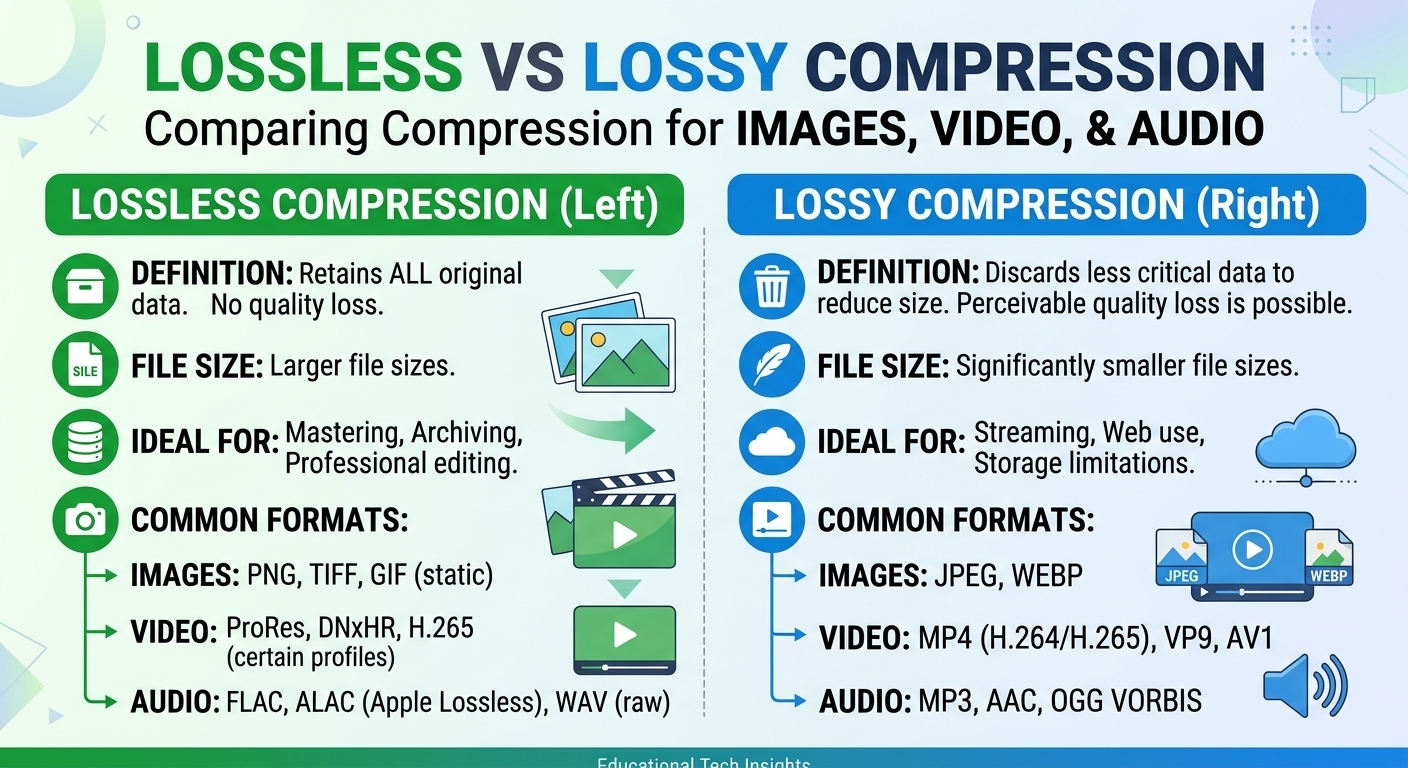
Lossy vs Lossless Compression: Images, Video and Audio
Lossy vs lossless compression comes down to one trade: lossless compression rebuilds every original bit and typically ...
The internet’s carbon footprint is now comparable to that of the entire aviation industry, with ICT and data infrastructure estimated to account for 2–4% of global greenhouse gas emissions. A significant share of that energy is spent simply moving bits of data across the world. That’s where the idea of a green CDN—a content delivery network designed for efficiency and sustainability—moves from buzzword to strategic necessity.
If your business delivers video, software, games, or SaaS at scale, your CDN choices directly influence both performance and emissions. The surprising truth: small architectural decisions—where you cache content, how you route traffic, how efficiently you use hardware—can translate into megawatt-hours saved and tons of CO₂ avoided every year.
This article explores how modern, sustainability-focused CDNs reduce carbon footprint without sacrificing performance, what “green CDN” really means in practice, and how to evaluate providers through a climate-conscious lens. Along the way, you’ll see where your current delivery strategy may be leaving efficiency (and money) on the table—and what to do about it.
As you read, consider: if you benchmarked your content delivery energy use today, would you know whether you’re ahead of the curve or quietly falling behind?
Before we dive into green CDNs, it’s important to understand the scale of the problem they help address. Every click, stream, and download triggers a chain reaction of energy use across data centers, networks, and user devices.
According to the International Energy Agency (IEA), data centers consumed roughly 460 TWh of electricity in 2022, while data transmission networks used about 260 TWh. Together, that’s around 2% of global electricity demand—and these numbers are rising with the growth of cloud computing, AI, and video streaming.
Even if data centers themselves become more efficient, the sheer volume of traffic means total energy consumption can still rise. Efficiency must therefore extend beyond the data center walls and into the network—exactly where CDNs operate.
Content delivery sits at the intersection of infrastructure, software, and user experience. A typical user never sees the complexity behind a 4K video stream or a multi-gigabyte game update, but behind the scenes:
This is both a challenge and an opportunity. When you optimize content delivery, you simultaneously cut latency, improve user experience, and reduce energy consumption in the network. In other words, performance engineering and sustainability engineering are strongly aligned.
Looking at your current delivery path, how much of your traffic is traveling further than it needs to—and how much unnecessary energy is that costing you?
A content delivery network is a distributed system of caching servers that store and serve copies of your content closer to end users. While most teams adopt CDNs for speed and reliability, the same architecture can produce substantial carbon savings.
At a high level, a CDN sits between your users and your origin infrastructure. When a user requests content:
Over time, popular content becomes widely cached, drastically reducing the number of requests that need to traverse long-distance backbone links or hit your origin. For high-traffic workloads—streaming platforms, app updates, or viral websites—cache hit ratios can exceed 90%, tremendously shrinking upstream data transfer.
Green benefits emerge from this basic mechanism:
The result is less energy consumed in transmission networks, fewer origin servers to maintain, and lower cooling and power overhead at your own facilities. When combined with renewable energy sourcing and efficient hardware, CDNs become a powerful lever for reducing the carbon intensity of digital services.
As you look at your architecture today, how much of your traffic is still bypassing the CDN and hitting origin directly, undermining both performance and sustainability?

Not every CDN is automatically a green CDN. Two providers can offer similar latency and throughput while having very different energy footprints, depending on how they design, power, and operate their infrastructure.
A truly sustainable CDN strategy rests on a few core principles:
When comparing CDNs through a green lens, the following metrics and signals are particularly useful:
Even if not all metrics are public, asking structured questions about these factors can help you select a partner whose sustainability roadmap aligns with your own.
| Dimension | Traditional CDN Focus | Green CDN Focus |
|---|---|---|
| Primary KPI | Latency, availability, throughput | Latency, availability, throughput plus energy per TB and CO₂e per TB |
| Infrastructure planning | Overprovisioning for peak traffic | Dynamic scaling and efficiency-optimized capacity planning |
| Power sourcing | Grid mix, limited renewables focus | High share of renewable energy or matching with guarantees of origin |
| Software optimization | Performance-centric optimizations | Performance + CPU, memory, and network utilization optimizations |
| Transparency | Limited or ad-hoc reporting | Regular sustainability reporting, auditable claims |
Looking at your current providers, would you classify them as traditional or genuinely “green” based on these dimensions?
So how exactly does a modern CDN turn these principles into real-world energy and carbon savings? Let’s unpack five practical levers you can look for—and optimize.
The most powerful sustainability effect of a CDN is also its most basic: reduce the need to cross long-haul networks by caching content close to users.
Each incremental percentage point of cache hit improvement means fewer upstream requests, fewer router hops, and reduced energy consumption across transit networks. For high-volume video or game delivery, small tuning efforts can translate into massive energy savings over a year.
Have you recently analyzed your cache hit ratios, segmented by content type, to identify where you’re wasting both bandwidth and energy?
A green CDN also pays close attention to the “how” of data transfer. Modern protocols can move the same bytes with fewer retransmissions, lower overhead, and less time spent keeping connections open—reducing both energy consumption and user-perceived latency.
By modernizing transport, a CDN reduces the total “work” required to deliver each object. Users see faster page loads and smoother streams; operators see lower network utilization and power draw at scale.
Are you still serving a significant share of your traffic over legacy protocols that quietly inflate both your latency and your emissions?
Not all network paths are equal. Some are longer, more congested, or traverse less efficient infrastructure. Smart CDNs continuously measure path performance and dynamically route around bottlenecks.
From a sustainability angle, avoiding congested or circuitous routes reduces retransmissions, timeouts, and retries—each of which consumes energy on both client and server. Efficient routing is a performance win that also trims your indirect network emissions.
When you troubleshoot performance incidents today, do you also consider the hidden energy cost of repeated retries and circuitous routes?
A green CDN strategy extends into hardware choices and fleet management. Two CDNs with similar traffic volumes may have very different footprints depending on server design and utilization.
Large-scale operators have reported substantial drops in energy use per unit of traffic after hardware refresh cycles and tuning power management at the firmware and OS levels.
Do you ask your CDN partners how frequently they refresh hardware and what their strategy is for minimizing both operational and embodied carbon?
Perhaps the most underappreciated lever: sending fewer bits to achieve the same (or better) user experience. An efficient CDN platform and edge logic enable aggressive content optimization at scale.
Every megabyte you don’t send is energy saved in the CDN, the network, and the user’s device. In high-scale deployments, these savings add up quickly and often improve UX at the same time.
When you run performance audits, are you treating “bytes over the wire” not only as a speed metric, but also as a sustainability metric?
The push for green CDNs isn’t theoretical; major players across cloud, streaming, and web infrastructure have taken measurable steps.
Large streaming providers have long understood that bandwidth is both a cost and a carbon driver. By partnering closely with CDNs—or in some cases building specialized delivery infrastructure—they have achieved:
These strategies show that sustainability scales with performance; what’s good for user experience is typically good for energy efficiency too.
Cloud hyperscalers and large CDN operators have published ambitious sustainability targets, including matching their electricity use with renewable energy purchases and investing in more efficient data centers. For example, some operators have committed to 100% renewable energy on an annual basis across their data center and network footprint, while simultaneously driving down PUE and increasing utilization.
For enterprise customers, this creates an opportunity: by shifting workloads from fragmented, on-prem infrastructure to optimized, renewably powered CDNs, you can benefit from economies of scale in both performance and emissions.
Does your current hosting strategy fully leverage these advances, or are you still running critical delivery paths on legacy, inefficient infrastructure?
Selecting a sustainable CDN goes beyond checking a single “green” box on a feature list. It involves understanding how a provider designs, operates, and evolves its infrastructure.
When issuing RFPs or evaluating vendors, consider including questions like:
Strong answers to these questions indicate a provider that treats sustainability as a core engineering challenge, not just a marketing theme.
Many teams worry that “green” options will cost more or compromise performance. In the CDN world, the opposite is often true:
By prioritizing a green CDN, you’re not creating a separate “sustainability” project; you’re choosing an architecture that reduces waste, optimizes spend, and improves user outcomes simultaneously.
When you last reviewed CDN contracts, did sustainability sit alongside latency, uptime, and price in your selection criteria—or was it an afterthought?
Different industries experience the environmental impact of content delivery in distinct ways—but all benefit from greener CDNs.
For broadcasters and OTT platforms, video streaming is both the main product and the main emissions driver. High-bitrate streams, long viewing times, and large global audiences compound quickly.
For media companies under pressure to report and reduce digital emissions, choosing a green CDN is one of the most direct, measurable steps available.
SaaS platforms and web applications may not move as many gigabytes per user as video services, but they depend on ultra-responsive interfaces and frequent asset delivery: JavaScript bundles, CSS, fonts, images, and API responses.
These optimizations directly support better Core Web Vitals and SEO performance, making sustainable delivery a competitive advantage in user acquisition and retention.
Game publishers, platforms, and digital marketplaces face some of the most extreme traffic spikes: multi-gigabyte patches, day-one releases, and regional launch events. Without a CDN, these events can overwhelm origin infrastructure and transit networks.
By designing a green CDN strategy, gaming companies can handle launch surges with less overprovisioned infrastructure and a lower carbon footprint per player.
Enterprise software vendors distributing installers, updates, and documentation to global customers can unintentionally create huge traffic loads on a few central data centers. Moving these workloads to an efficient CDN cuts both infrastructure and energy costs.
For many vendors, this shift also simplifies compliance and uptime commitments, while shrinking the environmental impact of every shipped update.
As an example of how modern providers are aligning performance and sustainability, **BlazingCDN’s custom enterprise CDN infrastructure** is built to deliver high throughput and low latency at a starting cost of just $5 per TB (as of October 2026), giving large enterprises an alternative to legacy solutions. BlazingCDN uses Anycast routing with built-in failover while remaining cost-effective—an important factor when you’re delivering huge volumes of traffic daily. This combination of predictable performance, flexible configuration, and strong economics makes it an excellent fit for media, SaaS, gaming, and software companies that care about both operational efficiency and long-term sustainability.
Looking at your own sector, where does content delivery sit in your emissions profile today—and how much room do you have to improve that number through smarter CDN choices?
Turning “green CDN” from concept into practice doesn’t require a wholesale rebuild of your stack. It’s about iteratively optimizing what you already have and making better decisions as you grow.
You can’t reduce what you don’t measure. Start by gathering:
Even if you lack direct energy data, you can estimate emissions using traffic volumes and published grid carbon intensities. Over time, work with your CDN provider to obtain more precise estimates.
Next, focus on the low-hanging fruit that improves both performance and sustainability:
These steps often produce immediate reductions in bandwidth and origin load without any major architectural changes.
Work with your CDN provider to ensure you’re taking advantage of the latest transport capabilities:
These improvements reduce connection setup costs and improve resiliency, which in turn reduce wasted packets and compute cycles.
As you renew contracts or onboard new providers, explicitly include sustainability criteria:
This ensures that as your traffic grows, you’re partnering with vendors that are pulling in the same direction.
Finally, build a feedback loop:
By turning green CDN initiatives into an ongoing optimization process—much like performance tuning—you ensure continuous improvement rather than one-off wins.
If you ran an internal review today, could you show how your content delivery strategy has become more efficient and sustainable over the last 12 months?
The way you deliver content is no longer just a technical implementation detail; it’s a strategic lever that shapes user experience, operating costs, and your company’s climate impact. A well-designed green CDN approach can cut latency and error rates, shrink infrastructure bills, and reduce the emissions associated with every stream, download, and page view.
The next step is yours. Audit your current delivery path, identify where traffic is flowing inefficiently, and challenge your team—and your vendors—to treat sustainability as a first-class performance metric. Share this article with your colleagues in infrastructure, DevOps, product, and sustainability, and start a cross-functional conversation about what a greener CDN roadmap could look like for your organization.
What would it take for you to confidently tell your customers and stakeholders that your digital experiences are not just fast and reliable, but also delivered through one of the most efficient, low-carbon CDN strategies in your industry—and when will you start making that vision a reality?

Heavy traffic.
Light bill.
The CDN for video and large traffic
Learn
Lossy vs lossless compression comes down to one trade: lossless compression rebuilds every original bit and typically ...

Pricing - Pricing & Costs
The CloudFront vs S3 decision depends more on object size than on traffic volume. At a 500 KB average response, 100 TB ...

Learn
For most on-demand video, capped variable bitrate (VBR) wins the cbr vs vbr decision: it spends bits where the picture ...