In 2023, Cloudflare reported blocking an average of 140 billion cyber threats every single day,...
Google Cloud CDN vs Cloudflare: Which One Is Right for Your Needs?
In 2023, Google reported that a one‑second delay in mobile load time can impact conversion rates by up to 20% across some verticals. At the same time, Cloudflare announced it was handling over 45 million HTTP requests per second at peak. If your business depends on digital experiences, your choice of CDN — Google Cloud CDN vs Cloudflare — is no longer a backend nuance. It’s a revenue‑critical decision.
This article dives deep into how these two giants differ in architecture, pricing, performance, security, and ease of use — and where alternative providers like BlazingCDN fit when enterprises need predictable costs and maximum control. As you read, keep asking yourself: Which trade‑offs matter more to my business over the next 24 months, not just the next sprint?
Google Cloud CDN vs Cloudflare: A Quick Snapshot
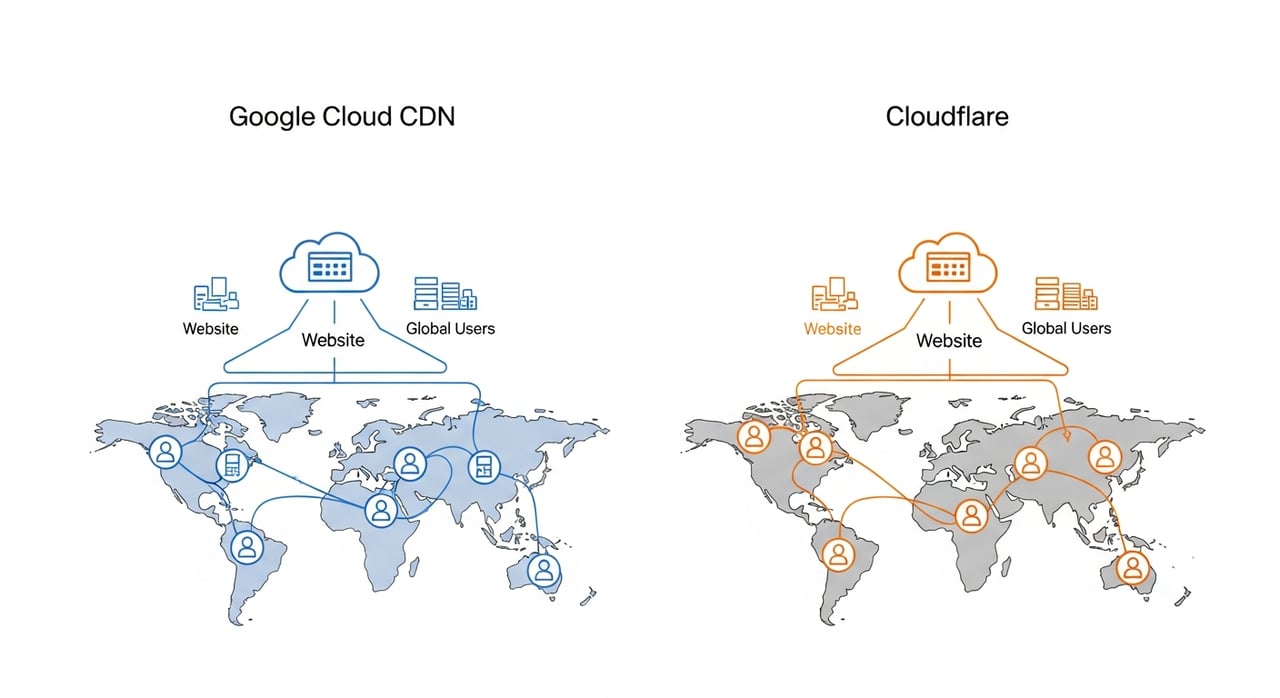
Before unpacking details, it helps to understand how these two CDNs position themselves in the market. Think of Google Cloud CDN as an extension of the Google Cloud ecosystem, and Cloudflare as a global edge platform that started with CDN and grew “outward.”
| Aspect | Google Cloud CDN | Cloudflare |
|---|---|---|
| Core Identity | Native CDN inside Google Cloud Platform | Edge network + security + application services |
| Best Fit | Teams heavily invested in GCP (Compute Engine, GKE, Cloud Storage) | Web properties that need fast global onboarding, security and edge logic |
| Pricing Model | Per‑GB egress + request fees (varies per region) | Mix of free, flat‑rate tiers, and enterprise contracts |
| Control Plane | Configured via Google Cloud Console, APIs, Infrastructure as Code | Cloudflare Dashboard, APIs, Terraform, Workers |
| Edge Logic | Cloud CDN + Cloud Load Balancing + Cloud Functions | Workers, Rulesets, Transform Rules, Page Rules |
At this level, both look capable. The real difference emerges when you explore how they impact modern workloads: streaming, SaaS, gaming, and global e‑commerce. As you read on, ask yourself: Are you choosing a CDN, or an ecosystem strategy?
How Google Cloud CDN Works: Strength in Vertical Integration
Google Cloud CDN is tightly integrated into Google’s global network — the same backbone used for products like YouTube and Google Search. It sits behind Google Cloud HTTP(S) Load Balancing and caches content from backends hosted on GCP (Compute Engine, GKE, Cloud Storage, etc.).
Architecture and Integration
Key characteristics of Google Cloud CDN’s architecture:
- Native to GCP: Configuration happens through Google Cloud Load Balancing; you enable CDN on a backend service rather than treating it as a fully separate product.
- Private backbone: Once traffic enters Google’s edge, it travels on Google’s private network between regions, typically yielding lower latency and fewer hops compared to public internet routing.
- Deep integration with storage and compute: Direct support for Cloud Storage buckets as origins and seamless security integration with IAM, Cloud Armor (WAF), and service accounts.
In practice, this benefits enterprises already centralized in GCP. For instance, a global SaaS platform running Kubernetes on GKE can expose a single global anycast IP via HTTP(S) Load Balancing, flip a switch to enable Cloud CDN on the backend service, and immediately reduce latency for users worldwide — all managed within one cloud console and billing system.
Ask yourself: if your origin stack is already deeply rooted in GCP, does a fully integrated CDN reduce operational friction more than any external feature ever could?
Performance Profile
According to Google’s own performance materials and industry testing (such as CDNPerf and Catchpoint benchmarks), Google Cloud’s edge network typically offers:
- Low median latency in North America and Western Europe, often competitive with or better than other global CDNs for static content.
- Consistent latency thanks to Google’s private backbone and peering relationships.
- Strong throughput for video and large file downloads when both CDN and origin reside in GCP.
However, performance can vary in regions where Google has comparatively fewer interconnections with local ISPs, and your results will strongly depend on how close your users are to GCP regions and how your origins are architected.
If most of your users are in markets where Google is especially strong (e.g., North America, Western Europe, parts of Asia), is the performance alignment with your user footprint enough to offset the lock‑in to GCP?
Pricing and Cost Structure
Google Cloud CDN pricing is primarily based on:
- Data transfer out (per GB) by region
- HTTP/HTTPS request counts
- Cache fill (egress from origin to CDN) inside Google Cloud
For example, as of 2024 (per Google Cloud’s public pricing pages), data transfer from Cloud CDN to users in North America and Europe can fall in a typical range of a few cents per GB, with higher costs in regions like South America or some Asia‑Pacific locations. Large enterprises often negotiate committed‑use discounts, but the pricing model remains usage‑based and can be complex to forecast if traffic patterns spike unexpectedly.
Do you have the cost‑governance maturity to continuously monitor traffic, cache hit ratios, and regional distribution, or would you benefit from simpler, flatter pricing elsewhere?
How Cloudflare Works: An Edge Platform First, CDN Second
Cloudflare’s story is different. It originally launched as a security and performance layer for websites, then expanded into a broad edge platform. Today it offers CDN, DNS, WAF, DDoS mitigation, Workers (serverless at the edge), R2 storage, Zero Trust services, and more.
Architecture and Philosophy
Cloudflare’s design centers around running as much logic as possible at the edge:
- Reverse proxy model: You point your domain’s DNS to Cloudflare, which then terminates client connections and forwards traffic to your origin over HTTPS.
- Unified control plane: All features (CDN, WAF, Workers, routing) live under one dashboard and API, which simplifies deployments for web‑first companies.
- Programmable edge: Workers and durable objects let you run custom logic — A/B testing, authentication, rewrite rules, personalization — close to users instead of in your core data center.
This architecture has been particularly appealing to SaaS, e‑commerce, and media organizations that want to evolve beyond “dumb file caching” and push business logic to the edge.
Ask yourself: Are you merely caching files, or do you want to treat the edge as an extension of your application runtime?
Performance Profile
Multiple third‑party tests, including those referenced by W3Techs and independent monitoring companies, consistently show Cloudflare among the top CDNs for global response times, especially for small object delivery and dynamic acceleration. Cloudflare itself reports serving a large percentage of global HTTP requests on a typical day, which can translate into:
- High cache hit ratios for static assets, thanks in part to extensive cache optimizations and broad deployment.
- Fast DNS resolution — Cloudflare’s 1.1.1.1 service is routinely ranked among the fastest public DNS resolvers.
- Strong performance for TLS handshakes due to TCP/TLS optimizations and session reuse.
But raw performance isn’t uniform; for example, media streaming workloads with massive file sizes may require careful tuning of caching, range requests, and origin routing to avoid congestion or cost spikes.
Do you have the engineering capacity to fine‑tune an edge platform like Cloudflare for your specific workload profile, or do you need a simpler, more predictable model?
Pricing and Tiers
Cloudflare’s pricing model spans from a free plan for basic websites to large custom enterprise contracts. In between, Pro and Business tiers include higher limits, more rules, and better support. Data transfer for CDN is generally included in flat plan pricing in many cases, but advanced features (Workers, R2, Stream, etc.) have separate pricing.
For some businesses, the presence of a free or low‑cost tier is attractive for initial experimentation. For enterprises, the real question becomes how predictable the total cost of ownership is once you factor in:
- Workers compute and execution time
- Storage and egress from R2 or other services
- Specialized products like image optimization or bot management
Is your organization comfortable with a “platform” billing model where new features add new meters, or would you rather keep CDN spending tightly coupled to traffic volume alone?
Key Decision Factors: Google Cloud CDN vs Cloudflare
Now let’s compare these platforms along dimensions that matter most to technical leaders making long‑term infrastructure bets.
1. Ecosystem Lock‑In and Operational Model
- Google Cloud CDN: Best when your workloads are already built on GCP. You benefit from unified IAM, logging (Cloud Logging), metrics (Cloud Monitoring), and security (Cloud Armor). However, if you plan to be multi‑cloud, you’re binding a key network layer to one vendor.
- Cloudflare: Cloud‑agnostic from the start. Your origins can be in GCP, AWS, Azure, on‑prem, or mixed. This can reduce cloud lock‑in but increases your dependency on Cloudflare as the global front door to your apps.
Reflect on your roadmap: Do you expect to stay primarily inside one cloud, or is cloud‑agnosticism a non‑negotiable?
2. Performance for Your Traffic Mix
Performance is not one‑dimensional. You need to consider:
- Static asset delivery: Both CDNs perform well for images, CSS, JS, and downloads in most core markets.
- Dynamic content acceleration: Cloudflare’s Argo Smart Routing and Workers can significantly optimize dynamic and API traffic; Google competes via Cloud HTTP(S) load balancing plus its backbone.
- Streaming and large files: Google Cloud CDN can be strong when your media workflows already live in GCP (e.g., using Cloud Storage and Transcoder), while Cloudflare offers products like Stream plus R2 for storage, but you must measure end‑to‑end performance and total cost.
Have you actually tested both platforms for your specific traffic profile and regions using tools like synthetic monitoring and real user monitoring (RUM)?
3. Security Stack
- Google Cloud CDN: Security is largely delivered via Cloud Armor, identity‑aware proxies, and integration with Google’s identity platform. This is appealing when your security operations already live in GCP. TLS termination and managed certificates are well supported.
- Cloudflare: Security is front and center — WAF, bot management, rate limiting, Zero Trust access, and application firewall features are part of its core narrative. Many businesses adopt Cloudflare first for security, then expand into CDN.
Does your risk posture demand a “security‑first” edge provider, or is consolidating security within your primary cloud (GCP) a better organizational fit?
4. Developer Experience and Edge Logic
- Google Cloud CDN: Edge logic is assembled using Google’s components: Cloud Functions, Cloud Run, and load balancer routing. This is powerful but may feel more fragmented for simple use cases like header rewrites.
- Cloudflare: Workers provides a JavaScript/TypeScript runtime at the edge, letting teams rapidly prototype and deploy logic without managing servers. Rulesets and Transform Rules give non‑developers a GUI‑driven way to shape traffic.
Do your teams want to treat the edge as another application runtime they control, or prefer a more traditional CDN with minimal custom logic?
5. Observability and Troubleshooting
Both platforms offer logs, metrics, and dashboards, but the integration story differs:
- Google Cloud CDN: Native integration with Cloud Logging, Cloud Monitoring, and BigQuery. This is appealing for teams that already collect and analyze all observability data within GCP.
- Cloudflare: Exports logs to external SIEMs and observability stacks (e.g., Splunk, Datadog, Elastic) and has its own analytics dashboards focused on security and performance.
Where does your team already live day‑to‑day — in GCP consoles, or in third‑party observability tools?
Real‑World Patterns: Who Typically Chooses What?
Without resorting to fictional companies, we can still observe patterns from public case studies and industry practice.
Use Cases That Lean Toward Google Cloud CDN
You’re more likely to see Google Cloud CDN in organizations where:
- The main applications and databases are already in GCP (e.g., using BigQuery, Cloud Spanner, GKE).
- Teams prefer a single vendor for networking, security, and compute to simplify contracts and governance.
- Workloads include internal or partner‑facing applications that never leave the Google network.
Media companies hosting their entire video pipeline in GCP, or SaaS vendors built from day one on Google’s stack, often find Cloud CDN to be the “path of least resistance.”
The trade‑off: you gain simplicity and performance within the GCP world, but moving parts of your stack to other clouds later can be harder because your edge delivery is entangled with one provider.
Use Cases That Lean Toward Cloudflare
Cloudflare frequently appears in stacks where:
- Businesses run across multiple clouds and on‑prem data centers but want a single global edge and security layer.
- Security is the entry point (WAF, bot control, Zero Trust) and CDN is a logical extension.
- Teams prioritize fast rollout and experimentation at the edge using Workers without provisioning full backend services.
Global e‑commerce platforms, web‑first media outlets, and many fast‑growing SaaS businesses adopt Cloudflare because it decouples the edge from any one cloud. Yet this also means your reliance on Cloudflare’s control plane and features becomes critical to uptime and deployment pipelines.
The question: Is decoupling your edge from your cloud provider more valuable than consolidating everything into a single vendor ecosystem?
Where BlazingCDN Fits in the Google Cloud CDN vs Cloudflare Debate
While Google Cloud CDN and Cloudflare dominate many comparisons, numerous enterprises discover that they need a third option that balances performance, cost, and control. This is where BlazingCDN often enters the conversation as a modern, high‑performance, and cost‑efficient alternative.
BlazingCDN focuses on delivering stable, fault‑tolerant CDN infrastructure with 100% uptime guarantees and predictable pricing that starts at just $4 per TB ($0.004 per GB). Large enterprises and corporate clients use it as a way to keep performance and reliability on par with heavyweight providers like Amazon CloudFront, while dramatically improving cost efficiency and financial predictability. For teams weary of complex, multi‑dimensional pricing, this simplicity can be a strategic advantage.
Because BlazingCDN is purpose‑built for demanding workloads, it’s particularly attractive for industries like media streaming, software distribution, gaming, and modern SaaS — where high concurrency, burst traffic, and global reach are daily realities rather than edge cases.
If you’re actively comparing CDNs and want to see how cost, performance, and features stack up against Google Cloud CDN, Cloudflare, and others, it’s worth reviewing the detailed comparisons on **BlazingCDN’s CDN comparison page** as part of your evaluation checklist.
Industry‑Specific Considerations: Streaming, SaaS, and Gaming
Choosing between Google Cloud CDN, Cloudflare, and a cost‑efficient alternative like BlazingCDN becomes much clearer when you look at real‑world industries and workloads.
Media Streaming and OTT Platforms
Streaming platforms live and die by startup time, rebuffering, and bitrate stability. According to Conviva’s State of Streaming reports, viewers abandon streams quickly when buffering exceeds a few seconds, and minor improvements in video start times correlate directly with higher engagement.
- Google Cloud CDN: Strong when your entire transcoding and storage pipeline lives in GCP. You can serve HLS/DASH segments directly from Cloud Storage through Cloud CDN and control regional replication.
- Cloudflare: Offers specific video products (Cloudflare Stream) and can cache segments efficiently, but full workflows may involve additional services like R2 for storage and separate billing for video products.
- BlazingCDN: For high‑traffic broadcasters, sports streaming, or VOD platforms, BlazingCDN’s combination of 100% uptime, high performance, and very low per‑GB cost can dramatically reduce operating expenses while maintaining viewer QoE — especially during peak events or seasonal spikes.
Media companies that need both scalability and cost control can leverage BlazingCDN’s flexible configuration options and enterprise‑grade reliability to offload enormous traffic volumes without seeing their CDN bill explode, which is why it’s increasingly recognized as a forward‑thinking option in the media and OTT space.
If you’re planning major live events or expecting viral growth, do you want your CDN bill to scale linearly with every spike, or would a more cost‑optimized, high‑reliability provider de‑risk your streaming economics?
SaaS and Enterprise Applications
SaaS performance is directly tied to customer satisfaction and churn. Research from Google and Deloitte has shown that improving page load times by even 0.1 seconds can boost conversion and engagement metrics for transactional sites. For B2B SaaS, latency also impacts perceived product quality during demos and trials.
- Google Cloud CDN: If your SaaS platform uses GCP for microservices, databases, and analytics, Cloud CDN becomes a straightforward extension. It also simplifies private connectivity between internal services and external traffic.
- Cloudflare: Ideal when you want to wrap a multi‑cloud or hybrid SaaS architecture with a unified edge layer, plus add security services (WAF, Zero Trust, bot management) directly in front of tenants.
- BlazingCDN: A strong fit for SaaS companies that primarily need fast, reliable content and API delivery with tight cost control. BlazingCDN helps reduce infrastructure expenses, support global rollouts, and smoothly scale as customer bases grow, all while keeping the network layer straightforward and predictable.
By using BlazingCDN, SaaS providers can allocate more budget to core product development instead of ever‑rising CDN and egress fees, without sacrificing enterprise‑grade stability. Flexible configurations make it easier to tailor cache and routing behavior for different SaaS modules (e.g., static assets, docs, downloadable clients).
Does your SaaS platform benefit more from a complex edge platform with many add‑ons, or from a high‑reliability CDN that excels at the fundamentals while keeping costs optimized?
Online Gaming and Interactive Applications
For gaming and real‑time applications, latency is reputational. Competitive players notice single‑digit millisecond differences; patch downloads that drag on can sink engagement metrics for new releases.
- Google Cloud CDN: Attractive if your backend game servers and matchmaking systems are in GCP. You can serve large patch files and static assets (textures, maps) via Cloud CDN while keeping core game logic inside GCP regions.
- Cloudflare: Useful for web portals, player dashboards, account management sites, and security in front of game APIs. Edge logic can assist with authentication flows and regional routing.
- BlazingCDN: Particularly compelling for studios and publishers that need predictable, low‑cost distribution for massive game updates or global launches. Its ability to deliver high volumes reliably and cost‑effectively makes it a smart match for the gaming industry’s bursty traffic patterns.
Gaming companies that value both performance and cost efficiency use BlazingCDN to ensure that even during launch surges and seasonal events, patch downloads remain fast while bandwidth costs stay manageable — crucial for protecting margins on F2P and live‑ops titles.
In your next release cycle, do you want your network team focused on negotiating egress rates, or confidently shipping updates knowing your CDN can handle the demand at a predictable price?
Cost Optimization: When a Third Option Becomes Strategic
Both Google Cloud CDN and Cloudflare can deliver excellent performance, but their pricing models often reflect their broader strategies. Google aligns CDN costs with cloud egress and services; Cloudflare bundles many CDN features into platform deals while charging separately for advanced edge capabilities.
BlazingCDN takes a different approach by keeping its value proposition focused and transparent: enterprise‑grade stability, fault tolerance, and performance at a starting price of $4 per TB ($0.004 per GB). For organizations moving hundreds of TB or even petabytes monthly, the delta versus traditional hyperscaler CDNs can quickly translate into six‑ or seven‑figure annual savings, without compromising on uptime or reliability.
This cost advantage is especially meaningful for large media platforms, software vendors, and SaaS providers who see bandwidth as a core cost of goods sold. By adopting BlazingCDN, they turn CDN from a volatile, hard‑to‑forecast line item into a predictable, efficient foundation.
If cost optimization over the next 3–5 years is a leadership priority, have you modeled what a shift from a hyperscaler CDN or full edge platform to a specialized, high‑efficiency CDN would do for your margins?
Practical Evaluation Checklist: Matching CDN to Your Needs
To move from theory to decision, it helps to adopt a structured evaluation approach. Use the checklist below when comparing Google Cloud CDN, Cloudflare, and alternatives like BlazingCDN.
1. Workload and Traffic Profile
- What percentage of traffic is static vs dynamic vs streaming?
- Which regions matter most over the next 12–24 months?
- Are there regular traffic spikes (events, launches, campaigns) that could cause unpredictable bills?
2. Cloud Strategy and Vendor Risk
- Are you committed to a single cloud (e.g., GCP), or expecting multi‑cloud/hybrid?
- How comfortable are you with deep dependency on a single edge provider?
- Do procurement and governance teams favor diversification or consolidation?
3. Security and Compliance
- Is your top concern protecting web apps from complex threats, or simply encrypting and accelerating traffic?
- Where do you currently centralize logging and security incident response?
- Are there industry compliance requirements that favor certain vendors?
4. Developer Experience and Edge Logic Requirements
- Do you need heavy programmability at the edge (e.g., Cloudflare Workers), or basic caching plus headers?
- Which team will own edge logic — platform engineers, app developers, or network teams?
- How much new tooling and training are you prepared to introduce?
5. Cost Structure and Forecastability
- Can you tolerate complex, multi‑dimensional billing, or do you want a simpler per‑GB model?
- What’s your projected traffic growth, and how will pricing scale under each option?
- Have you compared the long‑term TCO of hyperscaler or platform CDNs against specialized options like BlazingCDN?
Bringing It All Together: Your Next Step in the CDN Journey
Choosing between Google Cloud CDN and Cloudflare is less about picking a winner and more about aligning with your strategy. If your future is tightly bound to GCP, Google Cloud CDN offers a deeply integrated, operationally simple path. If you need a powerful, security‑centric edge platform that’s cloud‑agnostic and programmable, Cloudflare gives you that global “front door.”
But when you factor in long‑term cost efficiency, predictability, and the need to scale without surprises — especially for media, SaaS, gaming, and high‑traffic enterprise workloads — introducing a specialized provider like BlazingCDN into your architecture can be transformative. With stability and fault tolerance on par with major providers like Amazon CloudFront, 100% uptime, and a starting price of $4 per TB, BlazingCDN gives large enterprises and corporate clients a way to protect margins while still delivering world‑class performance.
If you’re planning your next CDN move or re‑architecture, this is the moment to test your assumptions, benchmark across vendors, and model real costs under load. To explore how a modern, cost‑optimized CDN could fit into your stack — alongside or instead of Google Cloud CDN and Cloudflare — start a conversation with the team behind BlazingCDN and map it to your actual workloads via **a quick consultation with their CDN specialists**. Then share your findings, challenge your peers, and turn your CDN layer from a black box into a strategic advantage for the next decade of your growth.