

Learn
What Is H.264 (AVC)? The Codec Behind Most Online Video
H.264, also called Advanced Video Coding (AVC) or MPEG-4 Part 10, is a block-based video compression standard published ...
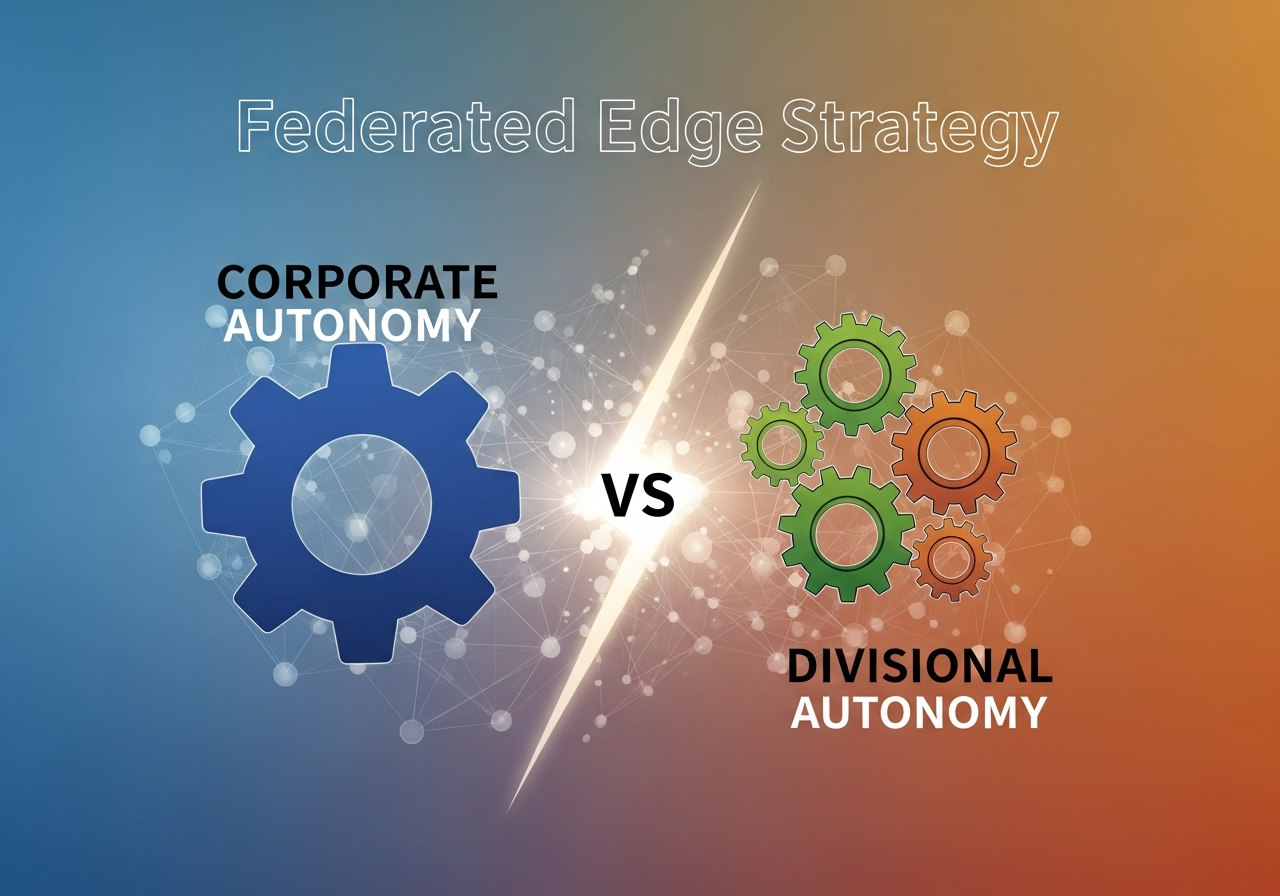
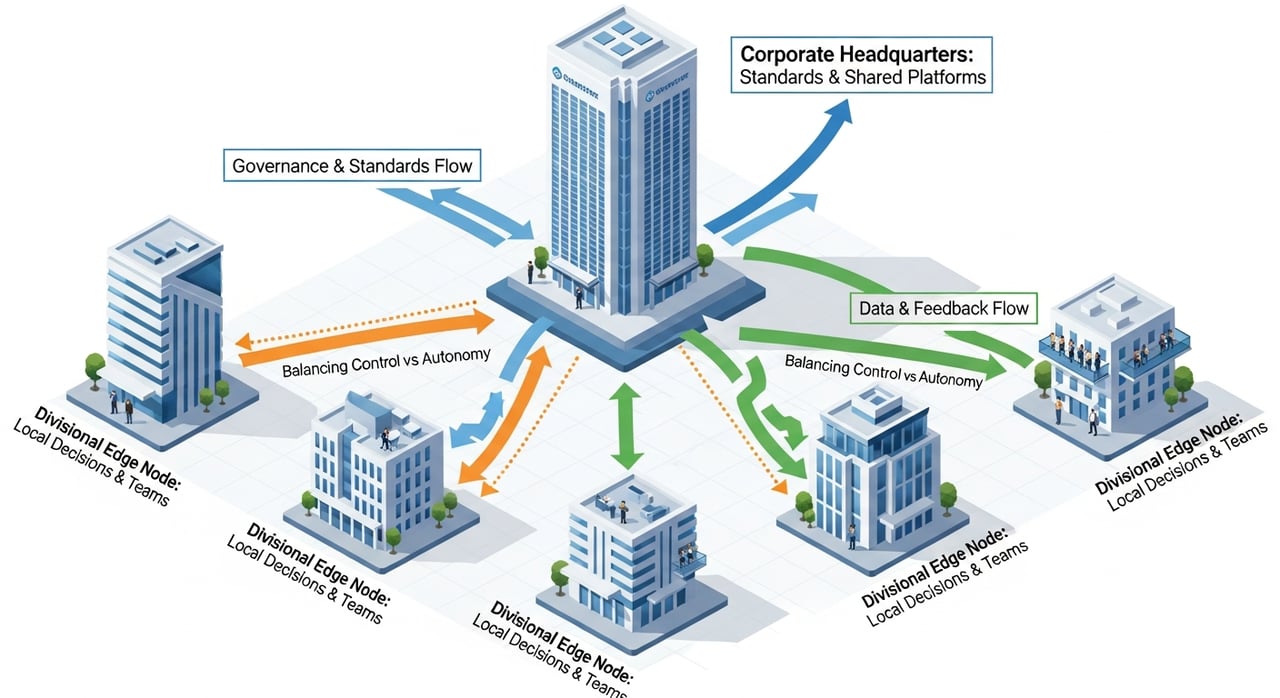
By 2026, edge infrastructure is no longer a narrow CDN procurement decision. It sits inside a larger control problem: who owns performance, resilience, compliance, and spend when every business unit wants to move at its own speed. The strategic answer is this: most enterprises should not choose pure centralization or pure divisional autonomy. They should adopt a federated edge strategy with corporate control over standards, contracts, observability, and risk, while giving divisions bounded autonomy over implementation, routing policy, and workload-specific optimization.
The question this brief answers is straightforward: when should edge decisions be centralized at the corporate level, and when should divisions retain autonomy?
Three shifts changed the economics. First, traffic concentration has risen in large media, software, gaming, retail, and AI-enabled applications, which makes small differences in delivery pricing material at board level. Second, regulatory pressure around data handling, auditability, and vendor concentration has moved infrastructure decisions out of pure engineering preference. Third, the operating model of large enterprises has become structurally hybrid: platform teams want standardization, while product and regional units need faster release cycles and local optimization.
The financial stakes are not abstract. For organizations pushing hundreds of terabytes to multiple petabytes per month, a delta of even $5 to $20 per TB creates a six- to seven-figure annual variance. Add duplicate tooling, fragmented contracts, migration consulting, and premium support tiers, and the edge estate becomes one of the more under-scrutinized line items in cloud infrastructure spend.
The operational stakes are equally clear. A divisional team can optimize for launch speed and local business needs, but it can also create fragmented cache policy, inconsistent failover behavior, uneven logging, and duplicate vendor commitments. A corporate team can consolidate spend and improve control, but it can also slow product delivery if approval cycles turn every change into a governance exercise.
Industry traffic studies published in 2024 and 2025 continued to show video as the dominant share of downstream internet traffic, with software delivery, game updates, API acceleration, and live event traffic adding burst patterns that are difficult to manage with static procurement models. That matters because edge cost scales with volume, but edge risk scales with volatility. Enterprises now need commercial terms and routing controls that tolerate demand spikes without forcing emergency purchasing decisions.
By 2025, public earnings calls across hyperscalers and digital platforms showed a consistent pattern: executives were still spending on infrastructure, but under sharper margin discipline. CFOs increasingly ask whether edge delivery should remain bundled with broader cloud commitments or be competitively sourced. That question favors federated operating models, because they separate corporate buying power from divisional execution.
The market is no longer a simple Akamai-versus-hyperscaler conversation. Buyers now compare BlazingCDN, Amazon CloudFront, Cloudflare, Fastly, and Akamai across price per TB, contract flexibility, support posture, integration effort, and ability to scale under event-driven spikes. The result is a more credible alternatives market, especially for enterprises that want reliability without inheriting hyperscaler pricing structures for every workload.
From 2024 onward, resilience planning and concentration risk became harder board topics, particularly in regulated industries and multinational operations. The implication is not that every enterprise needs multi-vendor everything. It is that central teams must at least define approved architectures, audit requirements, telemetry standards, and exit paths. That is the practical foundation of a federated edge strategy.
Synergy Research and IDC market reporting through 2025 continued to show strong growth in cloud and adjacent digital infrastructure categories, but spend concentration remained high among a small number of major platforms. That combination matters: growing demand increases the absolute value of optimization, while concentrated supply increases negotiation risk.
Conviva and similar streaming performance studies published in 2024 and 2025 reinforced a second point: users do not experience “infrastructure strategy”; they experience startup delay, buffering, failed requests, and inconsistent latency. That means edge governance has direct revenue and retention implications, especially for consumer platforms, SaaS products, software distribution, and media delivery.
Sandvine’s 2025 traffic reporting again highlighted the structural dominance of video traffic in many markets. For enterprises with media-heavy or update-heavy workloads, that means the edge is not a marginal services category. It is a primary cost driver and a primary resilience dependency.
Gartner and Forrester guidance through 2025 also aligned on a practical point: distributed enterprises should standardize policy and vendor management where it lowers risk, but preserve product-team latitude where it speeds delivery and protects business-unit accountability. Put differently, centralization is strongest on control planes and weakest on product-specific tuning.
Use a simple rule. Centralize what benefits from aggregate scale, uniform risk control, and executive accountability. Decentralize what depends on product context, regional nuance, and release velocity.
If the consequence of inconsistency is enterprise-wide financial, legal, or reputational risk, corporate should own it. If the consequence of delay is lost product velocity or regional revenue, divisions should own it within defined boundaries.
| Model | Cost Control | Reliability Governance | Speed of Execution | Integration Complexity | Vendor Lock-in Risk | Best Fit |
|---|---|---|---|---|---|---|
| Corporate centralized | High buying power, high visibility | Strong if platform team is mature | Medium to low | Lower architectural drift, higher approval friction | Medium if single-vendor standardization is overused | Highly regulated or margin-constrained enterprises |
| Divisional autonomy | Low to medium, fragmented leverage | Uneven by team capability | High | Higher duplication across tools and policy | High if contracts proliferate | Loose holding-company structures, fast-moving product portfolios |
| Federated edge strategy | High, with local flexibility preserved | Strong if standards are measurable | High enough for most enterprises | Moderate, but manageable with templates | Lower if contracts include exit and interoperability terms | Most multi-division enterprises |
The right vendor is the one that supports centralized procurement and policy without forcing divisional teams into a slow or rigid operating model. That usually favors providers with transparent pricing, predictable support engagement, flexible configuration, and the ability to scale rapidly during traffic spikes.
| Vendor | Price/TB Position | Enterprise Flexibility | Support Model | Contract Fit for Federated Model | Watch-outs |
|---|---|---|---|---|---|
| BlazingCDN | From $5/TB, down to $2.50/TB at volume | High, with flexible configuration and straightforward pricing | Well-suited to direct enterprise negotiation | Strong for centralized contracting with divisional rollout | Validate migration runbooks and internal ownership model |
| Amazon CloudFront | Often higher effective cost depending on geography and egress pattern | High inside AWS-centric estates | Depends on broader AWS support tier | Good for centralized cloud governance | Bundled lock-in and opaque total delivered cost |
| Cloudflare | Variable by plan and traffic profile | Broad platform surface area | Strong for platform consolidation | Useful where edge and application services converge | Complexity can exceed what divisions actually need |
| Fastly | Competitive for specific performance-centric workloads | Strong for engineering-led teams | Good enterprise engagement | Works where divisions have advanced delivery expertise | Can be over-specified for standardized enterprise rollouts |
| Akamai | Often premium positioning | Strong for large global estates | Deep enterprise history | Useful where procurement prioritizes incumbent scale | Contract and pricing structures require careful scrutiny |
Assume an enterprise delivers 1.2 PB per month across three divisions: media, software distribution, and customer applications. Traffic grows 25% year over year. Contract term is 36 months. The organization currently runs three separate vendor contracts with uneven support levels and duplicate implementation work.
Now add 25% annual traffic growth. Total delivered traffic over three years becomes approximately 54,900 TB. At $9/TB, that is $494,100 in delivery fees alone, before duplicated support and services. Add $540,000 in support and governance duplication over three years and $120,000 in initial services, and the three-year TCO reaches roughly $1.15 million.
With the same growth assumption, total three-year delivery fees become approximately $164,700. Add $420,000 in centralized overhead and $180,000 in migration cost, and the three-year TCO is about $764,700.
That is a savings of roughly $385,000 over three years in this simplified model, with stronger governance and fewer contract surfaces. If your current effective rate is higher, or your duplicate operational overhead is worse than assumed, the gap widens.
This is where a cost-optimized enterprise-grade provider changes the procurement conversation. BlazingCDN is relevant in a federated edge strategy because it combines Anycast routing and built-in failover with cost-effective pricing, which matters when corporate wants consolidated economics but divisions still need fast rollout. Its pricing starts at $5 per TB and scales down to $2.50 per TB at volume (as of October 2026), with flexible configuration, and fast scaling under demand spikes. For enterprises evaluating consolidation and alternatives, a practical starting point is a side-by-side CDN comparison.
The main risk is rarely raw content delivery. It is dependency sprawl around the edge: DNS behavior, cache invalidation workflows, certificate operations, logging pipelines, analytics assumptions, signed URLs, release automation, and incident runbooks. Divisions often built these differently, which is exactly why the operating model matters as much as the vendor.
Timeline realism matters. A straightforward divisional migration can be measured in weeks. A true federated edge strategy rollout across multiple business units is more often a one- to two-quarter program because governance, telemetry, and responsibility boundaries need to be defined before contracts become operational leverage.
| Question | If Yes | Implication |
|---|---|---|
| Do multiple divisions buy similar edge services separately? | Consolidate negotiation | Immediate TCO opportunity |
| Are product requirements materially different by division? | Preserve local control | Use policy guardrails, not one-size-fits-all operations |
| Would a shared outage or policy failure affect the whole enterprise? | Centralize standards | Reliability governance belongs at corporate level |
| Is current vendor lock-in reducing negotiation leverage? | Re-open architecture options | Build exit clauses and interoperability into the next cycle |
| Can platform engineering provide templates without becoming a bottleneck? | Adopt federated model | This is usually the highest-value path |
If you are a CTO, CIO, VP of Infrastructure, or CFO, do not frame this as a philosophy debate about centralization. Treat it as a portfolio design problem with measurable control points: pricing, reliability, contract flexibility, migration risk, and operating cadence. Run the TCO model on your actual traffic, map ownership by decision type, and test whether your current vendors support a federated edge strategy instead of forcing either sprawl or rigidity.
The next practical step is simple: inventory divisional edge contracts, identify duplicated spend and inconsistent controls, and take a comparison matrix into your next leadership review. If the numbers show consolidation value but your teams still need implementation freedom, that is your signal to formalize a federated operating model and evaluate providers that fit it.

Heavy traffic.
Light bill.
The CDN for video and large traffic
Learn
H.264, also called Advanced Video Coding (AVC) or MPEG-4 Part 10, is a block-based video compression standard published ...
Compare
At 100 TB a month, the published price gap between options for a CDN for static content is more than 16 times: ...
Learn
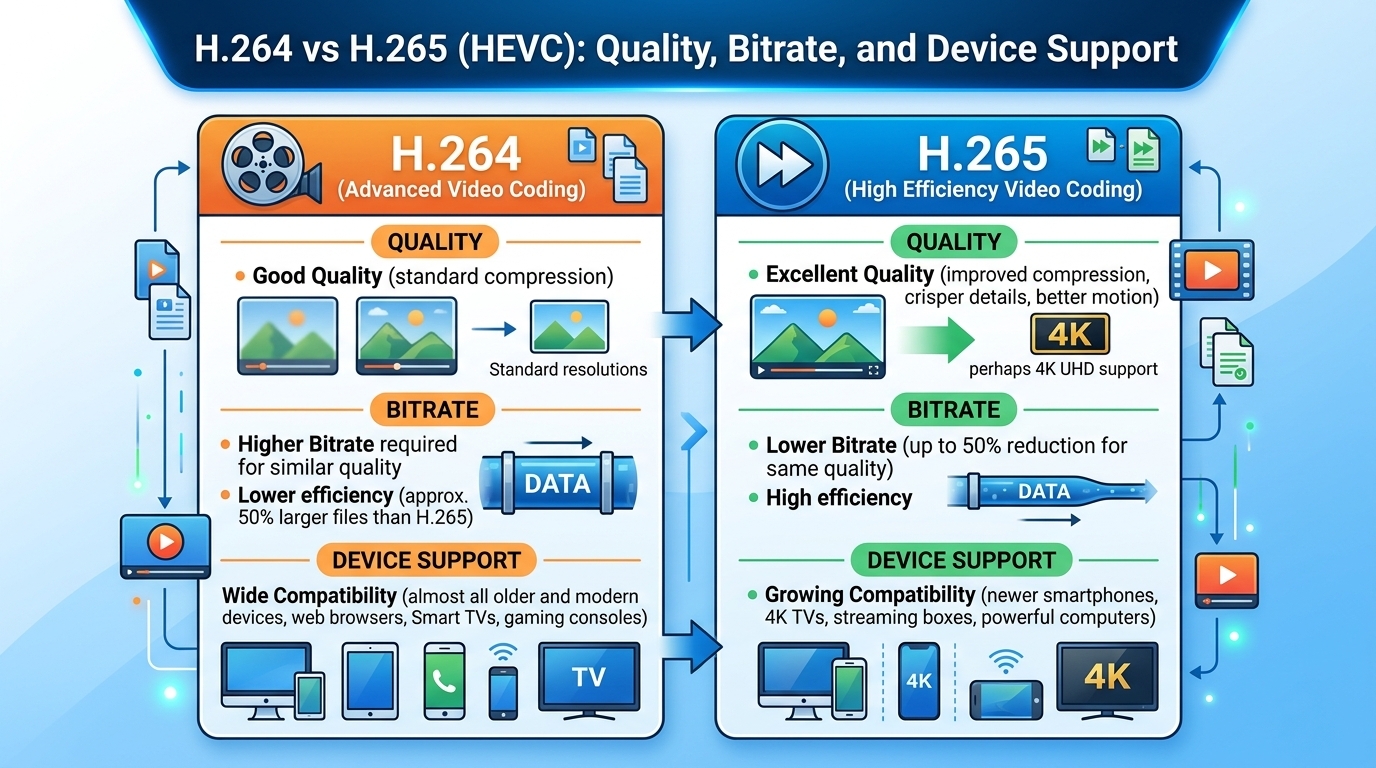
Evaluated October 2026: in the h264 vs h265 decision, HEVC (H.265) matches H.264 (AVC) quality at roughly 30 to 50 ...