Imagine navigating a complex city with intricate alleys and concealed pathways. A knowledgeable...
Fastly vs Cloudflare: Which CDN Is Faster for Global Delivery?
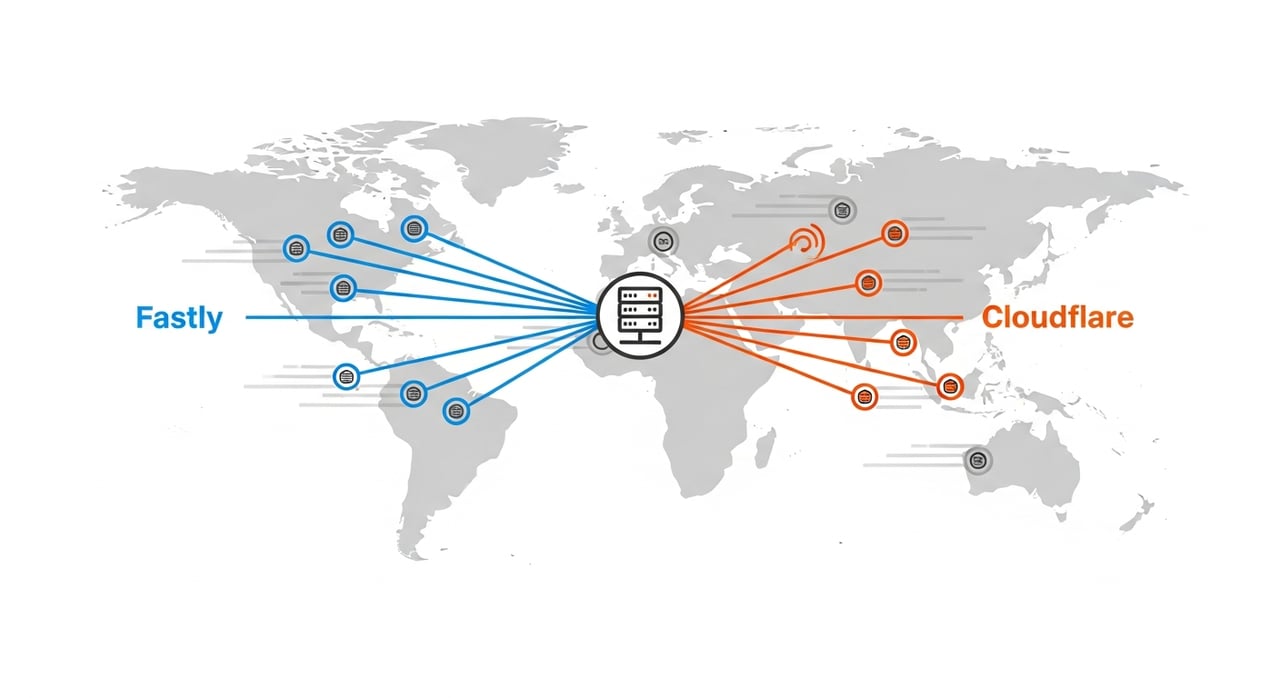
In 2023, Cloudflare claimed it was “the fastest public DNS resolver in 45% of countries,” while Fastly regularly tops independent CDN performance charts for US and European traffic. Yet many global enterprises still struggle with one simple question: when your users are everywhere, which is actually faster — Fastly or Cloudflare?
Speed isn’t just a vanity metric. A 0.1s improvement in mobile site speed can increase conversion rates by up to 8.4% for retail and 10.1% for travel, according to Google’s benchmark report. When you’re serving millions of users or video streams, the wrong CDN choice doesn’t just slow pages; it quietly erodes revenue, engagement, and brand trust.
This article breaks down Fastly vs Cloudflare for global content delivery performance — using independent data, real-world usage patterns, and practical recommendations for enterprises operating at scale. Along the way, you’ll also see how modern providers like BlazingCDN fit into this landscape for organizations that want CloudFront-level stability with far more cost control.
Fastly vs Cloudflare: Why “Which Is Faster?” Is the Wrong First Question
At first glance, Fastly and Cloudflare look similar: edge caching, global infrastructure, programmable logic at the edge, and integrated security. But the core of their performance story is shaped by their DNA.
- Cloudflare began as a security and protection layer that evolved into a full CDN and edge platform.
- Fastly was built from day one as a performance-focused CDN for dynamic, API-driven, and real-time workloads.
That heritage shows up in how they design caching, routing, and edge compute. It’s why you’ll see Fastly heavily used by streaming platforms, developer-heavy teams, and media organizations, while Cloudflare dominates as an all-in-one protection, performance, and DNS layer for websites of all sizes.
Before comparing raw speed, it’s worth asking: are you optimizing for global page load time, API latency, video start time, or security plus speed? The answer changes which platform “wins.”
As we explore metrics and regions, keep this in mind: are you sure you’re chasing the right type of speed for your business model — or just the loudest benchmark numbers?
How to Measure CDN Speed Objectively
Fastly vs Cloudflare performance debates often rely on marketing claims. To cut through the noise, you need to understand how CDN speed is measured and what actually impacts your users.
Core Metrics That Matter for Global Delivery
- Latency (Time to First Byte / TTFB) – The time between a user request and the first byte arriving. Critical for API responses and initial page rendering.
- Throughput – How much data can be transferred per second. Important for streaming, large file downloads, gaming updates, and software distribution.
- Cache Hit Ratio – The percentage of requests served from CDN cache instead of the origin. Higher ratios mean less origin load and usually lower latency.
- Consistency Across Regions – A CDN that’s blazing-fast in North America but inconsistent in India, Brazil, or Southeast Asia may hurt a truly global product.
- Tail Latency (P95 / P99) – The worst 5–1% of requests. This is where user frustration, buffering, and cart abandonment usually live.
According to Google’s performance research, reducing server response time (TTFB) dramatically improves Core Web Vitals, especially LCP (Largest Contentful Paint). That means a CDN’s edge and routing architecture directly influence SEO, UX, and revenue.
When you evaluate Fastly vs Cloudflare, do you look beyond average speed to how they behave under load, in traffic spikes, or across less-served regions where many growth markets are?
Fastly Performance: Strengths, Trade-offs, and Real-World Fit
Fastly is famous for being the “developer’s CDN,” heavily adopted by engineering-driven organizations that need fine-grained control over caching and logic. Large media, streaming, and SaaS companies rely on Fastly for low-latency global delivery, particularly in North America and Western Europe.
Where Fastly Tends to Excel
- Low-latency dynamic content: Fastly’s architecture, built on powerful edge nodes and HTTP/2/3 support, is optimized for modern web apps and APIs.
- Programmability: With VCL (Varnish Configuration Language) and Compute@Edge (WebAssembly-based), Fastly gives engineering teams fine-grained control over routing, caching rules, and edge logic.
- Media and streaming optimization: Many streaming platforms rely on Fastly to reduce startup time and improve cache efficiency for HLS/DASH segments.
Independent benchmarks like Catchpoint, Cedexis (before acquisition), and various public tests have historically shown Fastly leading in average response times in the US and parts of Europe for static and semi-dynamic content. While numbers vary by test, it’s common to see Fastly among the top performers for media-heavy and developer-first workloads.
Where Fastly May Lag
- Emerging market coverage: For some regions in Africa, parts of Asia, or Latin America, enterprises sometimes report better real-user metrics with other providers, depending on local peering and last-mile conditions.
- Ease of use: The deep configurability that engineers love can be intimidating or overkill for organizations that want a simpler, more turnkey CDN layer.
- All-in-one platform: While Fastly has strong security products, Cloudflare’s breadth (DNS, WAF, Zero Trust, email security, etc.) is more extensive.
Fastly is extremely fast when tuned well — but it often assumes you have the engineering maturity to take advantage of that power. Are your teams ready to treat the CDN as an extension of your application logic, rather than a simple cache?
Cloudflare Performance: Global Reach, DNS Speed, and Real-User Impact
Cloudflare’s story is different. It started as a protection and optimization layer but has become one of the most widely used CDNs and edge platforms in the world. For many businesses, Cloudflare is the default choice because of its integration of DNS, CDN, WAF, and security.
Where Cloudflare Tends to Excel
- Global DNS and edge presence: Cloudflare operates one of the fastest public DNS resolvers (1.1.1.1) and heavily markets its broad coverage and peering relationships. Independent DNS benchmarks regularly place it among the top resolvers globally.
- Website acceleration: For traditional and modern websites, Cloudflare’s caching, image optimization, and automatic compression often yield substantial performance wins with minimal configuration.
- Integrated security and performance: WAF, bot management, and security controls coexist with CDN features, reducing complexity for teams that don’t want to manage multiple vendors.
According to Cloudflare’s own speed test data and several third-party measurements, Cloudflare performs competitively or leads in many geographies for small to medium static asset delivery, especially when combined with their DNS and TLS termination optimizations.
Where Cloudflare May Lag
- Ultra-fine-grain edge control: Although Cloudflare Workers is powerful, some teams still find Fastly’s VCL/Compute@Edge more suitable for very specific, latency-critical routing and micro-optimizations.
- Complex enterprise cost structure: As traffic scales, add-ons and enterprise features can make cost forecasting less straightforward for some large organizations.
- Streaming and large-object tuning: Cloudflare supports video and large-file delivery, but some enterprises in media, VOD, and gaming historically benchmark Fastly or specialized CDNs as more predictable under very high throughput bursts.
Cloudflare is often “fast enough” and remarkably simple for many workloads — but if you’re operating a global streaming or game distribution platform, do you know how it behaves at the very edge of your peak demand curve?
Side-by-Side: Fastly vs Cloudflare for Global Delivery
To make this comparison tangible, the table below summarizes core performance-related aspects relevant to enterprises serving global users. Values are descriptive rather than numeric since concrete metrics change by region and test period.
| Aspect | Fastly | Cloudflare |
|---|---|---|
| Typical Strength | Low-latency, high-concurrency workloads; media & APIs | Web acceleration with integrated security & DNS |
| Edge Programmability | VCL & Compute@Edge (Wasm) for deep control | Cloudflare Workers & Rulesets, strong but different model |
| Performance in NA/EU | Often among top performers in independent CDN tests | Very competitive; sometimes slightly behind for specific workloads, but strong overall |
| Performance in Emerging Regions | Strong but may depend on peering; sometimes outperformed by broad-footprint players | Generally consistent, benefits from wide presence & peering policy |
| Best Fit Use Cases | Streaming, media, developer-heavy SaaS, API-first products | Commerce, content sites, security-sensitive businesses wanting one consolidated platform |
Both Fastly and Cloudflare can be extremely fast—but their sweet spots diverge. The question is less “who is faster?” and more “in which regions, for which workloads, and under what operational constraints?”
Given your current and target user geography, have you mapped your latency and throughput requirements to how each provider performs in your most critical markets?
Global Delivery by Region: Where Fastly and Cloudflare Shine
Real performance is local. A CDN that shines in synthetic tests from US data centers may deliver a different picture for users on congested mobile networks in India or South America. Let’s walk through regional realities using patterns seen in public benchmarks, RUM (real user monitoring) studies, and industry reports.
North America & Western Europe
- Fastly often leads or ties for lowest latency and fastest TTFB for static and semi-dynamic content.
- Cloudflare is competitively fast, especially when services like Argo Smart Routing are enabled, and is often indistinguishable to end users in practice.
For SaaS dashboards, e-commerce, and streaming services targeting primarily US/EU audiences, both options can deliver sub-50ms TTFB and excellent Core Web Vitals with proper tuning.
Asia-Pacific
- Cloudflare often benefits from its extensive presence and peering, particularly in large economies such as India, Japan, and Australia.
- Fastly can deliver strong performance, but outcomes vary by last-mile conditions and ISP relationships.
For APAC-heavy user bases, organizations often run their own RUM-based bake-offs before committing fully to one provider. It’s common to see slight edge differences in countries like India or Indonesia, where peering, local carrier relationships, and routes are decisive.
Latin America, Middle East, and Africa
- Performance can vary widely by country and ISP, for both Fastly and Cloudflare.
- Cloudflare’s aggressive peering strategy frequently gives it an advantage in certain markets, while specialized providers or hybrid multi-CDN setups may outperform both in others.
In these regions, many large enterprises and media platforms rely on multi-CDN strategies, combining providers like Fastly, Cloudflare, and newer players such as BlazingCDN, routing traffic dynamically based on real-time performance and cost signals.
Have you benchmarked real user metrics per region, rather than relying solely on global averages or vendor marketing slides?
Workload-Specific Performance: Static, Dynamic, Streaming, and APIs
CDN speed isn’t monolithic. A provider that is fast for static assets may not be equally optimized for high-concurrency APIs or large media files. Breaking it down by workload type helps clarify Fastly vs Cloudflare trade-offs.
Static Assets (HTML, CSS, JS, Images)
- Cloudflare: Very strong, especially with automatic optimizations (Brotli, HTTP/3, image resizing) and integration with their DNS and TLS termination.
- Fastly: Also excellent, with fine-grained cache control and advanced configuration; often shines when combined with sophisticated cache policies.
For most content-heavy websites, both platforms can easily deliver sub-second load times globally when configured correctly. Differences often matter more at very high scale or in edge-case regions.
Dynamic and API-Driven Workloads
- Fastly was designed for dynamic websites and APIs, with features like soft purges, real-time log streaming, and robust edge logic that lets you cache parts of a response while passing through others.
- Cloudflare offers strong edge compute with Workers and can cache APIs with appropriate rules, but its early reputation was more security and static-site-oriented.
For high-frequency API calls, microservices frontends, or GraphQL gateways, low tail latency (P95/P99) and flexible routing can make Fastly particularly attractive for engineering-led organizations.
Video Streaming and Large Files
- Fastly is widely used by major streaming and media properties for segment caching, midstream switching, and real-time purging.
- Cloudflare supports video streaming (including Cloudflare Stream) and large-object delivery but is often chosen when security, DDoS protection, and general site acceleration are top priorities.
Throughput, connection reuse, and how the CDN handles partial content requests (HTTP 206) become crucial here. Under sustained peak load, even small differences in edge node architecture and cache strategies can translate to shorter startup delays and fewer buffering events.
Have you segmented your traffic by type (static vs API vs streaming) and tested each segment separately on Fastly and Cloudflare to see which provider aligns best with your dominant workload?
Real-World Data: What Independent Benchmarks and Studies Show
Independent performance data is critical when comparing Fastly vs Cloudflare. Multiple third-party organizations publish speed, latency, and reliability metrics.
- Cloudflare Radar & public reports highlight Cloudflare’s strong DNS performance and low latency in many countries, particularly when using its 1.1.1.1 resolver and Argo routing.
- Various CDN benchmarks (from firms like Cedexis before its acquisition, Catchpoint, and large-scale RUM deployments by enterprises) frequently show Fastly as one of the fastest CDNs for static and semi-dynamic content in North America and parts of Europe.
- Google’s Web Vitals research underscores that improved server response time and TTFB, which CDNs heavily influence, correlate closely with better user engagement and conversion rates.[1]
While the exact ranking shifts from test to test, a few consistent patterns emerge:
- No single CDN is fastest in every country, ISP, and workload.
- Fastly frequently leads in developer-centric, media-heavy vectors in mature markets.
- Cloudflare performs extremely well for broad web workloads, especially when paired with its DNS and routing optimizations.
Instead of looking for a universal “winner,” the most sophisticated enterprises increasingly view CDN performance as a portfolio problem: choose providers that complement each other by region and workload, then use multi-CDN routing or smart DNS to send traffic where it will perform best.
Are you still thinking in terms of a single “best CDN,” or are you moving toward a performance mix tailored to your audience and content types?
Cost vs Speed: When Faster Stops Being Worth It
Speed doesn’t exist in a vacuum. For large enterprises, the real question is: what is the business value of shaving another 20–50ms off TTFB, and at what cost?
Fastly vs Cloudflare: Pricing Dynamics
Both Fastly and Cloudflare offer enterprise plans that bundle bandwidth, features, and support. Public list pricing doesn’t always reflect what large customers pay, but generally:
- Fastly charges per GB transferred and requests, with additional costs for add-on features like Compute@Edge or security products. It’s often optimized for heavy, sustained traffic at scale.
- Cloudflare offers a wide range of plans, from free and self-service up to large enterprise contracts. Costs can be influenced by features like WAF, bot management, Workers, and Argo.
For enterprises pushing hundreds of terabytes or petabytes monthly, even a small per-GB difference — or small inefficiencies in cache hit ratio — can translate into six- or seven-figure annual deltas.
The Business Trade-Off
According to Google’s performance research, faster sites see higher conversion rates and lower bounce rates.[1] But after a certain point, extra speed offers diminishing returns if it dramatically increases infrastructure spend or operational complexity.
This is where modern players like BlazingCDN enter the picture. Built to deliver stability and fault tolerance on par with Amazon CloudFront while starting at just $4 per TB ($0.004 per GB), BlazingCDN gives enterprises a way to maintain high global performance without accepting runaway bandwidth costs. With 100% uptime, flexible configurations, and a feature set tuned for media, SaaS, and high-traffic digital products, it has quickly become a preferred option for companies that care equally about reliability and efficiency.
Have you quantified the actual revenue and UX impact of performance gains, and compared that directly to your all-in CDN cost — including missed cache potential and over-provisioned capacity?
Where BlazingCDN Fits in a Fastly vs Cloudflare World
Fastly and Cloudflare dominate the conversation, but many enterprises are now questioning whether a single “big brand” CDN is the only viable route — especially as traffic grows and budgets tighten.
BlazingCDN is designed for organizations that demand the resilience and predictability of hyperscale providers like Amazon CloudFront but want far more aggressive economics and hands-on flexibility. With 100% uptime guarantees and pricing starting at $4 per TB, it’s particularly attractive for high-volume media distribution, enterprise SaaS, gaming, and software delivery, where every cent per GB matters.
Media organizations, OTT platforms, and broadcasters can offload massive video libraries and live streams to BlazingCDN to cut delivery costs while maintaining the low-latency experience that viewers expect. Similarly, software vendors and SaaS platforms use BlazingCDN to accelerate downloads, updates, and dashboards globally, reducing strain on their origin infrastructure and simplifying scale-out during product launches or peak seasons. For modern, cost-aware enterprises weighing Fastly vs Cloudflare, adding BlazingCDN to the stack offers a practical way to enhance redundancy, optimize regional performance, and keep budgets predictable.
If you’re currently evaluating high-traffic or media-centric workloads, you can explore how BlazingCDN compares to legacy and hyperscale CDNs on its detailed CDN comparison page and map those capabilities to your performance requirements.
In your own environment, could a cost-optimized, enterprise-grade CDN like BlazingCDN sit alongside Fastly or Cloudflare to bring your overall cost-per-millisecond down?
Industry-Specific Insights: Which CDN Wins for Your Vertical?
Different industries stress-test CDNs in different ways. Instead of chasing one universal “winner,” it’s more useful to see how Fastly, Cloudflare, and modern alternatives like BlazingCDN behave under typical sector patterns.
Media, Streaming, and OTT Platforms
- Fastly: Popular choice for large streaming platforms because of segment caching, rapid purging, and strong performance under heavy concurrency.
- Cloudflare: Attractive when content sites, portals, and authentication flows need a strong mix of security and performance; Cloudflare Stream is an integrated video pipeline.
- BlazingCDN: Highly compelling for media organizations facing rising traffic and licensing costs, who need predictable pricing and CloudFront-level stability without overpaying for bandwidth.
For broadcasters, sports streaming, and VOD services, the combination of low latency, global stability, and aggressive per-TB pricing can make BlazingCDN a practical backbone for delivering events and on-demand catalogs at scale while keeping OPEX under control.
Enterprise SaaS and B2B Platforms
- Fastly: Strong fit for API-centric SaaS products that require complex caching strategies and custom edge logic.
- Cloudflare: A strong choice for B2B apps that want integrated security (WAF/Bot/Zero Trust) with performance optimization.
- BlazingCDN: Ideal for SaaS vendors that need to accelerate dashboards, asset delivery, and product updates globally, while keeping infrastructure spend predictable and controllable.
By combining a reliable backbone with flexible configuration and aggressive pricing, BlazingCDN helps SaaS products maintain fast, stable experiences for customers around the world—even as user counts and data volumes grow dramatically.
Gaming and Software Distribution
- Fastly: Excellent for low-latency game APIs and real-time services when finely tuned.
- Cloudflare: A strong contender for login flows, web frontends, and protection of gaming portals and APIs.
- BlazingCDN: Particularly valuable for patch distribution, game downloads, and large software update packages, where terabytes to petabytes of traffic can make or break budget planning.
In these scenarios, having CloudFront-grade reliability at a fraction of the cost, plus 100% uptime and easy scaling during launches or seasonal peaks, makes BlazingCDN an attractive complement or alternative to the traditional players.
Are you matching your CDN mix not just by brand recognition, but by how each provider actually aligns with your industry’s performance profile and cost pressures?
How to Decide: A Practical Framework for Choosing (or Combining) Fastly and Cloudflare
Instead of asking “Fastly or Cloudflare?”, many high-performing organizations now ask “how do we create the best possible performance and cost profile for our users?” Use this framework to structure your decision.
1. Map Your Traffic and Users
- Where are your users today? Where will they be in 12–24 months?
- What percentage of your traffic is static, dynamic, streaming, or API-based?
- What’s your baseline: current TTFB, throughput, error rates, and Core Web Vitals?
Without this foundation, you’re optimizing blindly. A media-heavy product with 70% traffic in APAC needs very different CDN characteristics than a North America–centric SaaS dashboard.
2. Run Real-World Benchmarks
- Set up identical test properties on Fastly and Cloudflare.
- Use a combination of synthetic monitoring and RUM to capture latency, throughput, and error rates per region and ISP.
- Test realistic scenarios: cache-warm, cache-cold, peak hours, origin failover events.
Include a third provider like BlazingCDN in your tests to benchmark how a cost-optimized, enterprise-grade CDN behaves against the traditional giants—especially in your most important geographies and during load spikes.
3. Evaluate Total Cost of Ownership
- Analyze bandwidth, requests, and optional feature costs at your actual or forecasted traffic volumes.
- Estimate the operational overhead: who will manage rules, routing, and monitoring?
- Factor in the cost of outages, slowdowns, or vendor lock-in.
CDN cost is not only about per-GB pricing; cache efficiency, multi-CDN routing, and origin offload all significantly change your final bill.
4. Consider a Multi-CDN Strategy
- Use Fastly for media-heavy or API-intensive workloads where its strengths shine.
- Leverage Cloudflare for security-heavy web frontends and DNS consolidation.
- Introduce BlazingCDN as a cost-efficient, high-availability backbone for bandwidth-intensive delivery, offloading large parts of your traffic at a predictable, low cost.
Enterprises increasingly route traffic dynamically among multiple CDNs based on real-time performance and regional cost, using DNS-based steering or traffic management services. This approach reduces risk, improves global performance, and provides negotiating leverage with all vendors.
Are you still locked into a single-provider mindset, or ready to architect a CDN layer that mirrors the resilience and flexibility of your broader infrastructure?
Putting It All Together: Speed, Stability, and Cost Under One Roof
Fastly is lightning-fast for many developer-centric, media-heavy, and API-driven workloads, particularly in North America and Europe. Cloudflare delivers highly competitive performance with exceptional DNS speed, broad global consistency, and deep security integration. Neither is universally “the fastest” for every region and workload — and that’s exactly why the most mature digital businesses are rethinking their CDN strategy.
The emerging best practice is clear: blend high-end performance with cost-optimized, enterprise-grade platforms to achieve the right balance for your audience. This is where BlazingCDN stands out. Offering 100% uptime, CloudFront-level fault tolerance, and aggressive pricing starting at just $4 per TB, it gives enterprises a modern way to handle surging traffic without sacrificing reliability or blowing up budgets. With flexible configurations and architectures tailored for media, SaaS, software distribution, and gaming, BlazingCDN is already recognized as a forward-thinking choice for organizations that measure success in both milliseconds and dollars. To explore how this approach could work for your stack, you can dive into the platform capabilities on the BlazingCDN features overview and map them to your existing Fastly or Cloudflare setup.
If you’re serious about web, app, or streaming performance, don’t let this be a theoretical comparison. Run your own benchmarks, test real user conditions across regions, and share your findings. What surprised you about Fastly vs Cloudflare in your environment? Which mix of CDNs gave you the best balance of speed, stability, and cost? Drop your insights in community discussions, talk with your engineering and product teams, and take the next concrete step: benchmark a modern, cost-effective provider like BlazingCDN alongside your current stack and see how much performance — and budget — you’ve been leaving on the table.
[1] Source: Google/SOASTA Research on mobile page speed and conversions, and Google Web Vitals documentation.