
Learn
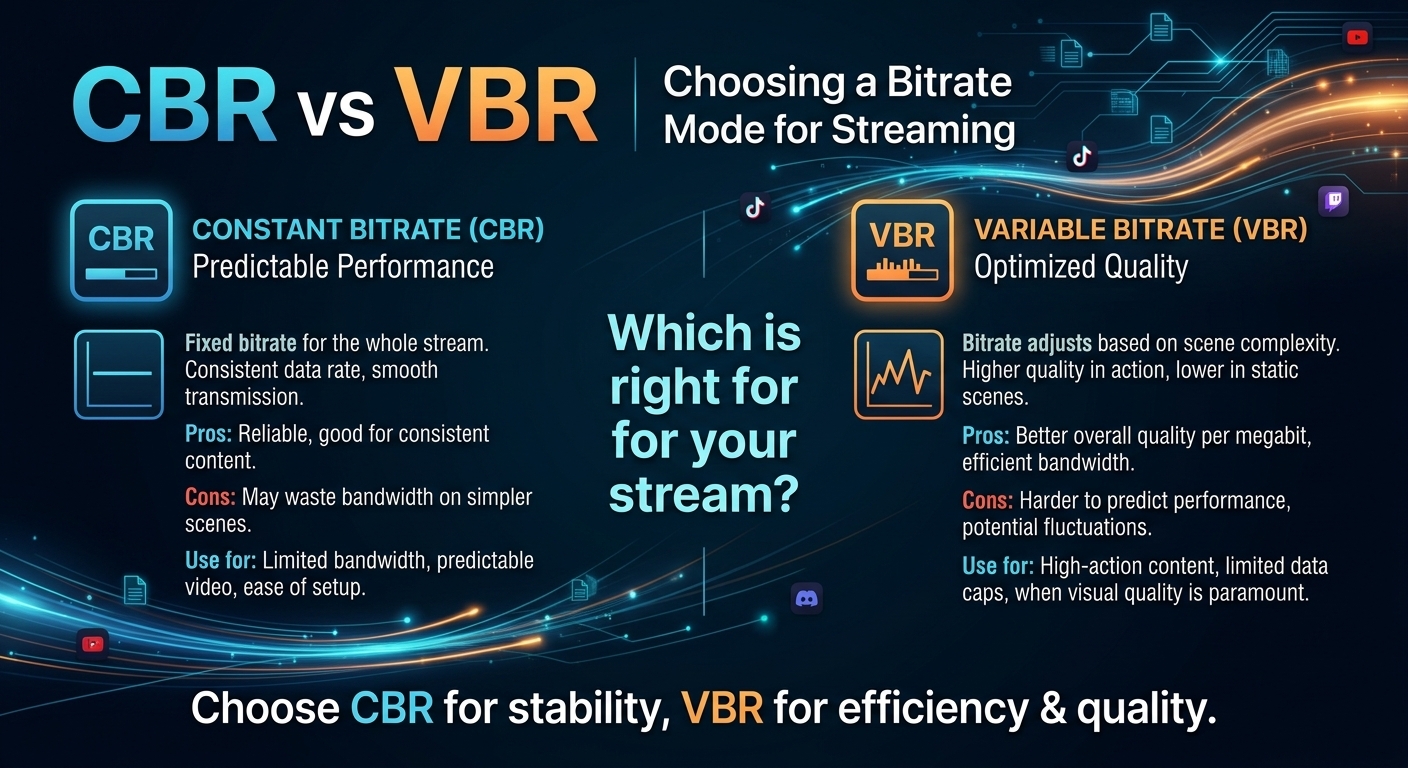
CBR vs VBR: Choosing a Bitrate Mode for Streaming
For most on-demand video, capped variable bitrate (VBR) wins the cbr vs vbr decision: it spends bits where the picture ...
A single misconfigured origin shield on Fastly can turn a $1,200/month bill into a $9,000 surprise before your finance team even opens the invoice. Fastly CDN pricing remains usage-based in 2026, but the actual cost per workload depends on regional bandwidth tiers, request volumes, TLS add-ons, and security bundles that compound faster than most teams model. This article gives you the current rate card as of Q2 2026, a region-by-region cost breakdown, a comparison against four major alternatives, and a workload-profile decision matrix you won't find in any vendor's docs. Use it to audit your current spend or model a migration.
Fastly bills on two axes: egress bandwidth (per GB delivered) and HTTP/HTTPS requests (per 10,000). Both are tiered by geography. There is no flat-rate plan, no free tier, and no bundled request allowance. You pay for what you push, measured at the edge. As of May 2026, the published pay-as-you-go rates have not changed from the figures Fastly lists on its pricing page, though negotiated enterprise contracts can reduce these by 20–40% depending on commit volume.
The first 10 TB each month is billed at these rates. Beyond 10 TB, Fastly applies volume discounts that vary by contract.
| Region | Price per GB (first 10 TB) |
|---|---|
| North America & Europe | $0.12 |
| Asia-Pacific, South America, Australia/NZ | $0.19 |
| South Korea, India, Africa | $0.28 |
These rates make Fastly competitive in NA/EU but expensive for workloads with significant emerging-market traffic. Serving 50 TB/month split 60/20/20 across NA, APAC, and India/Africa lands you around $8,600/month in bandwidth alone before request charges or add-ons.
| Region | Cost per 10,000 requests |
|---|---|
| North America & Europe | $0.0075 |
| Asia-Pacific, South America, Australia/NZ | $0.0090 |
| South Korea, India, Africa | $0.0160 |
Request costs look negligible until you do the math on API-heavy or small-object workloads. A site serving 500 million requests/month in NA adds $375 to the bill. That same volume in India/Africa adds $800. For microservice architectures with high request-to-byte ratios, request charges can exceed bandwidth charges.
The rate card is only part of the picture. Three line items consistently surprise teams migrating to or scaling on Fastly:
Fastly includes two SAN slots on shared certificates at no charge. Each additional domain costs $20/month. If you run 30 customer-facing domains, that is $560/month just for TLS. Premium managed TLS with dedicated certificates runs up to $275/domain/month, which adds up fast in multi-tenant SaaS architectures.
Fastly's Next-Gen WAF (powered by Signal Sciences) starts at approximately $3,000/month as of Q2 2026. This is a hard floor regardless of traffic volume, making it disproportionately expensive for smaller teams that still need L7 protection. Enterprise plans with full managed rulesets and SOC integration escalate well beyond that.
Log streaming to third-party endpoints (S3, BigQuery, Datadog, etc.) is included in the base product, but the volume of log data generated at scale can trigger costs on the receiving end. This is not a Fastly charge per se, but teams consistently underestimate it when modeling total delivery cost.
| Provider | NA/EU Bandwidth per GB | Best For | Watch Out For |
|---|---|---|---|
| Fastly | $0.12 | Edge compute (Compute@Edge), instant purge, VCL-level config | TLS add-ons, WAF floor at $3K/mo |
| Cloudflare | Bundled (plan-based) | Free/Pro tiers, broad security bundle | Less edge programmability, opaque egress on enterprise tiers |
| Amazon CloudFront | $0.085 (first 10 TB) | AWS-native stacks, Lambda@Edge | Request charges, origin fetch fees, invalidation costs |
| Akamai | Custom (typically $0.08–$0.20) | Massive enterprise footprint, media delivery | Contract complexity, slow config propagation |
| BlazingCDN | $0.005 (entry), down to $0.0025 (at volume) | High-volume delivery, media, software distribution | Fewer edge compute primitives than Fastly |
The delta is stark at scale. At 100 TB/month in NA, Fastly's list price for bandwidth alone exceeds $10,000. BlazingCDN covers that same volume for $415/month (as of October 2026). Enterprise teams at this scale often find that the per-GB economics of premium CDNs simply stop making sense.
Pricing tables don't answer the real question: which CDN fits your actual traffic shape? Here's a matrix based on five common workload profiles, modeled at 50 TB/month with traffic weighted 70% NA/EU and 30% APAC.
| Workload Profile | Key Cost Driver | Best Fit | Avoid |
|---|---|---|---|
| VOD/live streaming (large objects, low request count) | Bandwidth | BlazingCDN, CloudFront | Fastly at list price |
| API gateway / microservices (small payloads, high request count) | Requests | Cloudflare (bundled), Fastly (if you need instant purge) | CloudFront (request charges compound) |
| E-commerce full-site delivery (mixed objects, personalization at edge) | Edge compute + bandwidth | Fastly (VCL/Compute@Edge), Cloudflare Workers | Any pure-play CDN without edge logic |
| Software/game updates (bulk distribution, predictable spikes) | Bandwidth at peak | BlazingCDN, Akamai (NetStorage) | Fastly without volume commit |
| Multi-tenant SaaS (many domains, moderate traffic per tenant) | TLS certs + WAF | Cloudflare (SSL for SaaS), CloudFront | Fastly ($20/domain adds up at 100+ tenants) |
If your workload doesn't fit neatly into one row, model the blended cost across all three axes (bandwidth, requests, add-ons) before signing a commit. Fastly's strength is edge programmability and sub-second purge. If you don't use either, you are paying a premium for capabilities that don't touch your critical path.
Every cache miss is an origin fetch that costs you twice: once in origin compute and once in bandwidth out the edge. Audit your Vary headers and normalize query strings in VCL. A 5-point cache hit ratio improvement on 50 TB/month saves roughly $600/month in bandwidth alone.
Enable Brotli on text-based responses. Fastly supports on-the-fly Brotli compression. The size reduction (typically 15–20% over gzip for HTML/JS/CSS) directly reduces billed egress bytes.
Wildcard certs or SANs that cover multiple subdomains under a single Fastly TLS configuration eliminate per-domain fees. If you run 40 domains, restructuring to 5 wildcards saves $700/month.
Fastly's published rates are pay-as-you-go ceilings. With a 12-month bandwidth commit, discounts of 20–40% are standard as of 2026. If your traffic is predictable within ±15%, a commit almost always wins.
Fastly charges per GB of egress bandwidth and per 10,000 HTTP/HTTPS requests, both tiered by geographic region. North America and Europe are the cheapest tiers; South Korea, India, and Africa are the most expensive. The two charges appear as separate line items on your invoice.
Fastly does not publish a separate "full-site delivery" SKU. Full-site delivery uses the same bandwidth and request rates as static content delivery. The cost difference comes from lower cache hit ratios on dynamic content, which drives more origin fetches and higher effective per-request costs.
No. Fastly offers a free developer trial with limited traffic, but there is no permanently free tier comparable to Cloudflare's Free plan. Production usage is billed from the first byte.
As of Q2 2026, Fastly charges $0.009 per 10,000 requests in the Asia-Pacific / South America / Australia-NZ tier. For South Korea, India, and Africa, the rate is $0.016 per 10,000 requests.
Yes. The WAF (Next-Gen WAF / Signal Sciences) is a separate product with a $3,000/month minimum. You can use Fastly purely for delivery and handle L7 security elsewhere — at your origin, through a separate WAF provider, or via VCL-based custom logic for basic filtering.
At list price in NA/EU, CloudFront ($0.085/GB for the first 10 TB) undercuts Fastly ($0.12/GB) by roughly 30%. However, CloudFront adds per-request charges, origin fetch fees, and invalidation costs that can close the gap or flip the comparison depending on workload shape. Model both on your actual traffic before deciding.
Pull your last three months of CDN invoices and break them into three columns: bandwidth cost, request cost, and add-on cost (TLS, WAF, log streaming sinks). Map your traffic by region. Then model the same workload against at least two alternatives using the rates and the decision matrix above. The exercise takes about two hours and frequently reveals that 20–50% of a team's CDN bill comes from a workload profile that a different provider serves more efficiently. If you find that bandwidth dominates and edge compute isn't in your critical path, the per-GB gap between $0.12 and $0.005 is worth a proof-of-concept.

Heavy traffic.
Light bill.
The CDN for video and large traffic
Learn
For most on-demand video, capped variable bitrate (VBR) wins the cbr vs vbr decision: it spends bits where the picture ...
Compare
As of October 2026, the Azure service that matches Amazon CloudFront is Azure Front Door Standard or Premium: Microsoft ...

Learn
In answer to what is a keyframe: a keyframe, or I-frame, is a video frame encoded without reference to any other frame, ...