
Learn
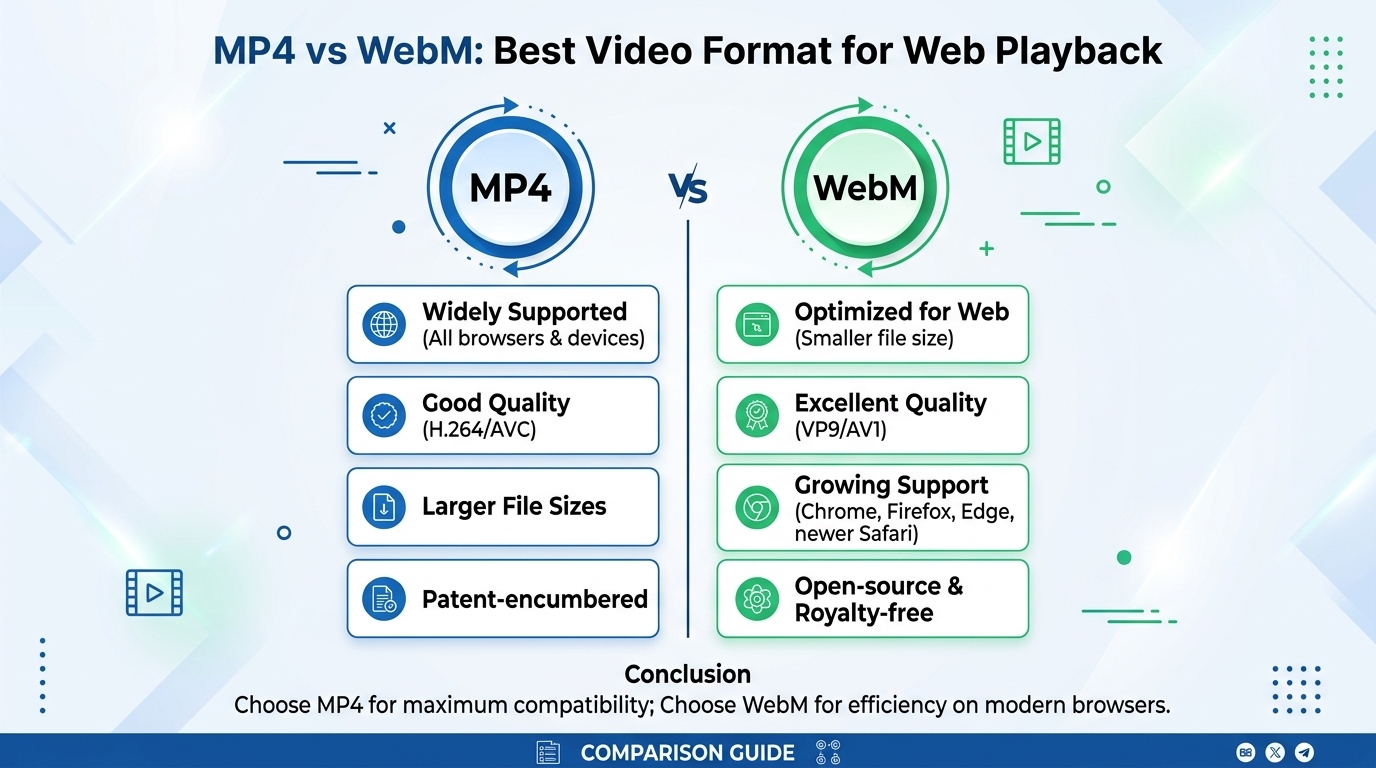
MP4 vs WebM: Best Video Format for Web Playback
For web playback in 2026, ship MP4 (H.264 video, AAC audio) as the universal baseline and add WebM (VP9 or AV1) as a ...
Fastly's free trial hands you $50 of credit and zero contractual commitment. That sounds generous until you realize $50 buys roughly 5 TB of delivery at Fastly's on-demand rate — and a single traffic spike during a load test can burn through it in hours. If you are evaluating the Fastly free trial in 2026, the real question is not whether you can sign up (you can, in under two minutes, no credit card required), but whether the trial's constraints let you run a meaningful experiment against your actual traffic profile. This article gives you three things: a precise accounting of what the Fastly free tier includes as of May 2026, a breakdown of the limits that are easy to miss in the docs, and a cost-comparison framework you can use to decide whether Fastly — or a different provider — is the right production commitment.
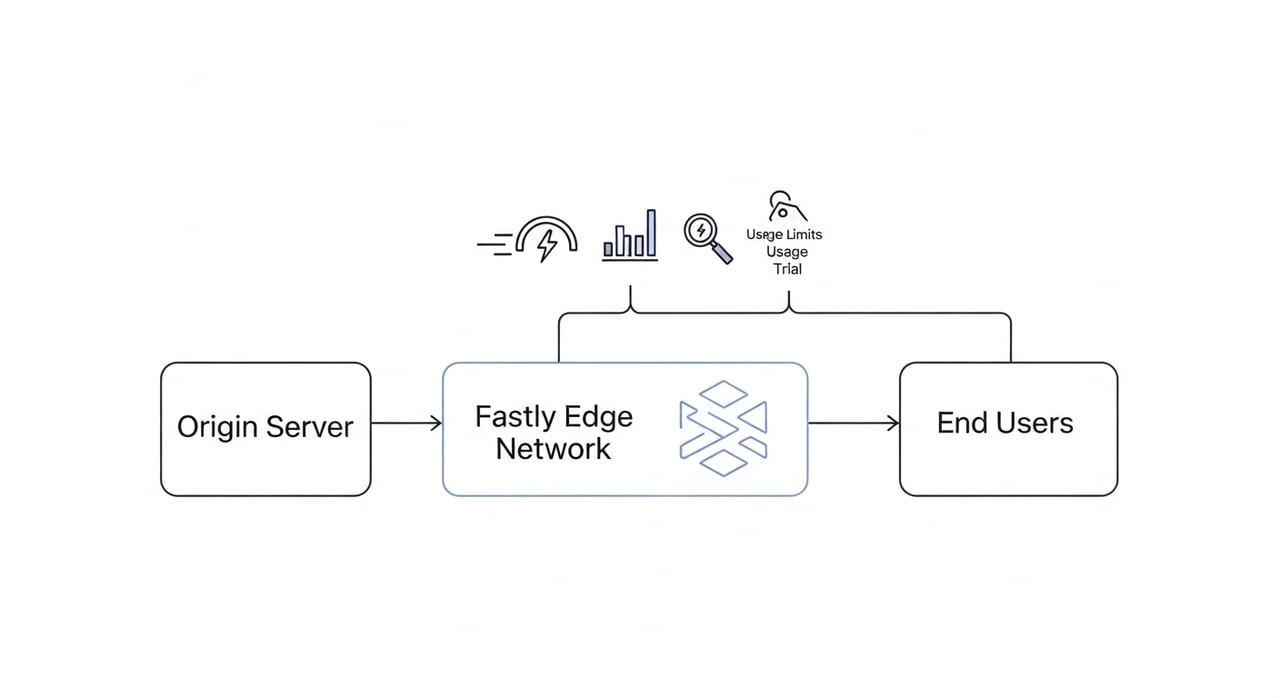
Fastly uses a credit-based developer account model rather than a fixed-duration trial. When you create a Fastly developer account, you receive $50 in free credit applied against metered usage. There is no 14-day or 30-day clock. Your trial lasts until the credit runs out or you convert to a paid plan — whichever comes first.
As of Q2 2026, the Fastly free plan includes:
Notably absent from the free tier: dedicated IP TLS (SNI only), custom SSL certificates managed by Fastly, enterprise support SLAs, and private peering configuration. The Web Application Firewall (Fastly Next-Gen WAF, powered by Signal Sciences) is not included in the developer account and requires a separate contract.
The $50 credit ceiling is the obvious constraint. Here are the ones that trip up experienced engineers during evaluation:
Fastly's on-demand delivery rate for North America and Europe sits at approximately $0.012 per GB as of early 2026. That means $50 of credit yields roughly 4.1 TB of delivery in those regions. Asia-Pacific rates are higher ($0.019/GB in many markets), so a geographically diverse test could exhaust credit under 3 TB. If you are stress-testing with synthetic traffic, you can burn the entire allocation in a single afternoon.
Delivery is not bandwidth-only. Fastly also charges per 10,000 requests. For workloads with many small objects (API responses, pixel trackers, JSON fragments), request costs can rival bandwidth costs. Run the numbers on your access logs before starting the trial.
Fastly does not require a credit card for the developer account. That protects you from surprise bills, but it also means your service stops the moment credit hits zero. If you are running a multi-day test with production-like traffic, plan for an abrupt cutoff rather than a graceful degradation.
Each Compute invocation is billed for both execution time and memory. A moderately complex edge function processing 1 million requests can consume $8–$15 of credit depending on duration. If your evaluation centers on edge logic rather than pure caching, budget at least half the credit for compute.
Developer accounts are capped at a small number of active services (typically 5 as of 2026). If your architecture involves multiple service configurations — say, separate services for media, API, and static assets — you may hit this ceiling before you hit the spend cap.
Signing up takes about 90 seconds: email, password, no credit card. From the Fastly control panel, create a Deliver or Compute service depending on your evaluation target. The Fastly CLI accelerates setup for Compute projects — run the init command, pick a starter kit (Static Content or a language-specific template), and deploy.
A useful evaluation requires structure. Here is a four-step approach that extracts maximum signal from the $50 budget:
Pick a single outcome: origin offload ratio, p95 latency to a specific region, TTFB improvement on a critical path. Trying to evaluate everything at once wastes credit on noise.
Route one path prefix or one subdomain through Fastly. Use your real origin. Synthetic tests against a mock origin tell you about Fastly's network but nothing about your integration.
Configure a streaming log endpoint on day one. Fastly's real-time analytics are useful for live monitoring, but you need durable logs for post-trial analysis. Ship to a system you already operate.
Fastly's billing dashboard shows remaining credit. Check it daily. There is no automated alert on the developer account, so build the habit or script a check against the billing API.
The free trial is a $50 sandbox. The real decision is what happens after. Here is a cost framework for comparing Fastly's paid tier against alternatives, using delivery volume as the primary axis.
| Monthly Volume | Fastly On-Demand (est.) | Fastly Contract (est.) | BlazingCDN |
|---|---|---|---|
| 10 TB | ~$120 | ~$80–$100 | $100 (up to 25 TB included) |
| 50 TB | ~$600 | ~$350–$500 | $215 |
| 500 TB | ~$4,500+ | Custom | $1,815 |
| 1 PB | Custom | Custom | $2,500 ($0.0025/GB overage) |
| 2 PB | Custom | Custom | $5,815 |
Fastly's on-demand estimates are based on published 2026 NA/EU rates. Contract pricing varies by commitment and is not publicly listed — the ranges above reflect reported values from engineering teams who have negotiated recent deals. The gap widens at scale: if your workload exceeds 100 TB/month, the cost difference between Fastly and volume-optimized providers becomes substantial.
For teams that need stable, high-throughput delivery without negotiating custom contracts, BlazingCDN's volume-based pricing offers predictable costs starting at $5/TB and scaling down to $2.50/TB at volume (as of October 2026). It runs on NVMe SSD servers with Anycast routing and built-in failover, which matters when your monthly transfer bill is a line item that finance actually scrutinizes.
The Fastly free trial is well-suited to a specific evaluation pattern: you want to test VCL or Compute@Edge logic against a narrow traffic slice, you care about Fastly-specific features (instant purge, real-time log streaming, edge dictionaries), and your test requires less than 4 TB of transfer.
It is a poor fit if your evaluation requires sustained load testing at realistic volume, multi-region latency benchmarking with significant traffic, or a side-by-side comparison that needs to run for more than a few days. In those cases, you either need to convert to a paid account early or run your comparison against providers that offer higher free-tier ceilings or flat-rate test plans.
No. As of 2026, Fastly's developer account requires only an email address. No credit card is collected during sign-up, and there is no automatic conversion to a paid plan. Service stops when the $50 credit is exhausted.
The $50 credit translates to approximately 4.1 TB in North America/Europe at current on-demand rates (~$0.012/GB). In APAC or South America, the effective bandwidth is lower due to higher per-GB pricing in those regions.
No. The trial is credit-based, not time-based. Your developer account remains active until you exhaust the $50 credit or voluntarily upgrade. There is no 14-day or 30-day deadline.
No. Fastly's Next-Gen WAF (Signal Sciences) is not included in the developer account. It requires a separate paid contract and onboarding process. You can test core CDN delivery, edge compute, and TLS, but not the WAF.
Your services stop delivering traffic through Fastly's network. There is no overage billing on the developer account and no grace period. Requests to your Fastly domains will fail, so ensure your DNS or load balancer can fall back to your origin or an alternative CDN.
Not in the traditional sense. The $50 credit is a one-time allocation on the developer account. If your site generates very low traffic, that credit could last months, but once it is gone, you need a paid plan. There is no ongoing free tier comparable to Cloudflare's free plan.
Before you sign up for any CDN trial, pull your last 30 days of access logs and calculate three numbers: total bytes delivered, request count by object size distribution, and geographic split of client IPs. Those three data points determine whether a $50 credit trial, a flat-rate provider, or a volume-committed contract is the right evaluation path for your workload. If you already have those numbers, spin up a Fastly developer account, route a single path through it, and measure the delta on the metric you care about most. That is the fastest way to turn a free trial into a real decision.

Heavy traffic.
Light bill.
The CDN for video and large traffic
Learn
For web playback in 2026, ship MP4 (H.264 video, AAC audio) as the universal baseline and add WebM (VP9 or AV1) as a ...
Compare
The brotli vs gzip choice depends on where compression runs. Pre-compressed at quality 11, Brotli typically makes ...

Learn - CDN Fundamentals
Imagine this: your latest blog post goes viral overnight, and your WordPress site crashes under the traffic surge. It’s ...