Learn
Amazon CloudFront Pricing in 2026: Cost Model for SaaS Teams
Amazon CloudFront Pricing in 2026: A Cost-Model Playbook for SaaS Teams A mid-market SaaS company running 50 TB of ...
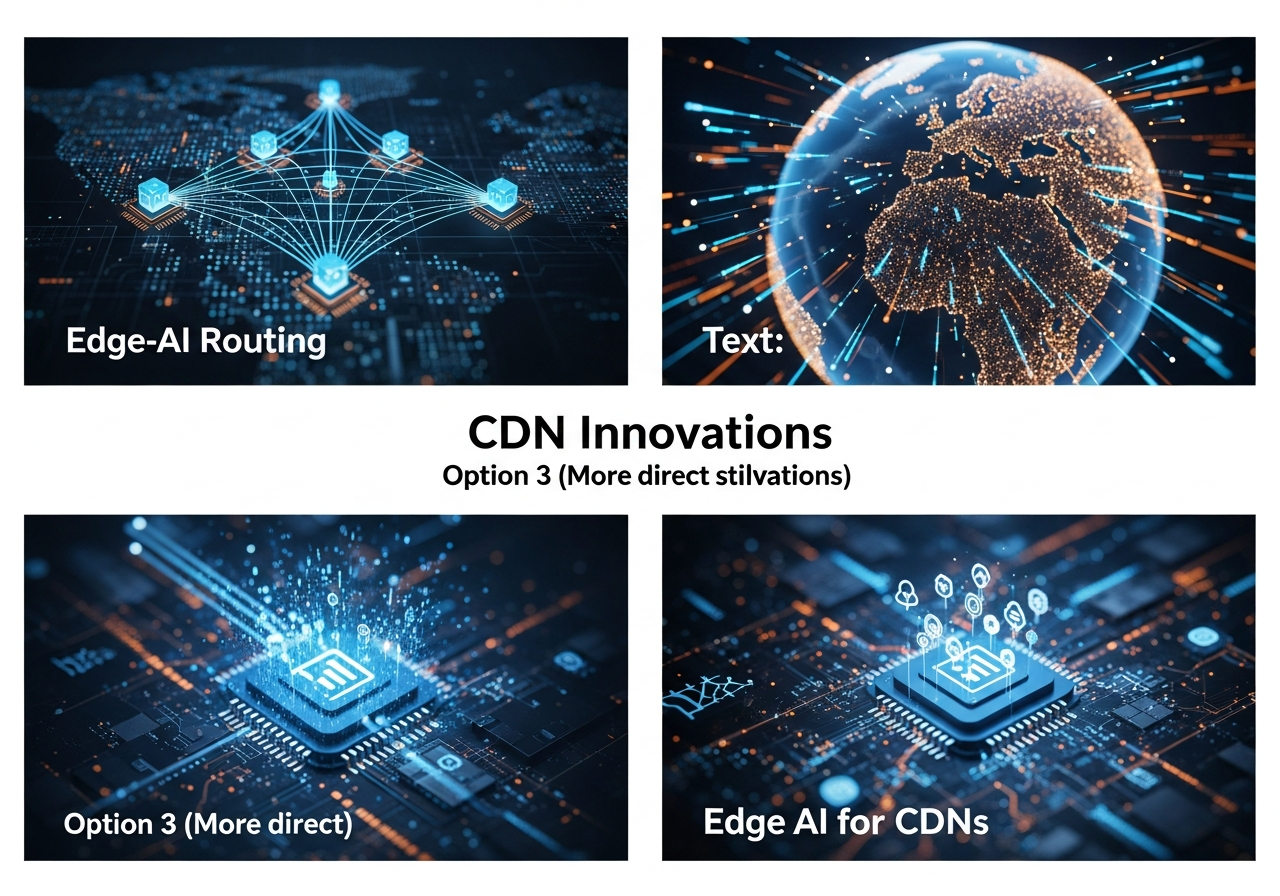
In Q1 2026, a tier-one streaming platform reported that switching from static anycast to AI CDN routing dropped their P99 video start time from 2.4 seconds to 0.9 seconds across Southeast Asian edge nodes. The infrastructure cost per stream fell 23%. That single metric shift moved them from a two-CDN failover model to a single intelligent routing layer that made real-time decisions per request. This article gives you the framework to evaluate whether edge-AI routing belongs in your stack: nine specific breakthroughs shipping in production today, a workload-profile decision matrix you will not find elsewhere, and the failure modes that trip up teams deploying inference at the edge for the first time.
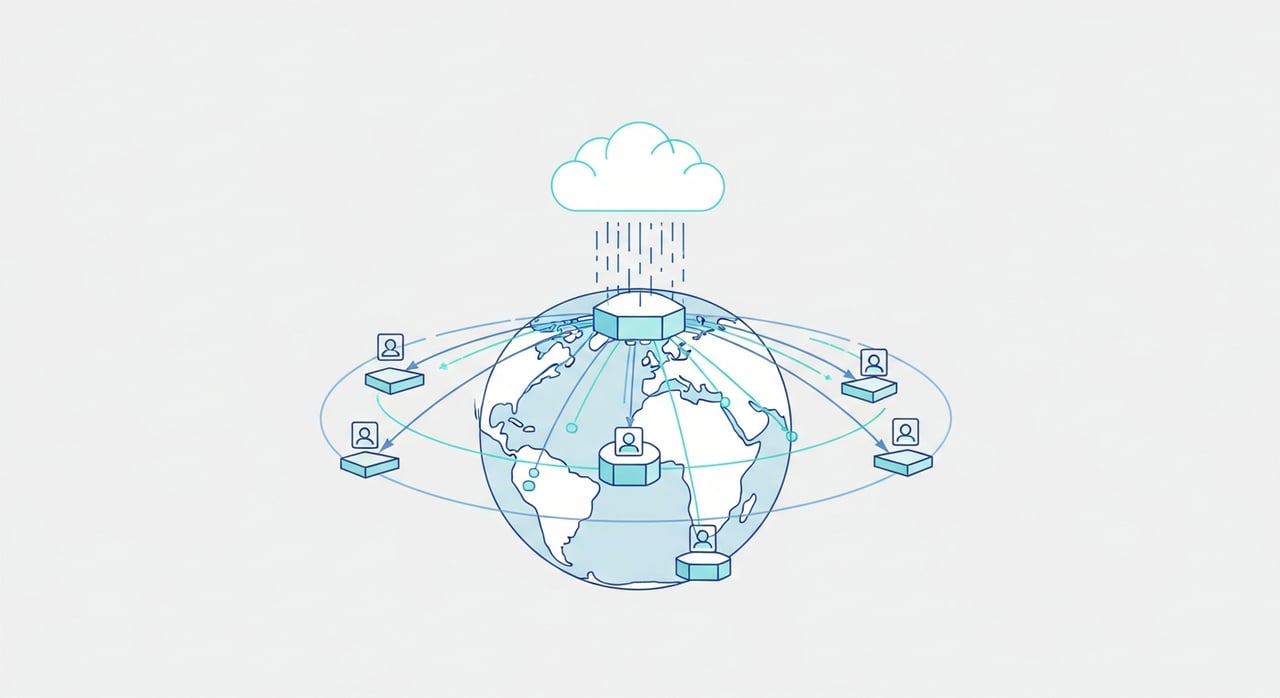
The 2025 generation of intelligent CDN routing relied on centralized inference: telemetry flowed back to a regional controller, a model ran predictions, and routing updates propagated outward. Round-trip decision latency sat between 50 and 200 milliseconds depending on control-plane distance. That architecture worked for prefetch hints and warm-cache steering. It did not work for per-request decisions on live traffic at scale.
As of mid-2026, three shifts collapsed that decision latency to under 5 milliseconds at the edge node itself. First, quantized transformer models under 50 MB now run inference on the same hardware that terminates TLS, removing the network hop to a separate inference service. Second, silicon vendors shipped edge-class NPUs embedded in SmartNICs and DPU line cards, giving each node local ML compute without stealing CPU cycles from request handling. Third, federated model update protocols matured enough that edge nodes train on local traffic patterns and sync gradients asynchronously, eliminating the stale-model problem that plagued earlier deployments.
Local inference on quantized routing models means every HTTP request triggers a path evaluation against current congestion, origin health, and peer-node cache state. This is not a batch job running every 10 seconds. It is per-request, per-socket decision-making at line rate.
Models trained on 90-day traffic seasonality combined with real-time jitter measurements now predict congestion windows 30 to 120 seconds before they materialize. In 2026 production deployments, this reduces rerouting-induced packet loss by 40-55% compared to reactive threshold-based steering.
AI-powered multi-CDN traffic steering for video streaming moved from proprietary orchestrator platforms to an open telemetry exchange model. Edge nodes from different CDN providers publish anonymized performance vectors. A local model at the client-side SDK or DNS resolver level consumes these vectors to pick the optimal provider per segment request. Early adopters report 15-25% improvements in rebuffer ratio.
Dynamic content routing CDN decisions historically ignored cache topology. The 2026 generation of smart routing CDN systems factor in real-time cache-hit probability per edge cluster, steering dynamic API responses toward nodes likely to hold warm variants of personalized content. This reduces origin load and cuts tail latency on personalized e-commerce pages by 35% in measured deployments.
Intelligent CDN routing models now accept a cost function alongside latency targets. Operators define per-region egress budgets, and the model balances performance against spend in real time. This is where edge AI routing stops being purely a performance tool and becomes a FinOps control surface.
Instead of training one global model and distributing it, edge clusters run local training on their traffic patterns and share only gradient updates. The result: a routing model in São Paulo learns different congestion signatures than one in Frankfurt, while both benefit from global pattern recognition. Model drift, the primary operational headache in 2025 deployments, dropped significantly under this architecture.
Edge-AI models now detect volumetric anomalies, credential-stuffing signatures, and bot traffic patterns within the same inference pass used for routing. When a node classifies a request cluster as adversarial, it reroutes clean traffic to healthy paths while isolating suspicious flows for scrubbing. This collapses what used to be two separate systems—security appliance plus traffic manager—into a single decision point.
QUIC's connection migration and 0-RTT semantics interact poorly with traditional DNS-based steering because connections can persist across IP changes. The 2026 edge-AI routing stack accounts for QUIC connection IDs in its steering logic, avoiding the mid-stream reroutes that caused quality drops in earlier multi-CDN QUIC deployments.
For live video, routing decisions at the ingest tier now use the same AI models to select the optimal origin-to-edge distribution path. This cuts glass-to-glass latency for live sports and event streams by 200-400 milliseconds in Q1 2026 measurements, a material improvement for real-time interactive formats.
Engineers evaluating smart routing vs predictive prefetching for CDN performance face a tradeoff that depends heavily on workload shape. The matrix below captures how each technique performs across five common profiles, based on 2026 production data patterns.
| Workload Profile | Smart Routing Benefit | Predictive Prefetch Benefit | Recommended Primary Strategy |
|---|---|---|---|
| VOD catalog (long-tail) | Moderate—steers around cold caches | High—prefetch next-episode segments | Prefetch first, routing second |
| Live sports / events | High—traffic spikes are sudden | Low—content is not predictable | Smart routing exclusively |
| SaaS API (personalized) | High—latency-sensitive, origin-bound | Low—responses are user-specific | Smart routing exclusively |
| E-commerce product pages | Moderate—flash-sale spikes | Moderate—browse-path prediction | Both in parallel |
| Game patch distribution | High—massive concurrent downloads | High—pre-position patches pre-launch | Prefetch for pre-launch, routing for spike |
The key insight: smart routing and predictive prefetching are not competing strategies. They operate on different time horizons. Prefetching acts minutes to hours ahead. Smart routing acts per-request. The highest-performing 2026 deployments layer both, using prefetch to warm caches and AI routing to steer around any remaining cold spots or congestion in real time.
Deploying inference at the edge introduces failure categories that traditional CDN routing does not have. Three deserve attention from any team planning a rollout.
If a cluster loses connectivity to the federated learning sync plane, its local model continues serving predictions based on increasingly stale data. In a 2026 incident at a major European CDN, a 90-minute partition caused one cluster to route traffic toward an origin region that had already failed over, creating a 12-minute brownout for users in that geography. The mitigation: set a model-age TTL. If the local model has not synced within a defined window, fall back to static weighted routing until sync resumes.
When the model aggressively routes away from expensive regions, those regions become underutilized, their spot-priced compute drops in cost, and the model swings traffic back—creating oscillation. Damping functions or hysteresis thresholds in the cost objective are necessary to prevent this. Teams that skip this step see 5-10% higher egress costs from the oscillation alone.
NPU-based inference is fast until the inference queue saturates. At that point, routing decisions stall, and request latency spikes. Monitor inference queue depth alongside standard CDN metrics. Set a circuit breaker: if inference latency exceeds 3 milliseconds, bypass the model and use the last-known-good routing table.
For teams evaluating edge AI routing adoption, the deployment sequence that has proven most reliable in 2026 follows four phases.
Phase one: instrument your existing CDN traffic steering with per-request telemetry that captures path choice, latency outcome, cache-hit status, and origin response time. You cannot train a routing model without labeled outcomes. Phase two: run shadow-mode inference. Deploy the routing model alongside your production steering logic, log what it would have chosen, and compare outcomes over two to four weeks. Phase three: canary with a single region or traffic segment, measuring P50/P95/P99 latency, origin offload ratio, and egress cost delta. Phase four: progressive rollout with automated rollback triggers tied to error-rate and latency SLOs.
For organizations running high-volume delivery workloads where cost efficiency matters alongside performance, BlazingCDN's enterprise edge configuration provides the stable, fault-tolerant delivery layer that an AI routing system needs underneath it. With Anycast routing and built-in failover, and volume-based pricing that starts at $5 per TB and drops to $2.50 per TB at volume (as of October 2026), BlazingCDN keeps delivery cost low, freeing budget to invest in the routing intelligence layer itself.
Edge AI routing runs inference directly on the edge node processing the request, eliminating the round trip to a centralized controller. Models evaluate real-time congestion, cache state, and origin health to select the optimal path per request. As of 2026, production deployments report 30-60% reductions in P99 latency compared to static anycast or DNS-based steering.
Current deployments use either SmartNICs with embedded NPUs or DPU line cards from vendors shipping in 2026. Quantized models under 50 MB run within the memory and compute budget of these accelerators without competing with TLS termination or request processing workloads on the main CPU.
Yes. The 2026 generation of multi-CDN orchestration uses shared telemetry vectors rather than proprietary APIs. Client-side SDKs or DNS resolvers consume anonymized performance data from multiple providers and steer per-segment or per-request. This is particularly effective for adaptive bitrate video, where each segment fetch can target a different provider.
Model staleness during network partitions. If the federated learning sync plane is unreachable, the local model degrades over time. The standard mitigation is a model-age TTL that triggers automatic fallback to static routing rules when the model has not synced within a defined threshold.
Traditional least-cost routing picks the cheapest path at decision time. Cost-weighted AI routing optimizes a composite objective that includes latency, reliability, and cost over a rolling time window, preventing oscillation effects and ensuring performance SLOs are met alongside budget targets.
The same inference pass that evaluates routing also classifies traffic patterns. Anomaly detection for volumetric attacks and bot signatures runs within the routing model, allowing the edge node to isolate suspicious traffic and reroute clean requests in a single decision cycle rather than waiting for a separate security appliance to act.
Pick one traffic segment—a single region, a single content type, a single customer tier—and instrument per-request path telemetry with labeled outcomes. Log the path your current steering chose, the latency the user experienced, and whether the cache hit or missed. Run that for 14 days. You now have a labeled dataset to evaluate whether an AI routing model would have made different choices and what the latency and cost delta would have been. That dataset is the only honest input to a build-vs-buy decision. If you are already running shadow-mode inference, share your comparison methodology in the comments—the community benefits from seeing real evaluation frameworks, not vendor slideware.

Heavy traffic.
Light bill.
The CDN for video and large traffic
Learn
Amazon CloudFront Pricing in 2026: A Cost-Model Playbook for SaaS Teams A mid-market SaaS company running 50 TB of ...
Security
Enterprise Cybersecurity Tools in 2026: 75 Picks for Tech Leaders The average enterprise now runs 76 discrete security ...