

Compare
BunnyCDN Pricing in 2026: What You Actually Pay per TB
Imagine a bustling global marketplace where digital content flows as smoothly as traffic in a well-orchestrated city. ...
In Q1 2026, a single Covariant-equipped robotic picking cell at a major European 3PL processed 1,200 mixed-SKU picks per hour with a 99.7% grasp success rate across deformable items like polybags and blister packs. That number matters because the industry median for traditional warehouse picking robots on the same SKU mix sits closer to 600 picks/hour with sub-95% reliability. The gap is not marginal; it is structural, and it comes down to how the AI behind the hardware actually works. This article gives you the architectural breakdown of Covariant's system as of 2026, a failure-mode analysis you will not find in other coverage, and a practical framework for evaluating AI warehouse automation against your own fulfillment topology.
Covariant's technical differentiator is not the robot arm. It is the Covariant Brain, a large-scale foundation model trained on physical-world manipulation data rather than internet text. As of early 2026, the model ingests data from deployments across multiple continents, creating a shared representation space where a picking policy trained on apparel in a Tokyo warehouse transfers meaningfully to mixed electronics in a Memphis distribution center.
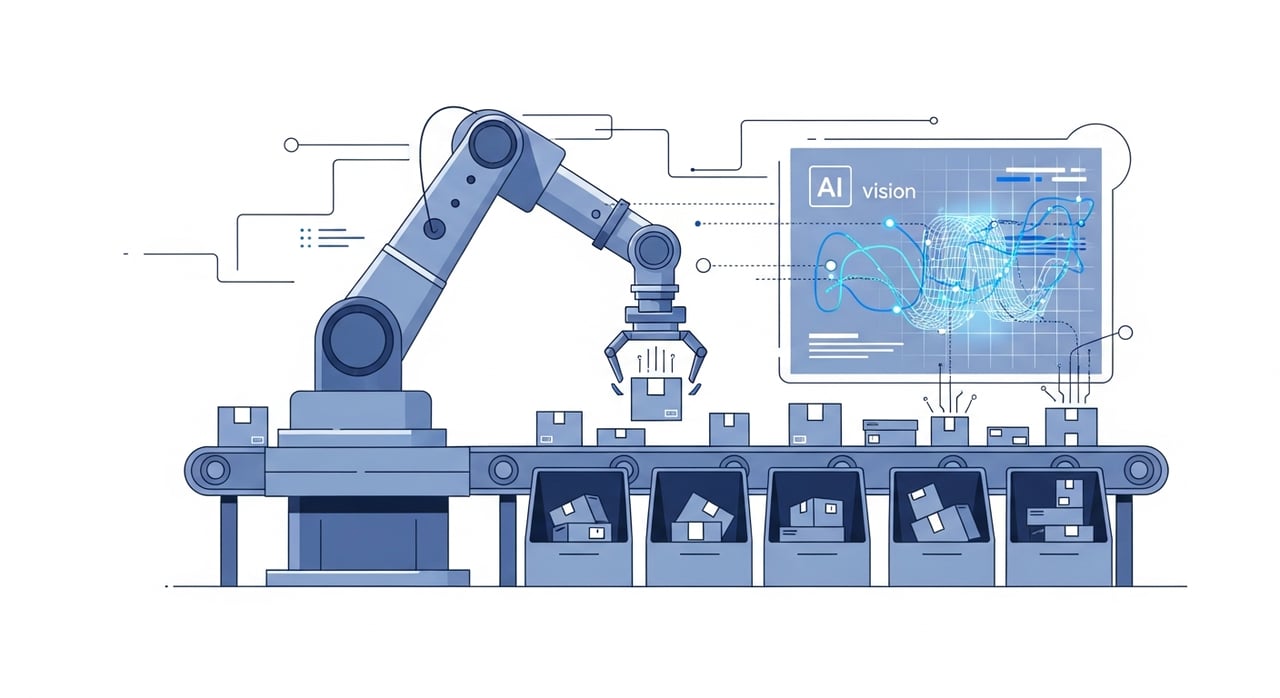
The architecture follows a perception-reasoning-action loop. Depth sensors and RGB cameras feed into a vision transformer backbone that segments the bin contents, identifies graspable surfaces, and estimates object properties like deformability and mass. A planning module then selects grasp strategy, approach vector, and place trajectory. Critically, the system runs inference locally at the edge with model updates pushed asynchronously, so a network interruption does not halt the cell.
Covariant expanded its model to handle transparent and reflective objects, which historically defeated depth-sensor-based pipelines. Their 2026 model revision fuses polarimetric cues with learned shape priors, addressing a failure class that accounted for roughly 8-12% of grasp failures in prior generations. They also introduced a sim-to-real curriculum that cuts new SKU onboarding from days to hours by pre-training manipulation policies on synthetic bin scenes before fine-tuning on a handful of real-world demonstrations.
Covariant's robots are not general-purpose humanoids. They target three specific warehouse automation workloads, each with distinct engineering constraints.
In goods-to-person configurations, totes or shelving units arrive at a stationary robot cell. The robot picks individual items from a source tote and places them into order-specific destination totes. Covariant's system handles mixed-SKU bins where item count, orientation, and stacking are non-deterministic. Major deployments in apparel and health-and-beauty verticals report sustained throughput above 900 picks/hour as of Q1 2026, with some optimized cells exceeding 1,200.
Robotic induction systems feed parcels or items onto sorters at rates that human inductors struggle to sustain over full shifts. Covariant's induction cells singulate items from bulk containers, orient them for barcode scanning, and place them onto conveyor inductions. The 2026-generation system handles parcels from polybag mailers through rigid boxes without mechanical changeover, which is the key value proposition for e-commerce fulfillment centers processing 50,000+ orders per day.
Case-level picking from pallets to build mixed-SKU outbound pallets is the newest application area. Covariant's approach here leverages the same vision backbone but adds load-planning logic that optimizes pallet stability and cube utilization. Early deployments in grocery distribution report a 35% reduction in pallet-build time versus manual operations.
No vendor coverage discusses this honestly enough. Here are the failure modes that matter when you are evaluating robotic picking systems for production deployment in 2026.
| Failure Mode | Root Cause | Covariant 2026 Mitigation | Residual Risk |
|---|---|---|---|
| Entangled items | Deformable goods (clothing, cables) interlock in bin | Multi-step disentanglement policy with force feedback | Medium: still causes 3-5% of intervention events |
| Transparent or reflective surfaces | Depth sensor returns invalid readings | Polarimetric fusion + learned shape priors | Low-medium: major improvement over 2025 generation |
| Novel SKU introduction | Object unseen by model during training | Zero-shot generalization from foundation model + sim-to-real fine-tuning | Low: 95%+ first-attempt success on novel items |
| Suction seal failure on porous surfaces | Vacuum gripper cannot form seal on textured packaging | Hybrid gripper with finger-based fallback; grasp strategy selector | Low: fallback adds ~0.8s per pick |
| Upstream data latency | WMS order feed delayed or batch-mode only | Local order buffer with predictive pre-staging | Medium: depends on integrator WMS config |
The entanglement problem remains the most operationally significant. If your catalog is heavy on apparel, bagged goods, or cable accessories, budget for a higher human-intervention ratio (one operator per 3-4 cells rather than 5-6) in your capacity model.
Before committing to Covariant or any robotic picking vendor, score your operation against these five dimensions.
Warehouse automation generates substantial telemetry: grasp-attempt logs, exception images, model performance metrics, and video streams for remote monitoring. Aggregating this data across dozens of facilities for centralized model retraining and operational dashboards demands reliable, high-throughput content delivery. For organizations streaming monitoring dashboards, distributing firmware updates to edge controllers, or serving video feeds from cell cameras to remote operations teams, a CDN that scales without punishing pricing is essential. BlazingCDN's enterprise edge configuration delivers 100% uptime with volume pricing that starts at $4 per TB and drops to $2 per TB at the 2 PB tier, offering stability and fault tolerance on par with Amazon CloudFront at a fraction of the cost. For multi-site warehouse operators pushing hundreds of terabytes of telemetry and video monthly, that pricing delta compounds fast.
Covariant Brain is a foundation model trained on physical manipulation data from real warehouse deployments worldwide. It provides the perception, reasoning, and motion-planning stack that allows robot arms from various OEMs to pick, place, and induct items across unpredictable bin configurations. Unlike task-specific models, it generalizes across SKU types and warehouse layouts.
Rule-based picking systems require explicit programming for each item geometry and bin configuration. AI-driven systems like Covariant's learn grasp strategies from data, enabling them to handle novel items on first encounter with above 95% success rates as of 2026. This eliminates the SKU-onboarding bottleneck that limits traditional automation.
Covariant-equipped goods-to-person cells sustain 900-1,200+ picks per hour on mixed-SKU bins in production as of Q1 2026. Actual throughput depends on item size distribution, bin density, and place-target complexity. Apparel-heavy operations typically run at the lower end due to entanglement-related slowdowns.
Yes. Covariant's induction cells handle the parcel heterogeneity common in e-commerce, from polybag mailers to rigid boxes, without mechanical changeover. Facilities processing 50,000+ orders per day use robotic induction to sustain sort-line feed rates across multi-shift operations, reducing the labor dependency that creates bottlenecks during peak seasons.
Covariant is the strongest contender for apparel-specific mixed-SKU picking due to its foundation model's training on deformable goods. Competitors include Berkshire Grey and Dexterity, but independent benchmarks from 2025-2026 consistently show Covariant leading on grasp success rate for polybag and folded-garment picks. Budget for higher human-intervention ratios than rigid-goods operations.
If you are evaluating AI warehouse automation for a 2026 or 2027 deployment, do not rely on vendor demo videos. Request a paid proof-of-concept on your actual SKU catalog, in your facility, with your WMS integration. Measure grasp success rate, picks per hour, intervention frequency, and mean time to recover from exceptions across a minimum 72-hour continuous run. Compare those numbers against your current manual or semi-automated baseline using the five-dimension framework above. That data, not a slide deck, is what your capital approval committee needs.
Compare
Imagine a bustling global marketplace where digital content flows as smoothly as traffic in a well-orchestrated city. ...

Learn
AWS CloudFront Pricing in 2026: Cost per TB Breakdown At 50 TB/month of egress from US edge locations, your AWS ...

Learn
CDN Failover in 2026: The Five-Nines Architect's Playbook In January 2026, a major European streaming platform lost CDN ...