
Learn
AI CDN Routing in 2026: A Decision Framework for Edge Intelligence
AI CDN Routing in 2026: A Decision Framework for Edge Intelligence In Q1 2026, a tier-one streaming platform reported ...
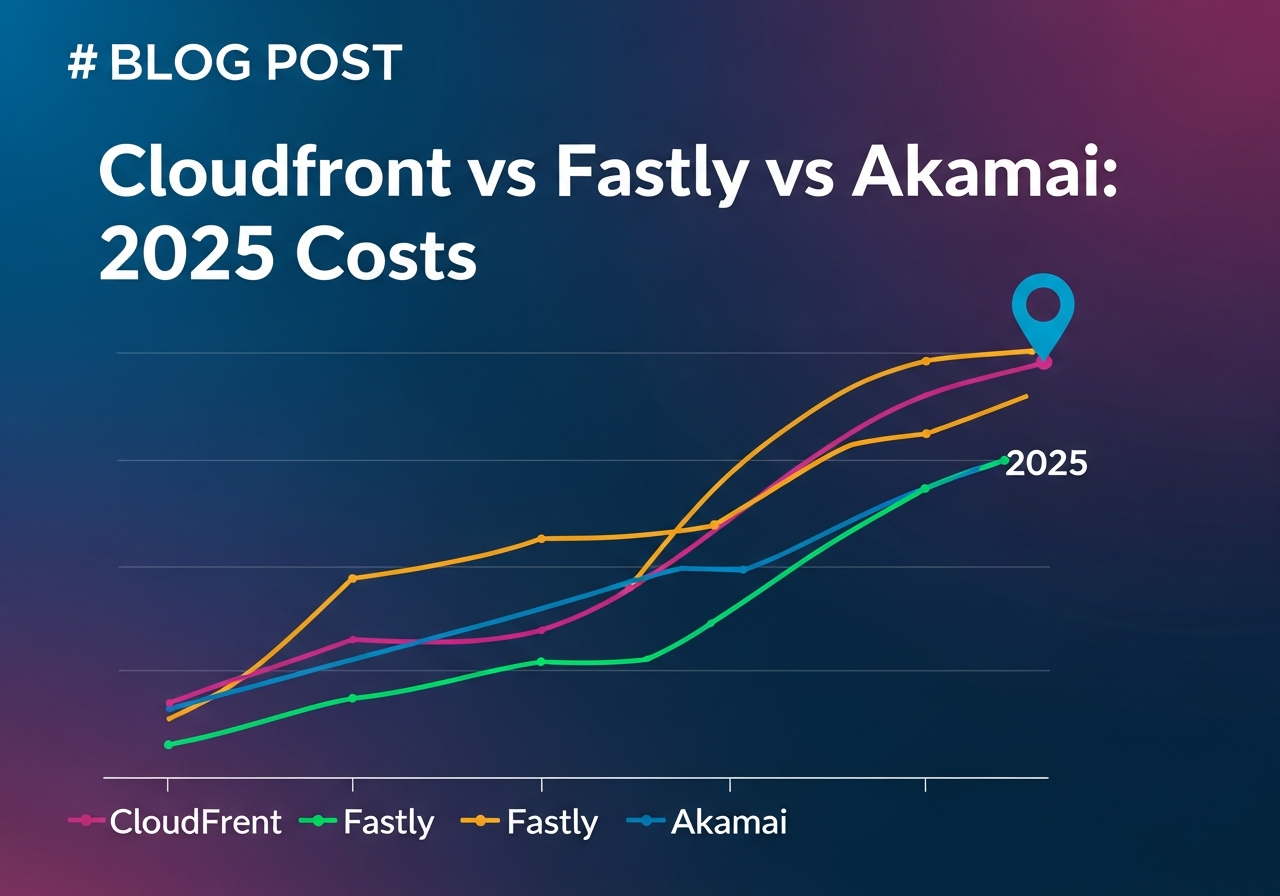
A 50 TB/month video workload priced on CloudFront's published rates costs roughly $3,750 in North America. The same traffic on Akamai's standard contract can exceed $6,000. Fastly lands somewhere between — but the final invoice depends on variables none of those headline numbers capture. If you are comparing CloudFront vs Fastly vs Akamai pricing in 2026, the sticker rate is the least interesting part of the analysis. Request fees, regional multipliers, origin shield charges, real-time log pipelines, and mandatory security bundles shift the true cost by 20–60% depending on your traffic shape. This article gives you the actual per-GB and per-request rates as of Q2 2026, a hidden-cost breakdown across all three vendors, and a workload-profile decision matrix you will not find in their marketing pages.
All three vendors use tiered, region-dependent pricing. The table below reflects publicly listed rates as of April 2026 for the most common delivery region — North America and Europe. Akamai's rates are contract-dependent; figures shown are representative of mid-market enterprise agreements reported in 2026 procurement benchmarks.
| Monthly Volume | CloudFront (NA/EU) | Fastly (NA/EU) | Akamai (typical contract) |
|---|---|---|---|
| First 10 TB | $0.085/GB | $0.08/GB | $0.08–$0.12/GB |
| 10–50 TB | $0.060/GB | $0.06/GB | $0.06–$0.10/GB |
| 50–150 TB | $0.040/GB | $0.04/GB | $0.04–$0.07/GB |
| 150–500 TB | $0.030/GB | Custom | $0.03–$0.05/GB |
| 500 TB+ | Custom / EDP | Custom | Custom |
At the 10 TB tier, CloudFront and Fastly are nearly identical on data transfer alone. Akamai's range is wider because rates depend heavily on contract length, commit volume, and bundled services. If your procurement team is comparing quotes, the Akamai number you receive at 50 TB may be lower than published CloudFront rates — but only if you commit to a multi-year term with a minimum spend floor.
Data transfer is roughly 60–75% of your CDN bill. The rest comes from request-level charges, feature add-ons, and regional surcharges that vary wildly across vendors.
CloudFront charges per 10,000 HTTP/HTTPS requests: $0.0075 for HTTPS in NA/EU, $0.0090 for HTTPS in Asia-Pacific. Origin Shield adds $0.0060 per 10k requests. Lambda@Edge invocations, CloudFront Functions, and real-time logs (via Kinesis) are billed separately. A high-request-count API workload delivering small payloads can see request fees exceed transfer fees — a pattern that surprises teams migrating from flat-rate providers.
Fastly bundles request costs into its bandwidth pricing for most tiers, which simplifies forecasting. However, compute charges on Compute@Edge are billed per invocation and per-GB of memory-second. Real-time log streaming is included at no extra charge — a notable difference from CloudFront. Image optimization (Fastly IO) is an add-on billed per transformation.
Akamai's fee structure is the most layered. Midgress (inter-region traffic within Akamai's network), surcharge fees for HTTP/2 push and advanced cache control, and mandatory bundles for features like Bot Manager Premier or App & API Protector add thousands per month to an enterprise invoice. Logging is available but typically requires a Datastream 2 subscription, priced separately. The advantage is that Akamai's contract model allows you to negotiate credits and offsets — but only if you have leverage through committed volume.
If your traffic is concentrated in North America and Europe, all three vendors price within 15% of each other at equivalent volumes. The gap explodes in other regions. CloudFront charges $0.110/GB in India and $0.140/GB in South America at the first 10 TB tier — 30–65% above NA rates. Fastly's Asia-Pacific surcharge is roughly 25–40% above base. Akamai's APAC and LATAM rates are entirely contract-specific and can be negotiated down if you bring sufficient regional commit.
For workloads with significant traffic in India, Southeast Asia, or Latin America, regional pricing is often the single largest variable in a CDN pricing comparison. Model it explicitly. A blended global per-GB rate that ignores regional splits will leave 20–30% cost variance on the table.
Rather than generic "best for" bullets, this matrix maps specific workload profiles to the vendor whose pricing model creates the lowest total cost of ownership as of 2026. "Lowest cost" here means all-in: transfer, requests, required add-ons, and origin costs.
| Workload Profile | Volume / Pattern | Lowest-Cost Vendor | Key Reason |
|---|---|---|---|
| AWS-native SaaS, API-heavy | 5–50 TB, high request count | CloudFront | Free origin transfer from S3/ALB; EDP discounts stack |
| Live/VOD streaming, 50+ TB | 50–500 TB, large objects | Fastly or BlazingCDN | Fastly includes log streaming; BlazingCDN at $0.003/GB undercuts both at scale |
| Global enterprise, regulated industry | 100+ TB, compliance-heavy | Akamai | Bundled security and compliance tooling offsets headline premium |
| Gaming / software distribution | 100+ TB, bursty | Fastly | Instant purge and compute at edge; no overage penalty model |
| E-commerce, NA/EU-centric | 10–100 TB, seasonal spikes | CloudFront | Tiered pricing drops steeply; Shield for origin protection is cheap |
| High-volume delivery, cost-first | 500 TB–2 PB, steady-state | BlazingCDN | $0.0025–$0.003/GB at scale with no request-fee layer |
Three developments since mid-2025 are worth tracking:
For organizations running 50 TB or more per month where the primary optimization target is cost per gigabyte delivered, BlazingCDN offers pay-as-you-go pricing starting at $5 per TB, down to $2.50 per TB at volume (as of October 2026): 100 TB costs $415 and 500 TB costs $1,815, with no request fees. For comparison, CloudFront is about $6,965 for 100 TB at pay-as-you-go rates. If your workload is high-volume delivery — software updates, media, or large-object distribution — model BlazingCDN into your cost comparison before signing a commit with any of the three vendors above.
On CloudFront, 10 TB in NA/EU runs approximately $850 in transfer plus $7.50–$15 in request fees depending on request volume. Fastly is roughly $800 all-in for the same traffic. Akamai varies: expect $800–$1,200 depending on your contract terms and whether security features are bundled.
For organizations that require integrated bot management, API security, and compliance certification support, Akamai's premium often displaces the cost of third-party tooling. If your security stack is already handled separately, Akamai's delivery-only cost is harder to justify at volumes below 100 TB/month.
In North America and Europe, the three are within 10–15% of each other at similar volumes. In South America, CloudFront surcharges can reach $0.140/GB, where Fastly's LATAM rates sit around $0.10–$0.12/GB. Akamai's regional rates are negotiable but tend to be higher than both unless contractually committed.
At 100 TB+ with steady-state traffic, CloudFront with an Enterprise Discount Program or Savings Plan commitment is typically the lowest among the three incumbents. BlazingCDN undercuts all three at this tier, with 100 TB priced at $415 per month (as of October 2026), about $0.00415/GB effective, versus about $6,965 on CloudFront pay-as-you-go rates.
Yes. A multi-CDN architecture using a traffic manager (e.g., NS1, Cloudflare Load Balancing, or Route 53 latency-based routing) lets you route by region or cost. Many teams send NA/EU traffic to CloudFront or Fastly, APAC traffic to Akamai where they have a regional commit, and high-volume bulk delivery to BlazingCDN.
CloudFront does not charge for origin pull from S3, MediaStore, or ALB in the same region. Fastly charges for origin fetch bandwidth at roughly the same rate as delivery bandwidth. Akamai waives origin pull from Linode instances in the same metro as of 2026; all other origins incur midgress fees.
Pull your last 90 days of CDN logs. Break traffic into five buckets: region, object size, request count, cache-hit ratio, and peak-to-mean ratio. Feed those numbers into each vendor's pricing calculator — CloudFront's is at calculator.aws, Fastly's is in their dashboard, and Akamai requires a sales call. Then model the same traffic through BlazingCDN's published tiers. The delta between the highest and lowest quote will likely be 3–5× at 50 TB and 5–10× at 500 TB. That spread is where your negotiation leverage lives. If you have already run this exercise, drop your findings in the comments — anonymized numbers are useful to every engineer making this decision in 2026.

Heavy traffic.
Light bill.
The CDN for video and large traffic
Learn
AI CDN Routing in 2026: A Decision Framework for Edge Intelligence In Q1 2026, a tier-one streaming platform reported ...
Learn
Amazon CloudFront Pricing in 2026: A Cost-Model Playbook for SaaS Teams A mid-market SaaS company running 50 TB of ...