
Learn
Lossy vs Lossless Compression: Images, Video and Audio
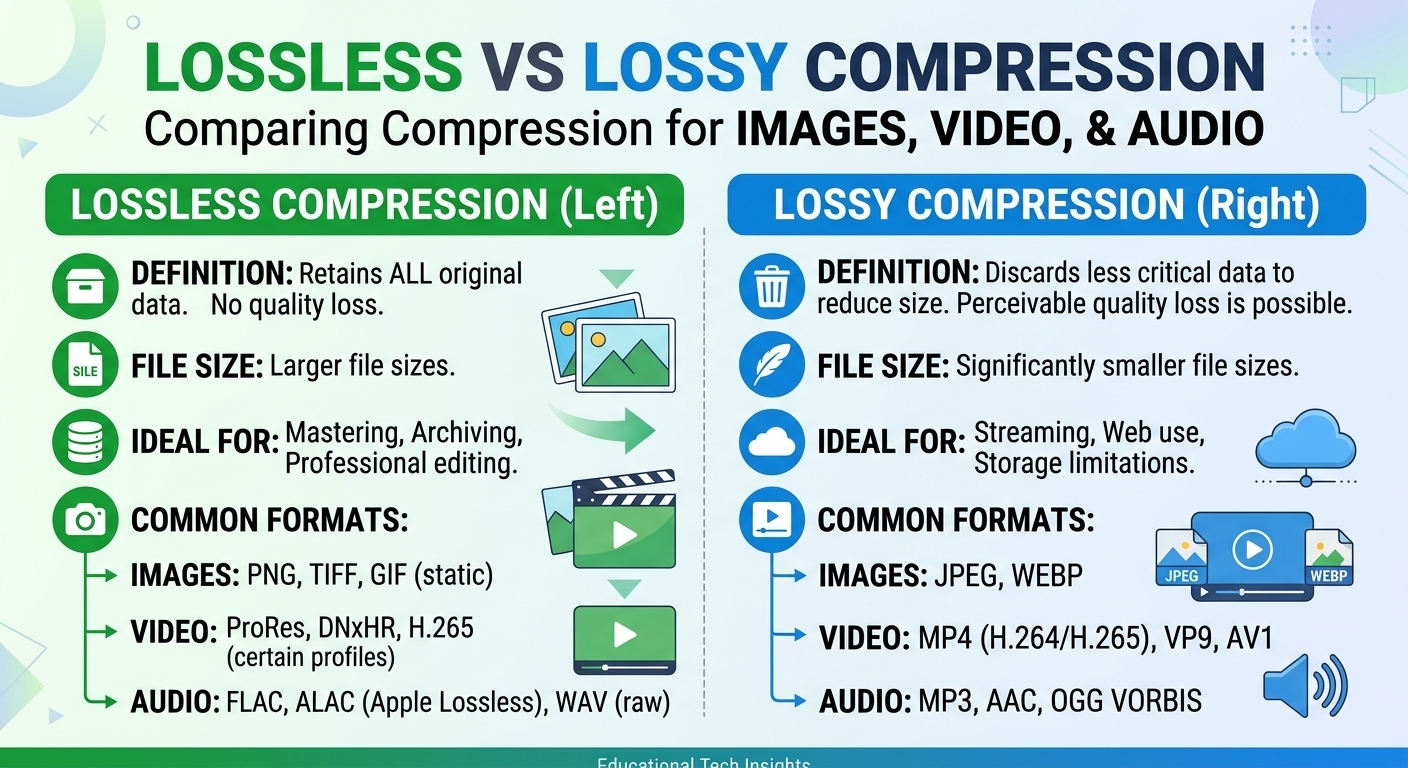
Lossy vs lossless compression comes down to one trade: lossless compression rebuilds every original bit and typically ...
A 50 TB/month live-streaming workload served from three CloudFront regions will cost you roughly $4,200 on your May 2026 AWS invoice. Move the same traffic through a volume-priced CDN alternative and you can land under $350. That spread is not a rounding error; it is the difference between a sustainable video platform and one bleeding margin on delivery alone. This article breaks down Amazon CloudFront pricing as it stands in Q2 2026, maps every line item that contributes to a video streaming bill, provides a workload-profile decision matrix for choosing the right CDN, and gives you a concrete optimization playbook you can execute this quarter.
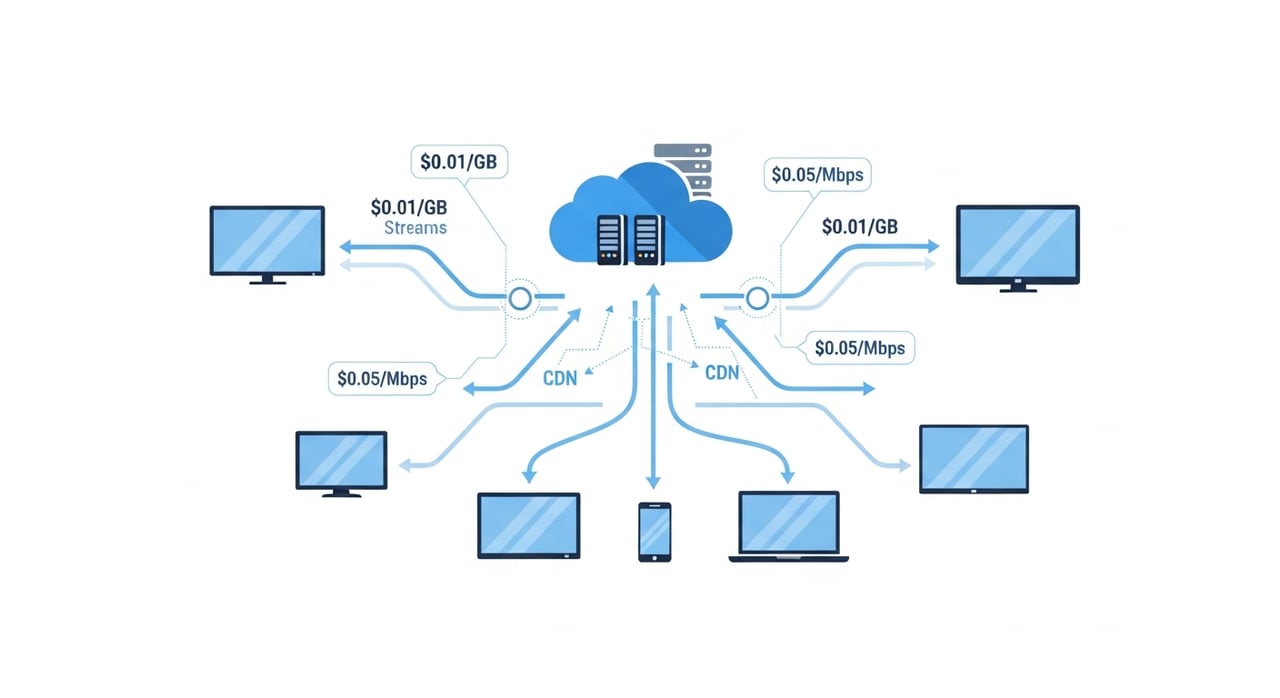
AWS publishes CloudFront rates across three billing axes: data transfer out to the internet, HTTP/HTTPS request volume, and optional feature add-ons. As of May 2026, the first-10-TB tier for data transfer out of North America and Europe sits at $0.085/GB. That number has not changed since 2023. What has changed is the surround: real-time log delivery now bills separately via Kinesis Data Firehose, Origin Shield carries an incremental request charge, and CloudFront Functions plus KeyValueStore have their own metering.
For video workloads, data transfer dominates the bill (typically 80–92% of the total). Request costs matter less for long-session HLS/DASH delivery than for high-frequency short-object APIs, but they still accumulate — a 4-hour live event at 6-second segment durations generates millions of GET requests per concurrent viewer cohort.
CloudFront pricing is region-tiered, and the variance is brutal for global audiences. The table below reflects published rates as of Q2 2026 for the first 10 TB/month tier:
| Region | Price per GB (first 10 TB) | Price per GB (next 40 TB) |
|---|---|---|
| United States, Mexico, Canada | $0.085 | $0.080 |
| Europe, Israel | $0.085 | $0.080 |
| Japan | $0.114 | $0.089 |
| Asia Pacific (Hong Kong, Singapore, etc.) | $0.120 | $0.085 |
| India | $0.109 | $0.085 |
| South America | $0.110 | $0.090 |
| Middle East, Africa | $0.110 | $0.090 |
Volume discounts flatten the curve above 150 TB, but even at 500+ TB/month the effective blended rate in North America only drops to roughly $0.030/GB. For comparison, dedicated CDN providers routinely quote $0.0025–$0.005/GB at that scale.
The per-GB headline number is where most teams start. It is not where the invoice ends. Four cost components catch video teams off guard in 2026:
Every cache miss triggers a fetch back to your S3 bucket or MediaPackage origin. Origin Shield adds a centralized cache layer to reduce these fetches, but it bills per 10,000 requests ($0.0090 in US-East). At scale, this line item is non-trivial — particularly during live events with cold-cache ramp-ups.
If you ship access logs to Kinesis Data Firehose for real-time analytics, you pay both the Firehose ingestion rate and the CloudFront log-line delivery charge ($0.01 per million log lines as of Q2 2026). A 10,000-concurrent-viewer stream generating 10 requests/second per viewer produces 360 million log lines per hour.
The first 1,000 invalidation paths per month are free. After that, $0.005 per path. VOD platforms with large, frequently updated catalogs can accumulate meaningful invalidation costs — especially if CI/CD pipelines invalidate aggressively on publish.
Token authentication, geo-blocking logic, and A/B manifest manipulation at the edge are common in streaming stacks. CloudFront Functions bill at $0.10 per million invocations. Lambda@Edge is substantially higher: $0.60 per million plus compute-duration charges. Both multiply with every segment request.
Choosing a CDN based on headline $/GB alone is insufficient. The right pick depends on traffic shape, geographic distribution, origin architecture, and tolerance for vendor lock-in. This matrix maps four common video workload profiles to the CDN posture that best serves them as of 2026:
| Workload Profile | Monthly Egress | Audience Geo | Best-Fit CDN Approach |
|---|---|---|---|
| Early-stage VOD (< 5 TB/mo) | 1–5 TB | Single region | CloudFront free tier (1 TB) + pay-as-you-go. Low risk, AWS-native. |
| Mid-scale VOD / FAST channels | 25–100 TB | Multi-region | Volume-priced CDN with flat-rate billing. CloudFront cost at this tier: $2,000–$7,500/mo. Alternatives: roughly $115–$415/mo. |
| Live sports / events (burst) | 50–500 TB (spiky) | Global | Multi-CDN with real-time switching. Primary: cost-efficient CDN for base load. Failover: CloudFront for burst and AWS-origin proximity. |
| Enterprise OTT (1 PB+) | 1,000+ TB | Global | Negotiated contracts. Multi-CDN mandatory. Blended $/GB target: $0.005 or below. |
The matrix highlights a structural reality: CloudFront's per-GB pricing is competitive only below roughly 10 TB/month or in scenarios where tight integration with MediaLive, MediaPackage, or S3 justifies the premium. Above that threshold, the cost gap widens fast.
If you are committed to CloudFront — or locked into a multi-CDN architecture that includes it — these five actions reduce your invoice measurably:
Origin Shield collapses cache fills to a single regional layer. For VOD catalogs with long-tail content, this can cut origin fetches by 50–80%, reducing both S3 egress charges and CloudFront origin-request costs.
Live manifests need short TTLs (2–6 seconds). Video segments can tolerate longer TTLs (matching segment duration or longer). Static poster images and metadata should carry TTLs of hours or days. Misconfigured TTLs are the single most common source of unnecessary origin fetches in streaming stacks.
AWS offers a 1-year commitment (CloudFront Security Savings Bundle) that provides up to 30% savings on CloudFront charges in exchange for a monthly spend commitment. If your traffic is predictable, this is straightforward savings. It auto-applies to your bill — no infrastructure changes required.
CloudFront price classes let you exclude expensive regions. Price Class 100 limits delivery to North America and Europe, eliminating the $0.110–$0.120/GB regions. If fewer than 5% of your viewers are in South America or the Middle East, this tradeoff is almost always worth it.
Route base-load traffic through a lower-cost CDN and reserve CloudFront for traffic that benefits from AWS-origin proximity or needs specific CloudFront features (signed URLs with Lambda@Edge, for example). Client-side or DNS-based CDN selection makes this operationally tractable.
At 100 TB/month, CloudFront's blended rate in North America lands around $0.050–$0.060/GB depending on your discount structure. That puts your CDN line item at $5,000–$6,000/month — before request fees, Origin Shield, and logging.
For teams running video workloads at this scale and above, BlazingCDN offers volume-based pricing that starts at $5 per TB and scales down to $2.50 per TB at volume (as of October 2026). A 100 TB/month workload runs $415, a fraction of the equivalent CloudFront bill of about $6,965 at pay-as-you-go rates, with flexible configuration and no request fees.
Assuming a North America / Europe audience mix, 50 TB/month on CloudFront costs approximately $3,900–$4,200 in data transfer alone as of Q2 2026. Add Origin Shield, request charges, and real-time logs and the total bill can exceed $5,000/month.
The per-GB and per-request rates are identical. However, live streaming tends to generate higher request volumes (frequent manifest polls, shorter segment TTLs) and more origin fetches during ramp-up, which increases the effective cost per viewer-hour compared to well-cached VOD.
It is a 1-year upfront spend commitment that discounts CloudFront usage by up to 30%. If your monthly CloudFront spend is stable and predictable (variance under 20%), the bundle pays for itself. It also covers AWS WAF charges billed through CloudFront, which sweetens the deal for security-heavy deployments.
Yes. CloudFront supports custom origins over HTTP/HTTPS. Performance depends on the round-trip time between your origin and the nearest CloudFront edge. Using Origin Shield with a custom origin reduces multi-region fetch latency but does not eliminate it. If your origin is outside AWS, evaluate whether the CloudFront premium is justified versus a CDN with better peering to your origin infrastructure.
At volumes above 25 TB/month, dedicated video CDNs typically undercut CloudFront by 85–95% on raw data-transfer cost. CloudFront's advantage is integration with the AWS ecosystem — MediaLive, MediaPackage, S3, IAM. If you do not depend on those integrations, a dedicated CDN will almost always be cheaper at scale.
Combine Price Class 100 (North America and Europe only), aggressive TTLs on segments, Origin Shield in a single region, and the Security Savings Bundle. For a 10 TB/month VOD workload with a US-only audience, this combination can bring the effective rate below $0.060/GB. For anything larger or more geographically distributed, mixing in a lower-cost CDN will save more than any CloudFront-specific optimization.
Pull your last three months of CloudFront invoices from AWS Cost Explorer. Filter by service, then break out data transfer, requests, Origin Shield, and Lambda@Edge separately. Calculate your blended $/GB per region. Then run the same workload through the pricing calculator of one alternative provider. If the gap exceeds 50%, you have a material cost-reduction opportunity that does not require re-architecting your origin — only adding a second delivery path and a switching layer. That is a one-sprint project with a multi-quarter payoff. Start with the numbers; the architecture follows.

Heavy traffic.
Light bill.
The CDN for video and large traffic
Learn
Lossy vs lossless compression comes down to one trade: lossless compression rebuilds every original bit and typically ...
Pricing - Pricing & Costs
The CloudFront vs S3 decision depends more on object size than on traffic volume. At a 500 KB average response, 100 TB ...
Learn
For most on-demand video, capped variable bitrate (VBR) wins the cbr vs vbr decision: it spends bits where the picture ...