
Learn
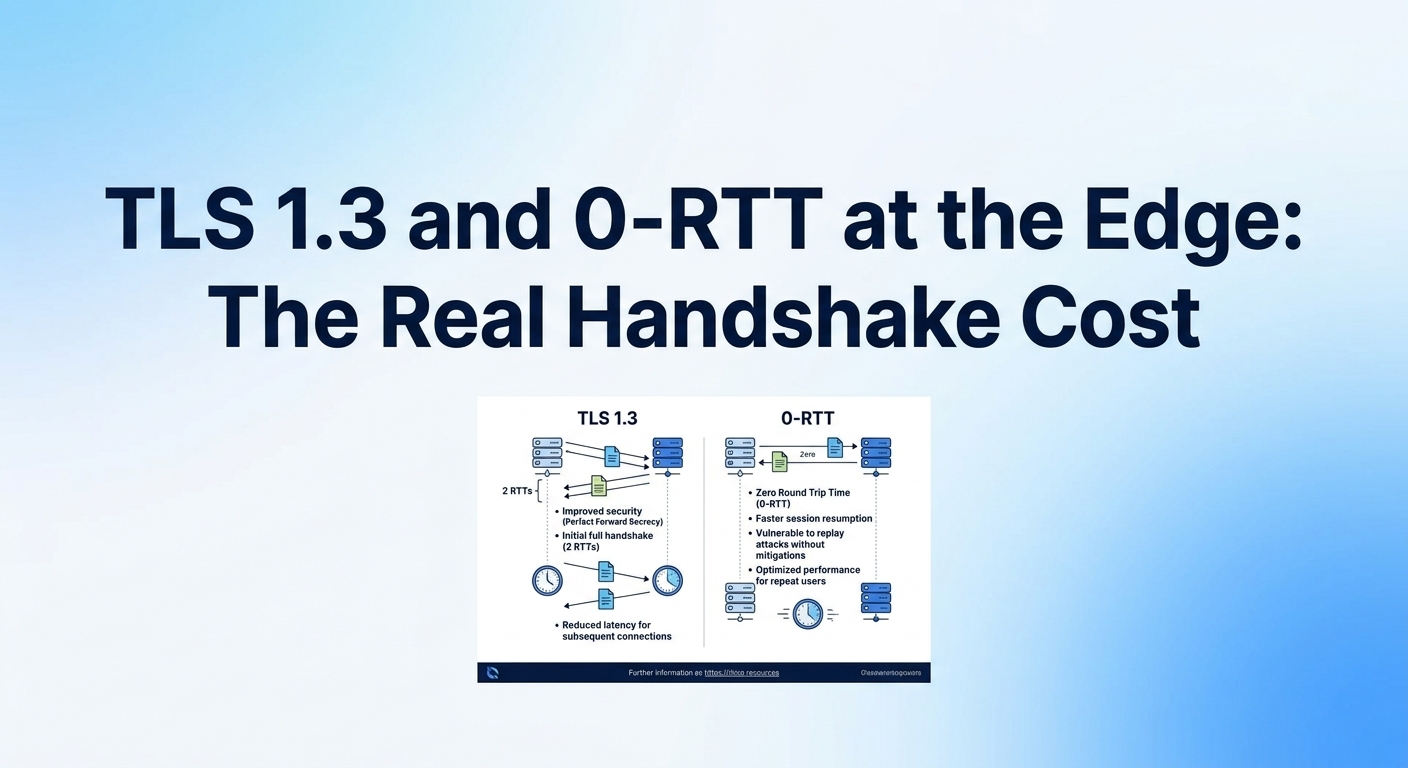
TLS 1.3 and 0-RTT at the Edge: The Real Handshake Cost
TLS 1.3 removes exactly one round trip from a full handshake compared with TLS 1.2, and 0-RTT removes one more on ...

Imagine a scenario where every millisecond counts and your digital content must reach users around the globe seamlessly. In today’s fast-paced online landscape, mastering the fundamentals of CloudFront CDN Essentials: Setup, Caching and Edge Functions is more than a technical exercise—it’s a competitive advantage. This in-depth guide unveils the comprehensive process required to deploy a robust CDN infrastructure, exploring intricate setup procedures, industry-leading caching strategies, and the transformative potential of edge functions. Whether you’re refining an existing system or embarking on a brand-new deployment, this article is designed to empower IT architects, developers, and business strategists with the insight needed to drive performance and scalability to new heights.\n\n
Before you dive into the hands-on technical setup of CloudFront, it’s essential to understand the broader context. The digital ecosystem is evolving at a breakneck pace, and placing content physically closer to your user is the secret behind reducing latency and elevating user experiences. Here, we explore the initial planning, assessment, and configuration steps that form the backbone of an effective CloudFront deployment.\n\n
The first step in building a high-performance CDN environment is a thorough evaluation of your existing infrastructure and traffic demands. Consider these crucial factors:
Research from leading industry analysts indicates that companies that implement these assessments early on can reduce latency by up to 40% while simultaneously cutting infrastructure costs.\n\n
Once you’ve laid the conceptual groundwork, it’s time to translate these plans into operational reality. CloudFront is integrated deeply within AWS, offering a streamlined setup process that ties in seamlessly with other AWS services. Here’s a methodical breakdown of the steps:
Each of these steps contributes to a secure, high-performance CDN configuration that is adaptable to varying business needs. With a keen focus on these details, organizations are better positioned to scale their operations and deliver content with unprecedented speed.\n\n
Caching is at the heart of CDN performance. When executed correctly, caching substantially reduces load times and minimizes the strain on your origin servers. In this section, we delve into the caching mechanisms that empower CloudFront and examine strategic techniques to improve delivery efficiency.\n\n
CloudFront employs a multi-layer caching approach that helps serve content rapidly to end-users:
Leveraging these layers effectively can significantly enhance performance, with studies showing that optimal caching can improve response times by over 50% in high-traffic environments.\n\n
Setting the right cache policies is fundamental in achieving a balance between speed and content freshness. CloudFront provides several key parameters:
Besides these settings, CloudFront supports cache invalidation commands that allow you to remove outdated or incorrect content from the caches manually. In mission-critical setups, especially within financial and e-commerce sectors, adjusting these values based on performance data has proven to be an effective strategy to navigate between strict data freshness and high availability.\n\n
To meet today’s complex demands, advanced caching strategies go beyond static configurations:
Research published in leading technical journals reveals that predictive caching strategies can reduce server load by an average of 30% in dynamic content environments, reinforcing their importance in next-generation digital architectures.\n\n
The evolution from traditional CDNs to intelligent, edge-compute-enabled solutions is a game changer. CloudFront’s integration with Lambda@Edge brings compute capabilities directly into the CDN’s edge, allowing for real-time code execution at locations closest to your users. This opens up a wealth of opportunities for personalization, security, and performance optimization.\n\n
\n\nEdge functions allow you to intercept and manipulate requests and responses as they pass through CloudFront. They empower you to execute code that can:
\n\nRecent industry research indicates that deploying edge functions can lead to performance improvements ranging from 15%-20% by cutting down on the time required for back-and-forth requests with the origin server.\n\n
\n\nLambda@Edge enables you to run custom code at AWS edge locations without provisioning any server infrastructure. The process entails:
\n\nThis step-by-step process is supported by extensive documentation available through AWS. Moreover, developers are encouraged to continuously test in real-world conditions to fine-tune their configurations.\n\n
\n\nEdge functions are rapidly being adopted in a variety of industries. The ability to execute code at the periphery of the network has significant implications, including:
\n\nSuch capabilities are critical in high-stakes areas like financial services, where even minor delays can have significant impacts. In practice, these implementations have led to smoother user experiences and bolstered application security overall.\n\n
\n\nDeploying a CDN such as CloudFront brings about a host of performance benefits, but it is equally important to be mindful of cost implications. Optimizing the interplay between speed and expense is key for large-scale operations. Let’s explore the primary factors influencing cost efficiency and how to monitor performance effectively.\n\n
\n\nSeveral metrics influence the overall cost when using CloudFront:
\n\nEntities that have optimized these configurations have reported reductions in data transfer costs by as much as 35%. Balancing these factors is integral to long-term cost efficiency and ensuring that the CDN scales in tandem with your business needs.\n\n
\n\nIt is essential to continually benchmark your CDN implementation against performance targets. Metrics to keep an eye on include:
\n\nA sample performance comparison table highlights these differences:
\n\n\n \n \n \n \n \n \n \n \n \n \n \n \n \n \n \n \n \n \n \n \n \n \n \n \n| Metric | CloudFront | Competitor A | Competitor B |
|---|---|---|---|
| Average Latency | 30ms | 45ms | 50ms |
| Cache Hit Ratio | 85% | 75% | 70% |
| Scalability | High | Medium | Medium |
Such comparative insights, supported by independent performance studies, provide a clear roadmap for achieving both cost efficiency and superior performance.\n\n
\n\nIn today’s omnichannel environment, it is increasingly common to pair CloudFront with other CDN solutions to form a hybrid architecture—leveraging the strengths of multiple platforms to create a resilient, high-availability network.\n\n
\n\nAdopting a hybrid CDN approach means combining the global reach of CloudFront with niche capabilities offered by specialized providers. Benefits of such integration include:
\n\nAligning these hybrid strategies with industry-specific requirements is key. Media companies, for instance, benefit from ultra-low latency for streaming services, while SaaS providers require rapid and secure data delivery. Maintaining an agile approach based on performance data from each CDN allows continuous refinement of the content delivery strategy.\n\n
\n\nDifferent industries have unique needs when it comes to content delivery:
\n\nNotably, those in the gaming sector have seen transformative benefits by integrating specialized solutions. In fact, BlazingCDN offers tailored CDN solutions that enhance performance and reduce latency for game companies by delivering content with pinpoint precision.\n\n
\n\nThe world of CDN technology is on the cusp of a transformative era. Innovations in AI, machine learning, and ultra-low latency networks are set to redefine how content is delivered. Key future trends include:
\n\nThese emerging trends, backed by data from leading technology research firms, highlight the importance of staying adaptable and integrating forward-thinking solutions into your CDN strategy.\n\n
\n\nDeploying a CDN is not a one-time setup—it requires ongoing monitoring and fine-tuning to maintain peak performance over time. A proactive approach involves:
\n\nTechnological reviews and whitepapers, including those from AWS, consistently emphasize that continuous monitoring not only stabilizes performance but also significantly reduces the risk of costly downtime events.\n\n
\n\nIn parallel with performance optimization, security remains a paramount concern. CloudFront provides built-in security features, yet a multi-layered approach is vital in today’s threat landscape. Consider incorporating the following measures:
\n\nEmpirical data from cybersecurity research consistently validates that layered security approaches reduce vulnerability exposure significantly, reinforcing the need for comprehensive defense strategies.\n\n
\n\nOptimizing edge functions is the next frontier in maximizing the benefits of CloudFront. Developers can further refine these functions by:
\n\nCase studies from high-traffic sectors consistently find that refined edge function performance can reduce overall content processing time by up to 18%, amplifying the speed and responsiveness of applications.\n\n
\n\nIntegrating CloudFront’s advanced setup, caching techniques, and dynamic edge functions creates a digital ecosystem that is both robust and agile. This architecture is invaluable for industries where performance, security, and real-time response are critical, such as e-commerce, financial services, media, and SaaS. By strategically leveraging these tools, businesses can not only optimize current operations but also future-proof their infrastructure against upcoming technological demands.\n\n
\n\nThis comprehensive exploration of CloudFront CDN Essentials: Setup, Caching and Edge Functions is designed to arm you with deep insights and practical strategies. Now it’s your turn to take action—share your thoughts, ask questions, or post your experiences with modern CDN implementations. Join the conversation by leaving a comment below, share this article on your social channels, and explore further opportunities to fine-tune your digital infrastructure. Your engagement is not just appreciated—it’s the first step towards transforming your content delivery strategy for a high-performance future!

Heavy traffic.
Light bill.
The CDN for video and large traffic
Learn
TLS 1.3 removes exactly one round trip from a full handshake compared with TLS 1.2, and 0-RTT removes one more on ...
Learn
Evaluated February 2026. Two mechanisms decide which edge serves a request, and they fail on completely different ...

Security
Cloudflare Rate Limiting Pricing 2026: Plans, Rules, Real Costs Cloudflare rate limiting pricing has one detail that ...