
Learn
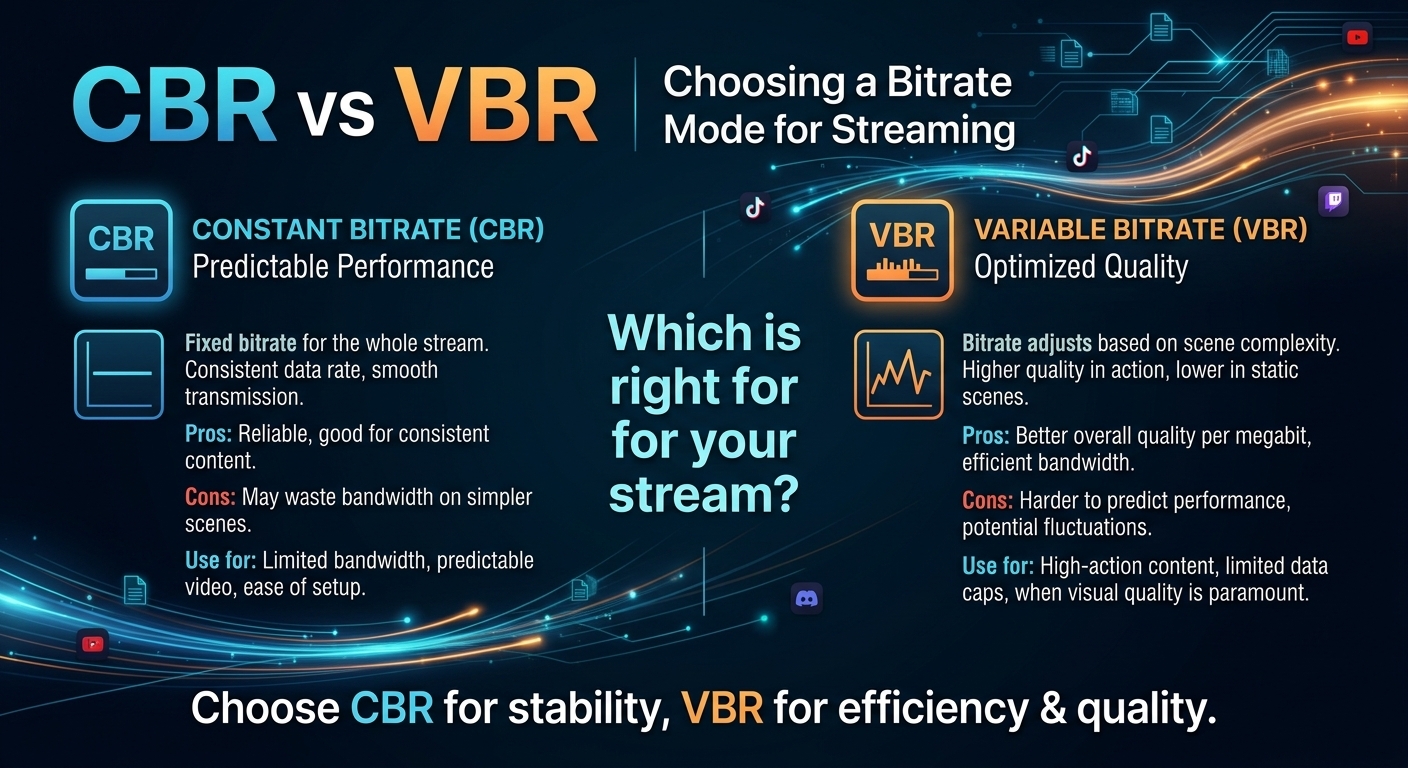
CBR vs VBR: Choosing a Bitrate Mode for Streaming
For most on-demand video, capped variable bitrate (VBR) wins the cbr vs vbr decision: it spends bits where the picture ...
A single Cloudflare Workers KV read now costs $0.50 per million operations under the standard plan — ten times what it cost when Workers launched. That one datapoint captures the trajectory of Cloudflare pricing plans in 2026: the free tier is still generous, the Pro and Business tiers are unchanged at $20 and $200 per month respectively, but the constellation of usage-based products around them has grown complex enough that your real monthly bill depends on decisions most teams never model upfront. This article gives you a concrete framework: exact pricing tiers as of Q2 2026, a workload-profile decision matrix the current top-10 results skip entirely, and the cost thresholds where alternative CDNs start saving you real money.
Cloudflare's four published tiers have remained structurally identical since 2020. What changed in 2025 and into 2026 is the feature gating and the expansion of metered add-ons.
| Tier | Monthly Cost | Key Inclusions (Q2 2026) | Primary Gap |
|---|---|---|---|
| Free | $0 | Unmetered DDoS mitigation, universal SSL, basic WAF managed rules, 100K Workers requests/day | No image optimization, 5 page rules, no custom WAF rules |
| Pro | $20/zone | Image/Polish optimization, mobile redirect, 20 page rules, enhanced WAF rulesets | No custom certificates, no advanced bot management |
| Business | $200/zone | Custom SSL certificates, advanced WAF with anomaly detection, 50 page rules, SLA (100% uptime) | No dedicated account team, no network prioritization |
| Enterprise | Custom (typically $5K+/mo) | Named account engineer, network prioritization, custom caching logic, China Network option, negotiated SLA | Annual commitment required, pricing opaque |
The Cloudflare business plan pricing has not changed since 2018 — still $200 per zone per month. What has changed is that capabilities previously included are now gated behind separately metered products. Bot Management, for instance, was partially included at the Business tier in 2023; as of 2026, the full Bot Management Enterprise add-on bills separately based on request volume.
How BlazingCDN compares: BlazingCDN publishes one rate for the US, Europe and Asia, from $5 per TB down to $2.50 per TB, so 100 TB of delivery costs $415 a month (as of October 2026) with no request fees. The plan-by-plan breakdown is on the BlazingCDN vs Cloudflare page.
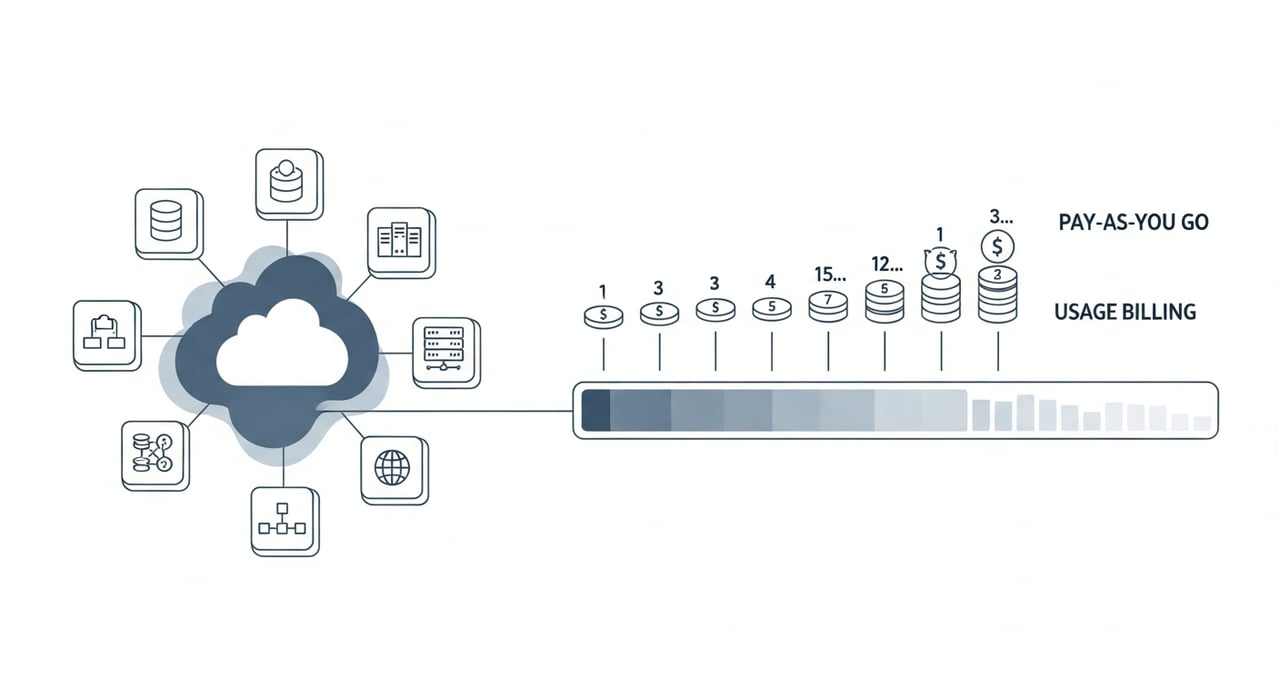
Cloudflare's pay-as-you-go pricing applies not to the core proxy tiers above but to the growing list of developer and security products billed by consumption. Understanding how does Cloudflare pay-as-you-go pricing work requires mapping each product to its billing metric:
| Product | Billing Unit | Free Allowance | Pay-As-You-Go Rate (Q2 2026) |
|---|---|---|---|
| Workers (Standard) | Requests + CPU time | 10M requests/mo, 30M CPU-ms | $0.30/million requests + $0.02/million CPU-ms (on $5/mo plan) |
| Workers KV | Reads / writes / storage | 100K reads/day (free), 1M reads/mo (paid) | $0.50/M reads, $5.00/M writes, $0.50/GB-mo stored |
| R2 Storage | Storage + operations | 10 GB storage, 1M Class A ops, 10M Class B ops | $0.015/GB-mo, $4.50/M Class A, $0.36/M Class B |
| Images | Stored images + deliveries | None | $5/100K stored images, $1/100K unique transformations |
| Stream | Minutes stored + delivered | None | $5/1K min stored, $1/1K min delivered |
| Zero Trust (Access + Gateway) | Seats | 50 seats free | $7/user/mo (PAYG), Enterprise negotiated |
The nuance that catches teams off guard: Cloudflare usage-based billing aggregates across your account, not per zone. A staging environment running Workers against the same KV namespace as production contributes to the same metered bucket. There is no per-environment isolation on billing unless you maintain separate accounts.
Cloudflare Zero Trust pricing expanded in late 2025 with the general availability of MASQUE-based device tunneling and the integration of Digital Experience Monitoring (DEX) into the Gateway product. As of 2026, the three tiers are:
The jump from 50 free seats to paid is steep for companies with 51–100 employees because you pay for every seat, not just the overage. At 75 users on the standard tier, that is $525/month — meaningful for an SMB whose CDN bill might only be $200.
Is Cloudflare pay-as-you-go worth it for small business? The answer depends on your traffic shape and product mix. Here are the thresholds that matter:
The structural advantage of Cloudflare's proxy plans is unmetered bandwidth. For pure CDN delivery — static assets, HTML at the edge — the $200 Business tier is effectively unlimited. The moment you start consuming compute, storage, or security products, Cloudflare's bill starts behaving like a cloud bill: variable, sometimes surprising, and worth modeling quarterly.
Cloudflare's billing dashboard improved in Q1 2026 with the addition of per-product spend breakdowns and projected monthly spend estimates. Practically, here is what a monitoring setup should include:
This matrix synthesizes the cost breakdowns above into a decision framework indexed by workload type. This is the part the current page-1 articles do not give you.
| Workload Profile | Recommended Tier | Estimated Monthly Cost (2026) | Key Consideration |
|---|---|---|---|
| Static marketing site, <50 GB/mo | Free | $0 | Limited page rules; no image optimization |
| SaaS app, 5–50 TB/mo, Workers for auth/routing | Pro + Workers Paid ($5) | $25–$75 | Watch KV read costs if session state lives in KV |
| E-commerce, custom SSL, bot protection needed | Business | $200–$500 | Bot Management add-on can double the cost |
| Video platform, 100+ TB/mo delivery | Enterprise (contract) or dedicated CDN | $5,000+ on Cloudflare | Stream pricing at $1/1K min delivered adds up fast; evaluate pure-play CDNs |
| Distributed workforce, 200 seats, ZTNA + DLP | Enterprise Zero Trust | $2,000–$3,000 | DEX monitoring adds incremental per-seat cost |
For the video platform profile in particular, the math shifts dramatically when you compare Cloudflare Stream at $1 per thousand minutes delivered against a dedicated CDN that charges by the gigabyte. A 1080p stream at 5 Mbps consumes roughly 2.25 GB per hour. At 100 TB/month, a provider like BlazingCDN charges about $415/month (as of October 2026), versus roughly $8,500 at CloudFront's $0.085/GB standard rate. For media-heavy or large-scale delivery, the per-TB economics matter more than platform convenience.
Three comparisons worth quantifying as of Q2 2026:
Cloudflare's competitive advantage is not bandwidth pricing — it is the integrated platform. If you need CDN + WAF + Workers + Zero Trust under one control plane, the premium is justified. If your primary cost driver is bandwidth and your security stack is already handled by dedicated tooling, you are paying for platform integration you may not need.
As of 2026, Workers, Workers KV, R2, Durable Objects, Images, Stream, Queues, D1, and the paid tiers of Zero Trust (Access, Gateway, CASB, DLP) all bill on a usage basis. The core proxy tiers (Free, Pro, Business) do not meter bandwidth, but metered products layered on top of them are billed independently per account.
For businesses consuming fewer than 10 million Workers requests per month and fewer than 50 Zero Trust seats, pay-as-you-go is almost always cheaper than an Enterprise contract. The break-even typically occurs around $1,500–$2,000/month in combined metered spend, at which point negotiated contract discounts of 20–40% become worthwhile.
Use the Billing API endpoints to pull daily spend data into your cost-tracking system. Enable Cloudflare's native budget alerts at 50% and 80% thresholds. For Workers specifically, the Analytics Engine exposes per-script CPU-ms and request counts that let you attribute cost to individual scripts before the billing cycle closes.
No. Proxy bandwidth on Pro ($20/zone) and Business ($200/zone) plans is unmetered. This is one of Cloudflare's strongest differentiators versus CloudFront or generic CDN providers that bill per GB. However, bandwidth consumed via Stream, Images, or R2 egress is metered separately from the proxy.
The tier prices themselves (Free, $20, $200) did not change. The main shifts were: Workers KV read pricing increased to $0.50/million; Zero Trust added DEX as a paid component within the Enterprise tier; R2 Class A operation pricing rose from $4.50 to $4.50/million (unchanged, but free allowances were reduced on free accounts from 1M to 100K Class A ops). The biggest practical impact is the reduced free-tier allowances pushing light users onto the $5/month paid Workers plan sooner.
Pull your last three months of Cloudflare billing data — or project it if you are evaluating a migration. Map each line item to the product tables above. If more than 40% of your spend is bandwidth or storage delivery rather than compute or security features, run a parallel cost model against a bandwidth-optimized CDN. The difference at 50 TB/month can be the annual salary of a junior engineer. That is worth a spreadsheet and a week of proof-of-concept traffic splitting.

Heavy traffic.
Light bill.
The CDN for video and large traffic
Learn
For most on-demand video, capped variable bitrate (VBR) wins the cbr vs vbr decision: it spends bits where the picture ...
Compare
As of October 2026, the Azure service that matches Amazon CloudFront is Azure Front Door Standard or Premium: Microsoft ...

Learn
In answer to what is a keyframe: a keyframe, or I-frame, is a video frame encoded without reference to any other frame, ...