
Learn
Lossy vs Lossless Compression: Images, Video and Audio
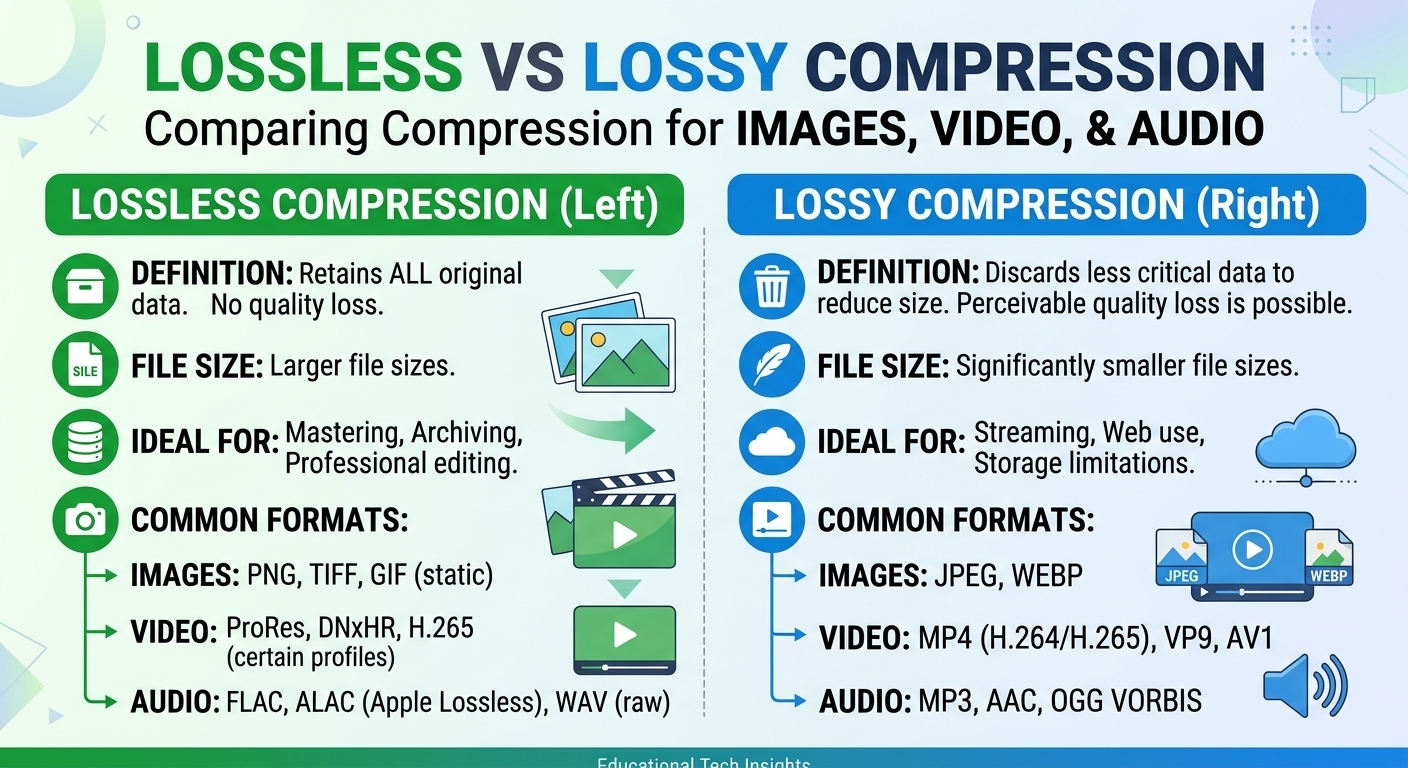
Lossy vs lossless compression comes down to one trade: lossless compression rebuilds every original bit and typically ...
A 100 GB build pulled by one million players in launch week moves roughly 100 PB of egress. At hyperscaler list rates near $0.085 per GB that line item is about $8.5M; at high-volume game download CDN rates of $2.50 to $5 per TB it is $250,000 to $500,000. That is a 17x to 34x spread on the same bytes ($8.5M versus $500,000 or $250,000; estimates, list pricing, no commit discounts applied). Launcher traffic is usually the single largest delivery cost a studio or platform carries, and the decision that sets it gets made in contract negotiation months before launch, not in the war room on day one.
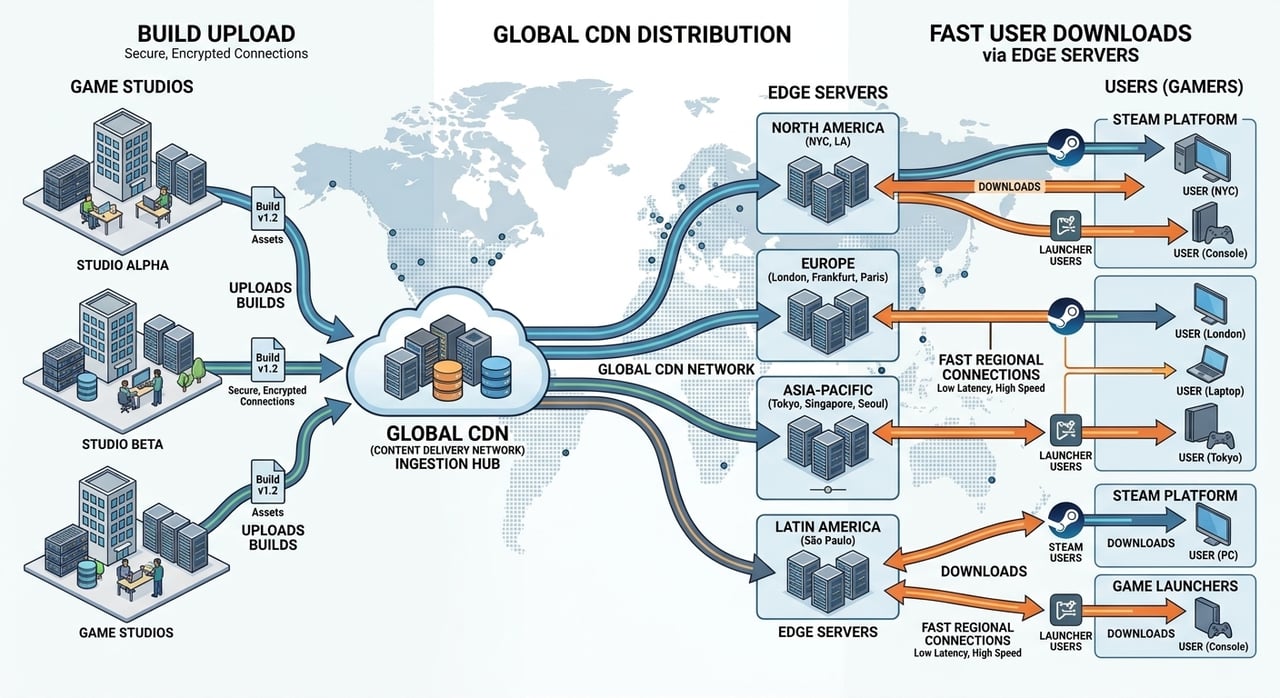
Game distribution is not video streaming with bigger files. A video session is a controlled bitrate over time; a launcher download is an uncapped request for every byte of an immutable build, as fast as the client's link allows, from every player simultaneously in the first hours after unlock.
Assume a 100 GB build, one million day-one installs, 60% of them completing inside the first 48 hours. Bytes: 100 PB total, 60 PB in the launch window. Average rate across those 48 hours is about 2.8 Tbps. Real traffic is not flat: regional unlock times and evening peaks concentrate 3–5x the average into short bursts, so plan capacity for 8–14 Tbps peaks.
Per player, a 100 GB build at 100 Mbps takes about 2.2 hours of sustained transfer. That is the number your support team feels. Anything that degrades throughput by 20% adds half an hour to every install and turns into refund requests.
Origins rarely fail on bandwidth. They fail on request concurrency. A 100 GB build chunked at 1 MB is roughly 100,000 distinct objects. If 200 independent cache groups all miss simultaneously at unlock, that is up to 20 million origin requests inside minutes, plus the connection and TLS handshake storm behind them.
Two controls collapse that number. Request collapsing at the edge folds concurrent misses for the same chunk into one upstream fetch. A tiered origin shield reduces the fan-out from every cache group to a handful of mid-tier nodes, cutting origin fill from a theoretical 20 TB to roughly the size of the build itself. Prewarming the build into edge storage before unlock removes the cold window entirely, which is why platforms preload encrypted builds days ahead.
The Steam CDN approach — content-addressed depot chunks, aggressive delta patching, encrypted preload before release — exists to convert an unpredictable bandwidth problem into a cacheable one. Two consequences matter to a budget owner. First, chunk-level immutability means near-perfect cacheability, so you should refuse to pay a premium for "dynamic acceleration" features you will never use in game launcher delivery. Second, delta patching is the cheapest optimization available: a binary-diff patch pipeline that cuts an average 20 GB patch to 4 GB removes 80% of the recurring egress bill for the entire live-ops life of the title.
| Criterion | Threshold that matters | What it buys or risks |
|---|---|---|
| Effective price per TB | Under $5/TB below 1 PB/month; under $3/TB above 1 PB/month | Dominates every other cost. A 2x price difference at 100 PB is millions. |
| Burst headroom vs. commitment | Peak month within 10x of average month with no overage penalty clause | Launch months are 5–15x a live-ops month. Flat-rate transit billed at 95th percentile punishes this shape hardest. |
| Edge storage medium and retention | NVMe-backed cache able to hold 8–12 TB hot set per region | Determines whether back-catalog titles hit 95%+ or thrash to origin. |
| Prewarm and purge control | API-driven cache fill completing 100 GB per region in under 6 hours | Eliminates the cold-start origin spike that causes most day-one incidents. |
| Range request and resume behavior | Correct partial-content handling with cache-aware slicing | Broken resume on a 100 GB transfer means restarted downloads and duplicated egress you pay for twice. |
| Switching cost | Onboarding measured in hours, no proprietary manifest rewrite | Preserves negotiating leverage at every renewal. |
Price per TB and burst-friendly billing decide the invoice; prewarm control and NVMe edge storage decide whether launch day is an incident.
| Delivery model | Effective $/TB | Time to production | Main exposure |
|---|---|---|---|
| High-volume pay-as-you-go CDN | $2.50-$5 | Hours to days | Single-vendor dependency |
| Hyperscaler CDN at list rates | $50–$85 list; $10–$30 with large commits | Days | Commit shortfall penalties |
| Multi-CDN with steering | $3–$8 blended, plus steering and observability | 4–8 weeks | Operational complexity, split hit ratios |
| Self-built caches on transit and peering | $0.50–$2 marginal, plus capex and 2–4 engineers | 6–12 months | Only pays back above sustained multi-PB months |
Below roughly 5 PB per month, buying pay-as-you-go CDN capacity beats building your own cache fleet on total cost once engineering headcount is priced honestly.
As of October 2026, BlazingCDN publishes pay-as-you-go pricing for this workload: starting at $5 per TB, down to $2.50 per TB at volume, with one rate for US, Europe and Asia and no long-term contract. Hyperscaler list rates sit near $85 per TB. For a studio shipping 100 PB in a launch year, that gap is the difference between a six-figure and a multi-million delivery bill.
BlazingCDN sits in the cost-at-scale league alongside Bunny.net, CDN77, Gcore and Medianova rather than competing on the edge-compute breadth of Amazon CloudFront or Fastly, and it runs NVMe SSD edge storage, with onboarding typically measured in about an hour. The honest limitation: if your roadmap depends on running custom logic at the edge, a compute-first provider fits better. For pure immutable-chunk game download CDN traffic, that capability is not what you are paying for. Studios sizing this properly usually start from the game download CDN delivery options for game companies and model their own launch curve against it.
The structural risk in large file delivery contracts is the annual commit. Commits priced against a launch year look cheap and then strand you in a live-ops year at 30% of forecast volume, paying for bytes you never shipped. Prefer pay-as-you-go or a commit sized to your trough, not your peak.
Technical lock-in is low here, which is your leverage. Immutable chunk URLs with long max-age headers and a signed-URL scheme you control mean a second provider can be validated in a staging channel and promoted with a DNS change. Keep the manifest generation in your own build pipeline, never in vendor-specific transformation rules, and every renewal becomes a real negotiation.
High-volume providers price game download delivery between $2.50 and $5 per TB in 2026, while hyperscaler CDN list rates run $50–$85 per TB before commit discounts. BlazingCDN pricing runs from $5 per TB down to $2.50 per TB at volume (as of October 2026). For a 100 PB launch year, that spread is the difference between a six-figure bill and several million dollars.
Origins break on request concurrency, not bandwidth. A 100 GB build split into 1 MB chunks is about 100,000 objects, and simultaneous misses across hundreds of cache groups can generate tens of millions of upstream requests in minutes. Request collapsing, a tiered origin shield, and prewarming the build before unlock remove almost all of that load.
Yes, and it is common above 1 PB per month. Because build chunks are immutable and content-addressed, traffic can be split by DNS, by client-side manifest weighting, or per region. The cost is operational: two sets of hit-ratio metrics, two purge paths, and diluted volume tiers on each contract.
Peer-to-peer can offload a meaningful share of bytes in dense player populations, but the savings are uneven. Offload collapses in regions with asymmetric residential uplinks or carrier-grade NAT, and client-side integration plus support burden is real engineering work. Most teams treat it as a supplement to CDN delivery, never a replacement.
Start the encrypted preload 24–72 hours before unlock for a 100 GB build. That gives edge caches time to fill across all regions at low priority, keeps cache-fill traffic out of the peak window, and leaves room to repeat the fill if a day-one patch replaces chunks close to release.
Take your actual numbers: install size, expected day-one installs, patch cadence, and average patch size. Multiply them out for a full live-ops year, then price that volume against your current contract and against $3 per TB. If the delta is larger than one engineer's annual cost, the delivery contract is your highest-leverage infrastructure decision this quarter. Then check two metrics you may not be tracking: edge hit ratio on back-catalog titles, and origin request rate during the first hour of your last launch. Those two numbers tell you whether your next launch scales or pages you.

Heavy traffic.
Light bill.
The CDN for video and large traffic
Learn
Lossy vs lossless compression comes down to one trade: lossless compression rebuilds every original bit and typically ...
Pricing - Pricing & Costs
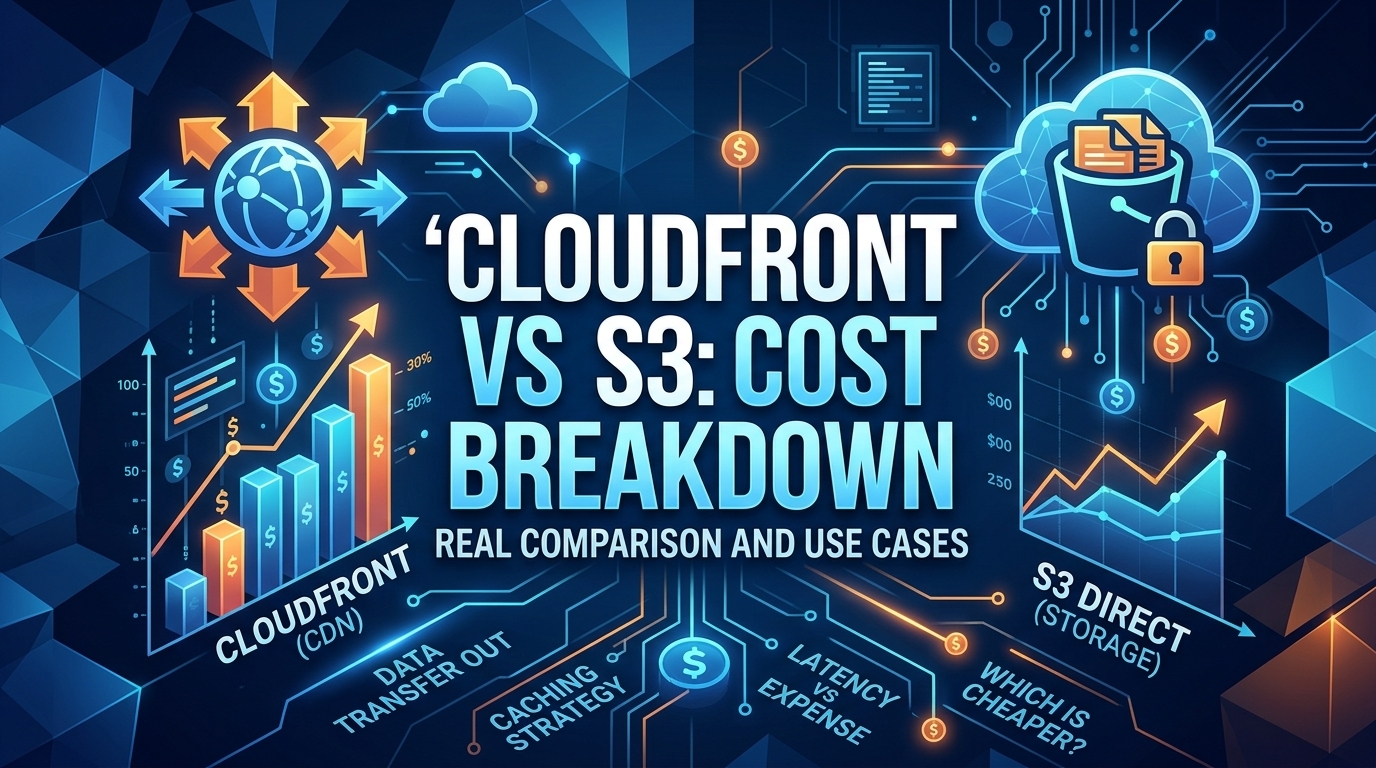
The CloudFront vs S3 decision depends more on object size than on traffic volume. At a 500 KB average response, 100 TB ...
Learn
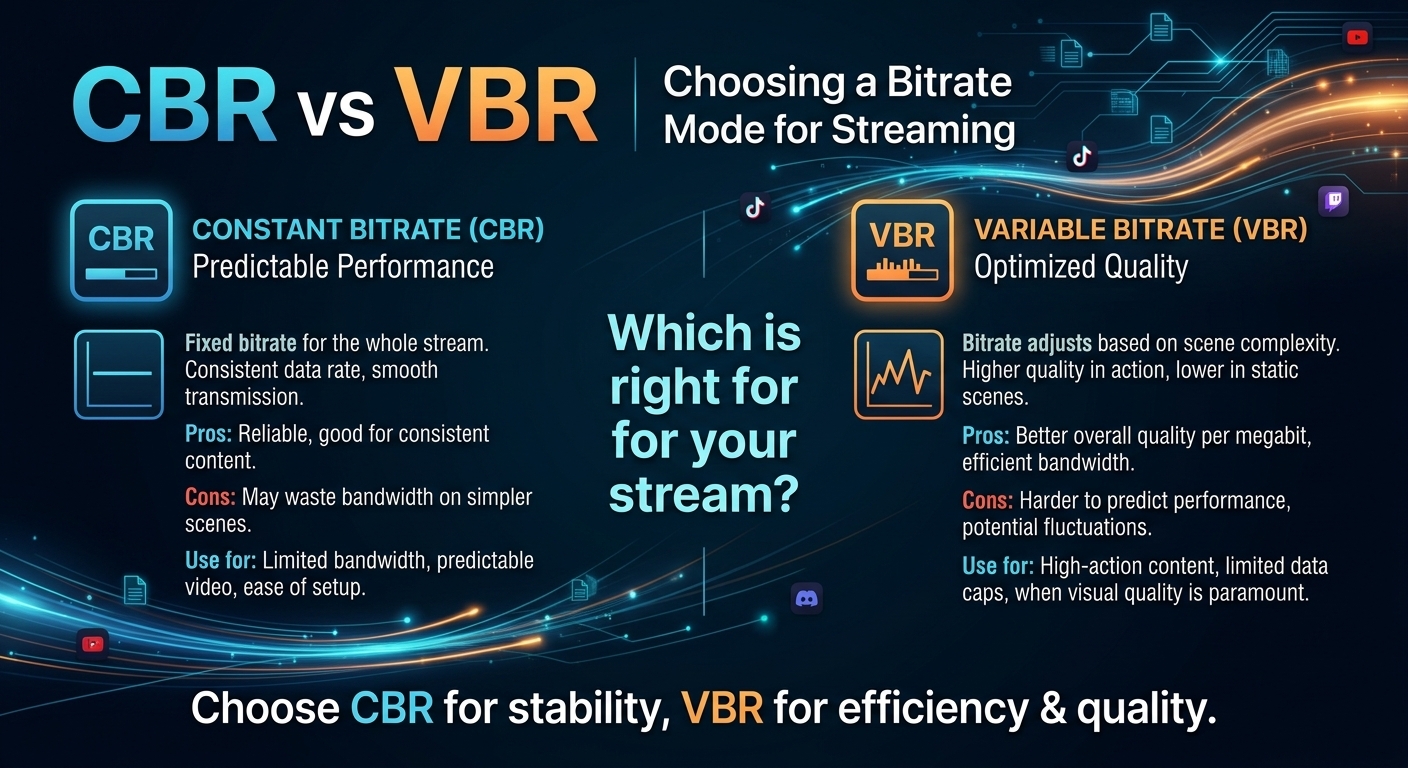
For most on-demand video, capped variable bitrate (VBR) wins the cbr vs vbr decision: it spends bits where the picture ...