

Learn
How a Multi-CDN Strategy Saved Us from Costly Downtime
In a recent survey, 60% of enterprises reported that a single hour of critical-application downtime costs them at least ...
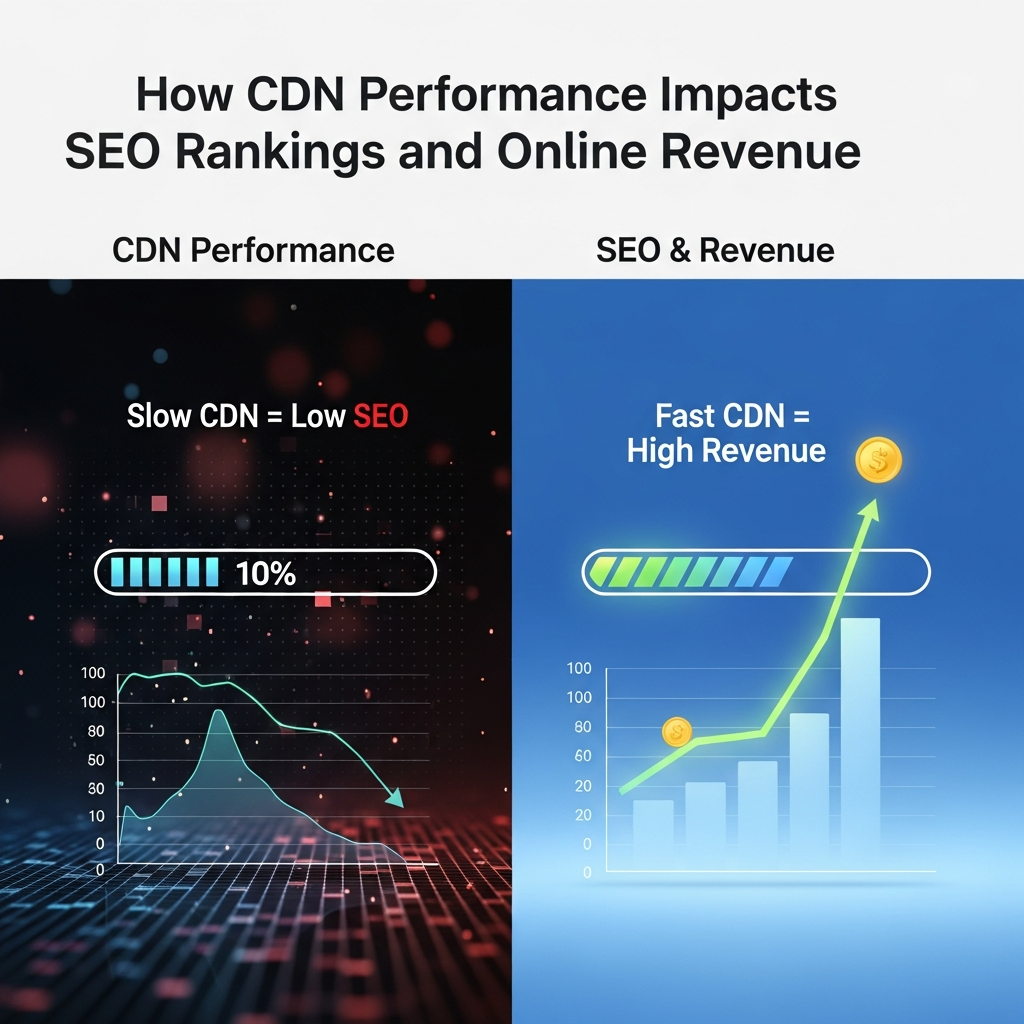
When Deloitte analyzed billions of user sessions, it found that improving mobile site speed by just 0.1 seconds increased conversion rates by up to 8.4% for retail and 10.1% for travel businesses — a tiny performance gain that translated directly into millions in extra revenue. Now combine that with Google’s public confirmation that page speed and Core Web Vitals are ranking signals, and a simple reality emerges: your CDN performance is no longer just an infrastructure concern; it’s a direct driver of SEO rankings and online revenue.
In other words, if your CDN is slow, inconsistent, or misconfigured, you’re quietly paying twice — once in lost organic traffic, and again in abandoned carts, lower ad ROI, and churn. If it’s fast and well-tuned, it becomes one of the most profitable “SEO levers” you can pull without rewriting a single line of content.
This article walks through how CDN performance shapes search visibility, user experience, and revenue across e‑commerce, media, gaming, and SaaS — and how to turn your CDN into a measurable growth engine instead of a silent bottleneck.
As you read, keep one question in mind: if Google crawled and ranked your site based only on its slowest user experiences, not its average, where would you stand today?
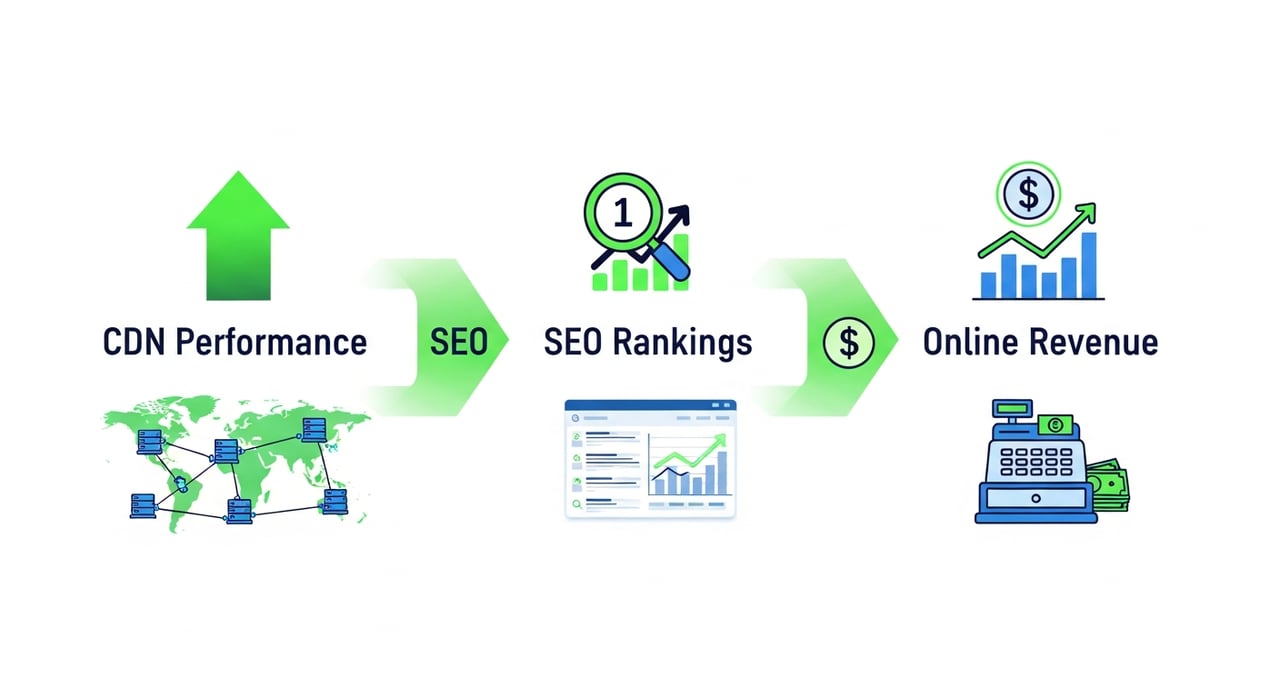
Before we dive into CDNs specifically, it’s worth unpacking why Google, Bing, and other search engines care so deeply about performance in the first place. Search algorithms increasingly reward sites that feel “instant” and reliable from a user’s perspective — and punish those that don’t.
In this section, we’ll connect the dots between Core Web Vitals, crawl efficiency, and uptime — and show where your CDN fits into each layer.
Core Web Vitals are Google’s set of user-centric performance metrics. They currently focus on three areas:
Your CDN has outsized influence on at least two of these:
Suboptimal CDN routing, poor caching policies, or slow TLS handshakes inflate Time to First Byte (TTFB), which cascades into worse LCP and overall user experience. Conversely, a well-optimized CDN setup can shave hundreds of milliseconds off LCP across entire regions without changing your application code.
If Google’s CrUX (Chrome User Experience Report) is sampling real users who hit your slowest CDN edges or uncached assets, what story is it telling about your brand’s performance?
SEO conversations rarely mention uptime beyond “we monitor it,” but search engines care deeply about whether your site is consistently available and error-free:
A resilient CDN with intelligent failover and robust health checking dramatically reduces origin overload, shields search crawlers from intermittent failures, and keeps pages available even under peak demand. That leads to fewer crawl errors, more complete indexation, and greater confidence in your site’s reliability.
How many times in the last year did your site experience spikes or glitches that your CDN could have smoothed out — and what did those moments look like through Googlebot’s eyes?
While Google is cautious about confirming which user metrics it uses directly, there’s strong correlation between fast pages, lower bounce rates, and higher rankings. Multiple studies have shown that:
Fast, stable delivery via a well-tuned CDN keeps users on-site longer, encourages deeper exploration, and improves the behavioral signals that search engines interpret as “this page satisfies intent.” Those signals synergize with your Core Web Vitals and uptime story to influence SEO over months and years.
If you plotted your organic traffic against your performance metrics, would you see the same pattern many enterprises see — that every technical speed gain unlocks a fresh plateau of SEO growth?
Now that we’ve framed the “why,” let’s unpack the “how.” In this section, we’ll walk from raw CDN behavior — latency, cache hit ratios, routing, TLS overhead — to the SEO outcomes you care about: higher rankings, more impressions, and better click-through rates.
Time to First Byte (TTFB) measures how quickly a browser receives the first byte of a response after requesting a page. While it’s not a Core Web Vital by name, it’s a foundational technical metric that influences all others.
A high TTFB usually points to one or more problems:
From an SEO standpoint, low TTFB is beneficial because:
A modern, optimized CDN minimizes TTFB globally by terminating TLS close to users, aggressively caching static and semi-static content, and routing requests through high-performance links. When TTFB drops from, say, 600 ms to 80–120 ms across key regions, the improvement shows up directly in both field data (CrUX) and lab tests.
If you sort your Search Console performance reports by country and device, do your poorest TTFB regions match your weakest organic visibility?
Since Google’s mobile-first indexing rollout, your mobile performance — not desktop — is the primary reference for ranking. Mobile users are more sensitive to latency due to weaker connections and potentially higher network variability.
CDN performance is crucial here because it determines how quickly large assets like hero images, fonts, and key JavaScript bundles arrive on constrained mobile networks. Specific CDN-driven optimizations that boost SEO-relevant metrics include:
Each millisecond removed from mobile resource loading increases the proportion of users who see your key content before they lose patience. That improved experience trickles into better Core Web Vitals scores, higher engagement, and stronger ranking potential.
What percentage of your organic traffic is now mobile, and are you tuning your CDN with that majority in mind or still optimizing as if desktop were the default?
Cache hit ratio describes how often content is served from CDN cache instead of hitting your origin. A high hit ratio means:
Typical SEO-impacting problems caused by poor caching include:
Improving cache policies — by normalizing query strings, setting sensible TTLs for static and semi-static pages, and selectively caching HTML for anonymous traffic — can dramatically increase hit ratios. That means more predictable speed for both real users and crawlers, which is exactly what search engines reward over the long term.
If you charted TTFB over time for your top landing pages, would you see a flat, well-optimized line — or a jagged pattern that reveals cache misses and origin overload?
To make the impact concrete, here’s a simplified comparison of common metrics before and after focused CDN optimization. These are representative patterns seen across large sites that introduce or tune their CDN; your exact numbers will differ, but the directional effects are consistent.
| Metric | Underperforming CDN / No CDN | Optimized CDN Configuration |
|---|---|---|
| Global TTFB (median) | 400–800 ms | 80–200 ms |
| LCP on mobile (field data) | 3.5–5.0 seconds | 1.8–2.8 seconds |
| Core Web Vitals “Good” URLs (Search Console) | 30–60% | 70–95% |
| Bounce rate on key landing pages | 45–60% | 25–40% |
| Crawl errors (5xx / timeout) | Thousands per month | Near zero |
Now imagine these improvements applied across your highest-value organic landing pages — category pages, product detail pages, content hubs, signup funnels. That’s the compound effect of strong CDN performance on SEO.
Which one of these rows — TTFB, LCP, bounce, or crawl errors — would move the SEO needle most for your business if you improved it in the next 90 days?
Once performance improvements start showing up in Core Web Vitals and rankings, the next question is simple: how much money is at stake? Multiple large-scale studies have quantified the financial impact of speed.
Deloitte’s “Milliseconds Make Millions” study found that a 0.1 second improvement in mobile site speed led to measurable uplifts in conversions and page views for major retail and travel brands, with revenue gains reaching the millions over a year.1 Separately, Google has shared data indicating that faster sites see lower abandonment rates and higher engagement across industries.2
What ties these findings together is not just app performance, but delivery performance — the part your CDN directly controls.
For online retailers, the relationship between performance and revenue is often brutally linear:
CDN-driven improvements in TTFB and asset delivery do three things simultaneously:
In practice, many enterprise retailers see that even a 5–10% improvement in conversion rate from speed optimizations can dwarf the cost of a high-performance CDN — especially if the CDN itself is cost-efficient.
If you look at your analytics for organic sessions that bounce within 3 seconds, how many lost purchases could be reclaimed by shaving 300–500 ms off LCP via better CDN performance?
For publishers, OTT platforms, and subscription-based media services, revenue depends more on engagement time and retention than on one-time purchases. Here, CDN performance determines:
Slow first loads and buffering don’t just hurt user satisfaction; they also reduce the inventory of ad impressions, cut average session length, and increase voluntary churn in subscription products. When those early experiences are driven by organic discovery, the link between CDN performance, SEO, and recurring revenue becomes especially tight.
If someone discovers your service via a high-intent Google query but experiences a stuttering first stream, how likely are they to come back — and how much did you pay in content and SEO investment to earn that one failed impression?
For online games, SaaS platforms, and B2B tools, the first interaction after signup is critical. Issues like:
all chip away at the perceived value of your product. A well-architected CDN setup that accelerates static assets, APIs, and onboarding content can materially increase trial-to-paid conversion rates and early retention — which, in subscription businesses, has enormous long-term revenue implications.
Among users who arrive from organic search and sign up for a demo or trial, how many quietly churn in the first session because your product “feels slow” before they even evaluate its features?
Knowing that CDN performance matters is one thing; figuring out what to fix is another. In this section, we’ll walk through a practical diagnostic approach that any SEO, product manager, or infrastructure lead can follow — without needing to become a network engineer.
Start by listing your top:
For each category, gather current performance metrics by device and country using:
The goal is to identify which critical pages are underperforming in LCP, INP, or TTFB — and where (e.g., “product pages are slow in Southeast Asia on mobile”).
Do your slowest Core Web Vitals scores cluster around particular templates or regions, suggesting CDN configuration issues rather than application problems?
Next, focus specifically on TTFB patterns using tools like:
Key questions to answer:
These patterns often reveal misaligned routing, insufficient caching, or origin saturation that your CDN could absorb with better configuration.
If you plotted TTFB by region as a heatmap, would you be comfortable showing it to your acquisition and SEO teams as a representation of how “fast” your brand is worldwide?
Work with your CDN logs or analytics to inspect:
Common issues include:
Every percentage point of cache hit ratio you gain translates into more stable performance for users and bots alike.
Are your most important SEO landing pages among the “coldest” in your CDN cache, or are they consistently hot and fast for every visitor?
Once you’ve identified where performance is lagging, your optimization efforts should prioritize changes that simultaneously improve user experience and search visibility. Here are practical, high-impact levers you can pull on the CDN layer.
Most organizations aggressively cache images, CSS, and JS — but are unnecessarily cautious with HTML, even for fully anonymous landing pages. Consider:
This often yields the fastest gains in TTFB and LCP for SEO-critical pages without any application changes.
What would happen to your average LCP if 80–90% of anonymous HTML requests never hit your origin again?
Large, unoptimized images are one of the biggest contributors to poor LCP and bandwidth waste. On the CDN, you can:
For video and rich media, prioritize fast start times and adaptive bitrates. A snappy first frame not only improves perceived performance but also signals to search engines that your video content is usable quickly, increasing watch time and engagement.
If you sorted your largest contentful paint elements in PageSpeed Insights, how many of them are heavyweight images that your CDN could transparently optimize?
Modern CDNs support protocols and configurations that reduce overhead and improve multiplexing:
While these are lower-level details, they add up to noticeably better performance on mobile and high-latency connections — the very environments where organic users often discover your site.
If you disabled HTTP/2 or HTTP/3 tomorrow, how much would your Core Web Vitals scores degrade across mobile users on weak connections?
Every unnecessary redirect adds latency and jeopardizes SEO equity. On the CDN, you can:
This helps preserve link equity, avoids redirect loops, and reduces the time to show users their intended content — all of which are SEO-friendly outcomes.
How many extra round trips are hidden in your redirect chains today that your CDN could collapse into a single, fast decision?
Technical SEO and CDN engineering often operate in silos, but the most successful organizations bridge that gap. Practical steps include:
This collaboration turns the CDN from a reactive cost center into a proactive growth tool directly tied to SEO and revenue outcomes.
When your SEO team last pushed a major content or site structure update, were CDN configurations updated in parallel — or left untouched out of habit?
CDN performance and CDN cost are often discussed separately, but in practice they’re intertwined. If your CDN pricing model penalizes you for traffic growth, you’ll hesitate to cache more, stream higher-quality media, or expand into new regions — all of which can limit your SEO and revenue potential.
That’s where modern providers like BlazingCDN are changing the equation. BlazingCDN is designed for enterprises and high-traffic businesses that need both top-tier speed and predictable economics. It delivers stability and fault tolerance on par with Amazon CloudFront, while staying significantly more cost-effective — with 100% uptime and a starting cost of just $4 per TB (that’s $0.004 per GB). For organizations moving hundreds of terabytes or more, those savings can be reinvested into content, product, and marketing rather than sunk into overpaying for bandwidth.
Because BlazingCDN is built with flexible configurations and enterprise customization in mind, it’s a strong fit for e‑commerce, media, gaming, and SaaS companies that need to scale quickly without compromising reliability. Forward-thinking brands that care about both performance and efficiency are already adopting this approach to keep SEO and user experience consistently fast as they grow globally.
To see how features like smart caching, edge rules, and performance analytics can be tailored to your stack, explore the BlazingCDN features overview and consider how a faster, more economical delivery layer could free up budget for growth initiatives.
If your SEO roadmap for the next 12 months includes new markets, richer media, or more dynamic experiences, are you confident your current CDN pricing and architecture will support that growth — or silently restrict it?
Different industries feel performance pain in different ways, but they all converge on the same outcome: slow pages lose rankings and revenue. Here are focused playbooks for some of the most CDN-dependent sectors.
For online stores, marketplace platforms, and D2C brands, SEO and performance are inseparable:
CDN recommendations for e‑commerce include:
With its combination of high performance, enterprise-grade reliability, and lower cost per GB, BlazingCDN is particularly attractive for retailers whose margins depend on squeezing maximum value from both organic and paid traffic, even at very high traffic volumes.
How much would your revenue change if your slowest 10% of product pages became as fast as your fastest 10% — and how quickly could a tuned CDN help close that gap?
News sites, magazines, blogs, and streaming platforms depend on search discovery and social sharing. In these environments:
A CDN tuned for media should prioritize:
BlazingCDN’s pricing and performance profile makes it a strong match for media companies that need to serve vast libraries of content globally while keeping delivery costs predictable and aligned with ad and subscription revenue.
If your next viral article or video took off organically, would your current CDN setup enhance that momentum — or buckle under the load and dilute the opportunity?
Online games and interactive experiences are extremely sensitive to latency and asset delivery speed. From an SEO and acquisition standpoint:
A performant CDN ensures:
BlazingCDN’s focus on reliable, low-latency delivery and predictable, low per-GB pricing helps gaming companies scale launches and live operations without being penalized for success in organic acquisition channels.
When your next major content update drops, will search-driven interest translate into smooth downloads — or support tickets and negative reviews about slow or stalled patches?
SaaS products and software vendors rely heavily on organic traffic for education, comparison, and evaluation. Key performance touchpoints include:
CDN-centric best practices here involve:
Modern SaaS companies that adopt solutions like BlazingCDN can maintain enterprise-grade uptime and speed while keeping bandwidth costs aligned with predictable subscription revenue — an essential balance for sustainable growth.
For your highest-value organic entry points — documentation, pricing, onboarding — are you absolutely certain the experience is equally strong for every prospect, regardless of where they are in the world?
Transforming CDN performance doesn’t have to be a multi-year project. With a focused plan, you can start seeing measurable SEO and revenue benefits within a single quarter. Here’s a practical 30‑day roadmap.
Outcome: a ranked list of URLs and regions where better CDN performance will have the highest business impact.
If you could only improve performance for five pages this quarter, which ones would generate the highest combined SEO and revenue upside?
Outcome: immediate reductions in TTFB and LCP for targeted pages, especially in previously underperforming regions.
After deploying these changes, do your synthetic and field metrics confirm the expected gains, or are there unexpected bottlenecks still tied to origin performance?
Outcome: a clear, data-backed picture of how CDN tweaks affect both UX metrics and bottom-line behavior.
Can you quantify, even conservatively, how many additional conversions or retained users the performance gains have generated in this period?
Outcome: CDN performance becomes an integral, measurable part of your SEO and growth strategy, not an afterthought.
If you repeated this 30‑day cycle quarterly, how quickly could you move from “average” performance to being recognized as one of the fastest, most reliable experiences in your category?
Your CDN is already sitting between your users and your content. Every impression, every visit from Google, every potential customer passes through it. The difference between a slow, opaque delivery layer and a tuned, high-performance CDN can mean:
By treating CDN performance as a first-class SEO and revenue lever — measuring it, optimizing it, and choosing a provider whose economics reward growth instead of punishing it — you turn what used to be a backend technical detail into a visible, predictable driver of business results.
The next move is yours: review your slowest organic landing pages, map them to your current CDN behavior, and decide whether your existing setup is helping you win or quietly holding you back. Then, challenge your team to run one concrete CDN optimization experiment this month and measure its impact on both rankings and revenue.
When you’re ready to push further, bring your SEO, marketing, and infrastructure stakeholders together and ask a simple question: what would it take for us to be the fastest, most reliable experience in our space — and how can our CDN help us get there faster than our competitors?
Share your experiences, wins, and open questions in the comments or with your broader team; the organizations that treat delivery performance as a shared responsibility are the ones that will own the top spots, the best user experiences, and the most sustainable online revenue growth in the years ahead.
1 Deloitte Digital, “Milliseconds Make Millions” (study on mobile site speed and revenue impact).
2 Think with Google, various research on mobile page speed, user behavior, and business outcomes.
Learn
In a recent survey, 60% of enterprises reported that a single hour of critical-application downtime costs them at least ...

Learn
When Deloitte analyzed billions of user sessions for major retailers, they found that shaving just 0.1 seconds off ...
Learn
Every extra second your site takes to load can drop mobile conversions by up to 20%—that’s the stark finding from a ...