
Learn
Lossy vs Lossless Compression: Images, Video and Audio
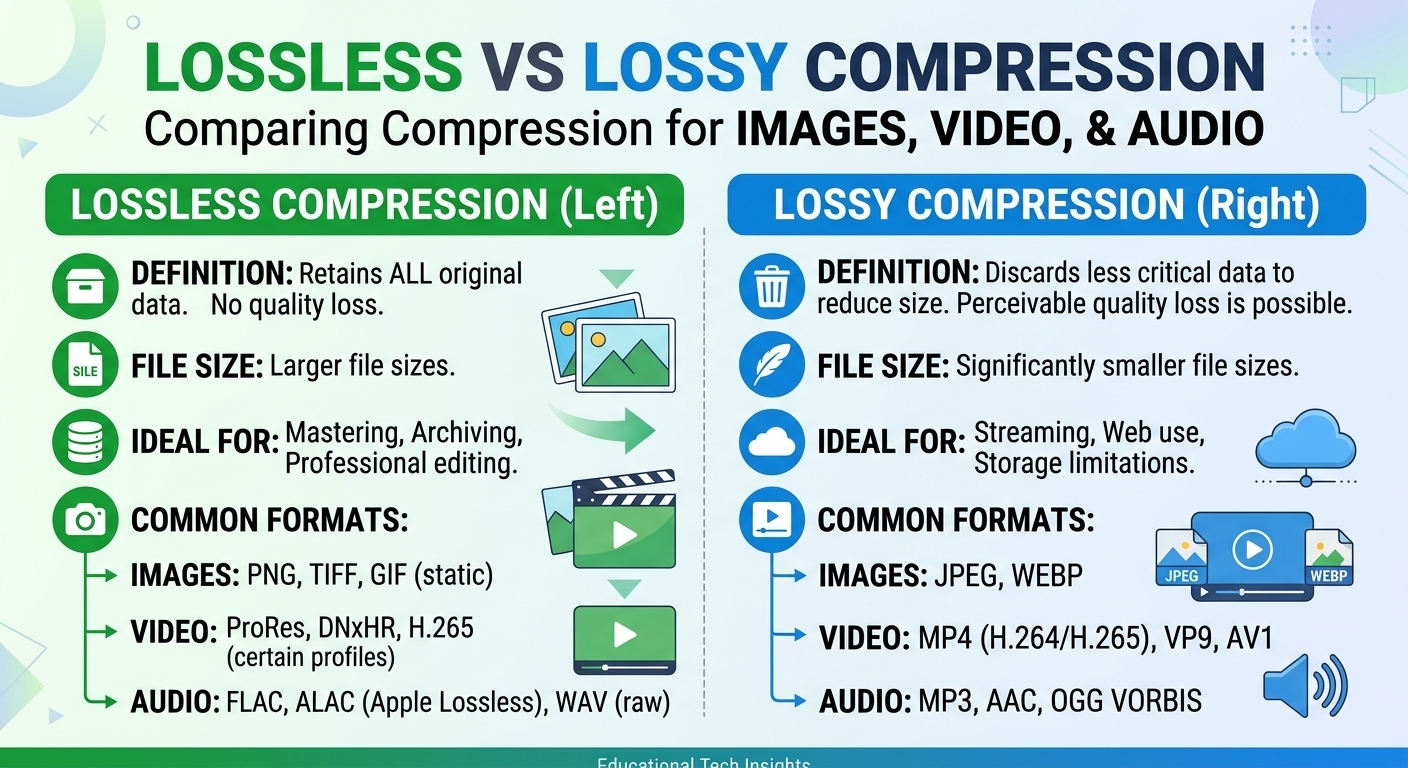
Lossy vs lossless compression comes down to one trade: lossless compression rebuilds every original bit and typically ...
During the 2026 ICC Champions Trophy semifinal in February, a major European broadcaster's origin cluster dropped three segments under a 14-million-concurrent-viewer spike. Viewers on traditional HLS saw a 22-second glass-to-glass delay; those on the operator's low-latency pipeline recovered in under 900 ms and never lost real-time parity. The difference was not bandwidth. It was CDN architecture. This article gives you a concrete framework for building and tuning a low latency streaming CDN stack that holds sub-second delivery at seven-figure concurrency: protocol selection criteria, segment and chunk math, edge topology decisions, a failure-mode playbook you will not find in vendor docs, and a decision matrix mapping workload profiles to the right transport.
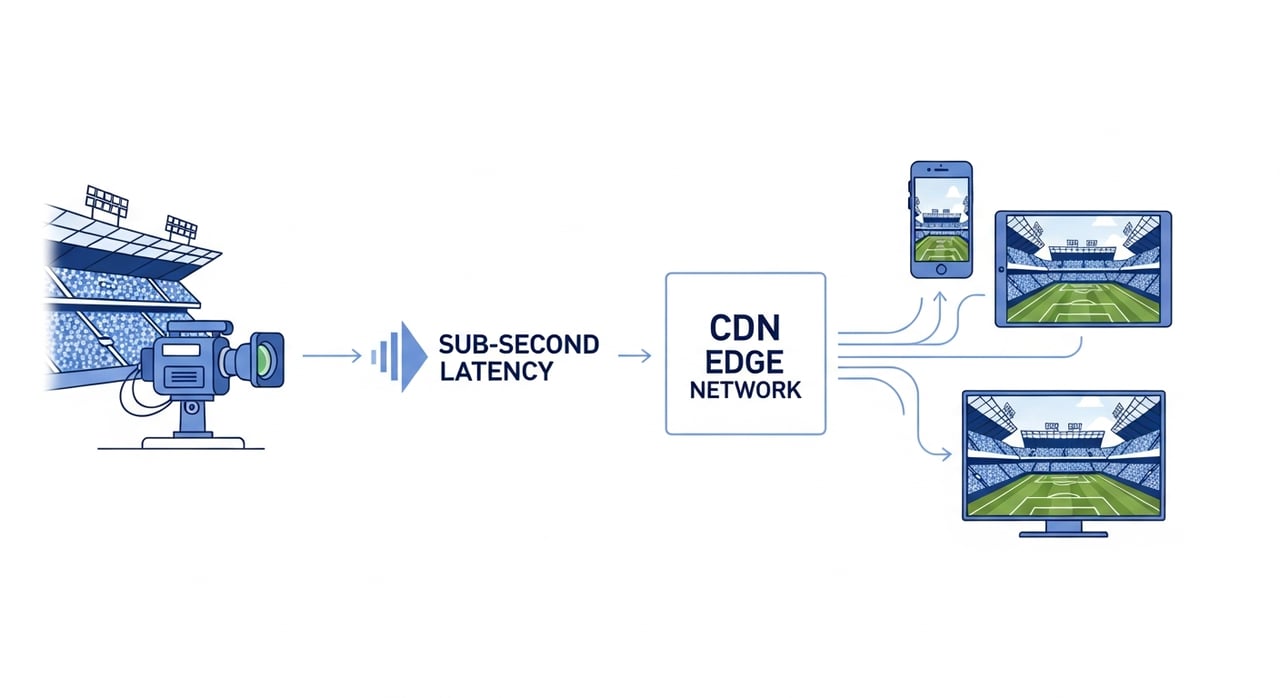
Glass-to-glass latency below one second is no longer a marketing checkbox. In-play betting platforms contractually require streams to trail the venue feed by no more than 1.5 seconds; regulators in the UK and Australia enforce synchronization audits as of Q1 2026. Second-screen social engagement collapses when the stream trails Twitter/X spoilers by even two seconds. And ad-insertion yield on SSAI workflows drops measurably when segments arrive late enough to miss the splice point.
The infrastructure challenge has intensified this year. Average peak concurrency for tier-one sporting events has grown roughly 30% year-over-year through early 2026, driven by free ad-supported streaming tiers from major rights holders. That growth compounds the hardest part of low-latency delivery: maintaining consistent chunk availability at the edge while the origin is encoding in near-real-time.
The protocol you choose bounds your achievable latency floor, your scalability ceiling, and your operational complexity. Here is how the viable options stack up for large-scale live sports as of mid-2026:
| Protocol | Practical Glass-to-Glass | Scalability at 1M+ | ABR Support | CDN Cachability |
|---|---|---|---|---|
| LL-HLS (Apple, RFC 8216bis) | 2–4 s | Excellent | Full | Native HTTP caching |
| LL-DASH (CMAF chunks) | 2–3 s | Excellent | Full | Native HTTP caching |
| WebRTC (via SFU/CDN bridge) | 300–800 ms | Hard ceiling ~500K without overlay mesh | Limited | Not cacheable (stateful) |
| HESP 2.0 | 700 ms–1.5 s | Good (HTTP-based) | Full | Cacheable with initialization stream |
For most sports broadcasters targeting 1M+ concurrency in 2026, LL-HLS or LL-DASH with CMAF chunks remain the pragmatic choice. WebRTC wins when sub-second is non-negotiable and audience size is bounded, such as in-venue second-screen or premium betting feeds. HESP occupies an interesting middle ground but still faces limited player ecosystem adoption.
Sub-second delivery on LL-HLS requires part durations around 200–330 ms. That means your edge nodes must be refreshing content every 200 ms per rendition. Multiply by six ABR rungs and you are looking at 30 requests per second per stream per edge location just for manifest and part fetches. At scale, the manifest request amplification is what kills you, not the media bytes.
Three architectural patterns that reduce this pressure in 2026 production stacks:
This section exists because no vendor blog covers it honestly. When you compress your segment pipeline to sub-second parts, you remove the buffer slack that traditional HLS used to hide problems. Here are the failure modes that will hit you in production:
If your encoder hiccups and delays a part by even 400 ms, the blocking playlist reload at the edge times out. Clients interpret this as a stall and rebuffer. With 6-second segments, this same encoder hiccup is invisible. Mitigation: run redundant encoders with automatic failover and segment-level deduplication at the packager. Set your CDN's blocking reload timeout to at least 3x your target part duration.
When a new part becomes available, every edge node simultaneously cache-misses and requests it from the mid-tier. If your mid-tier does not coalesce these requests, the origin sees a thundering herd proportional to your edge node count. Mitigation: request coalescing (sometimes called request collapsing) at the mid-tier is mandatory, not optional, for low-latency workloads.
CMAF chunks are timestamped. If your encoder's NTP source and your edge node's NTP source drift by more than one part duration, clients will either skip parts or double-buffer. Mitigation: enforce chrony or similar with sub-10 ms stratum-1 sync across all components in the ingest and delivery chain.
With 200 ms parts, the player's ABR algorithm has far less data to estimate throughput. Aggressive switching causes visual artifacts that are worse than a steady lower rendition. Mitigation: configure your player's ABR to use a sliding window of at least 3 seconds of part download times before switching up, and never switch down on a single slow part.
Not every live event needs the same latency target. Over-engineering latency wastes CDN spend and increases fragility. Use this matrix:
| Workload | Target Latency | Recommended Protocol | CDN Requirement |
|---|---|---|---|
| Premium in-play betting feed | < 1 s | WebRTC or HESP | SFU mesh or HTTP edge with sub-second TTL |
| Tier-1 live sport (mass audience) | 2–3 s | LL-HLS / LL-DASH | Blocking reload, request coalescing, QUIC |
| Second-tier sport / esports | 3–5 s | LL-HLS / standard DASH | Standard HTTP edge with short TTLs |
| VOD-near-live (highlights, replays) | 5–15 s acceptable | Standard HLS/DASH | Conventional cache hierarchy |
Match your CDN spend to the workload. A betting feed serving 50K concurrent viewers has different economics than a free-tier broadcast serving 5M.
Low-latency delivery increases request rate per viewer by 5–15x compared to standard HLS. That means your CDN bill scales with request count, not just egress bytes. When evaluating CDN partners for live sports in 2026, model both dimensions. For high-volume sports delivery, BlazingCDN's media delivery infrastructure offers volume-based pricing from $5 per TB down to $2.50 per TB at volume (as of October 2026), with the ability to scale rapidly under demand spikes. That cost structure matters when you are delivering hundreds of terabytes per event weekend across a full season.
With properly tuned part durations (200–330 ms), blocking playlist reload, and a CDN layer supporting QUIC and request coalescing, most operators achieve 2–3 seconds glass-to-glass at seven-figure concurrency. Achieving sub-2 seconds on LL-HLS requires aggressive part sizing that increases fragility and is rarely worth the trade-off for mass-audience sports.
Not natively. WebRTC is a stateful, session-based protocol that does not benefit from HTTP caching. Scaling beyond 500K requires either a cascading SFU mesh or a hybrid approach where WebRTC handles the last mile and an HTTP-based protocol handles mid-tier fan-out. Operational complexity is high, and few organizations maintain this in-house.
Instrument the source feed with a visible frame-accurate timecode (e.g., burned-in UTC timestamp at the encoder input). Capture the player output with a camera or frame grabber and compare. CDN-reported latency metrics typically exclude encoder, packager, and player buffer delays, which together can add 1–3 seconds that never appear in your CDN dashboard.
QUIC's primary latency advantage is 0-RTT connection establishment and the elimination of head-of-line blocking across multiplexed streams. For long-lived streaming sessions where the connection is already established, the steady-state difference is marginal. The win is on initial tune-in time and on lossy mobile networks where TCP retransmissions stall all streams. As of 2026, QUIC support at the CDN edge is broadly available but player-side adoption remains uneven.
Run active-active redundant encoders with a segment deduplication layer at the packager. The packager accepts parts from both encoders and publishes whichever arrives first with a matching sequence number. This absorbs single-encoder stalls without any playlist discontinuity. Avoid active-passive failover for sub-second workflows because the switchover gap will propagate as a visible rebuffer.
If you are running live delivery and have not measured your actual glass-to-glass latency with a burned-in timecode, start there. Most teams discover their real latency is 1.5–3 seconds higher than their CDN dashboard reports. Once you have a true baseline, you can make informed decisions about part duration, ABR tuning, and whether your current CDN layer supports the request coalescing and blocking reload behavior that low-latency protocols actually require. Measure first. Then architect.

Heavy traffic.
Light bill.
The CDN for video and large traffic
Learn
Lossy vs lossless compression comes down to one trade: lossless compression rebuilds every original bit and typically ...
Pricing - Pricing & Costs
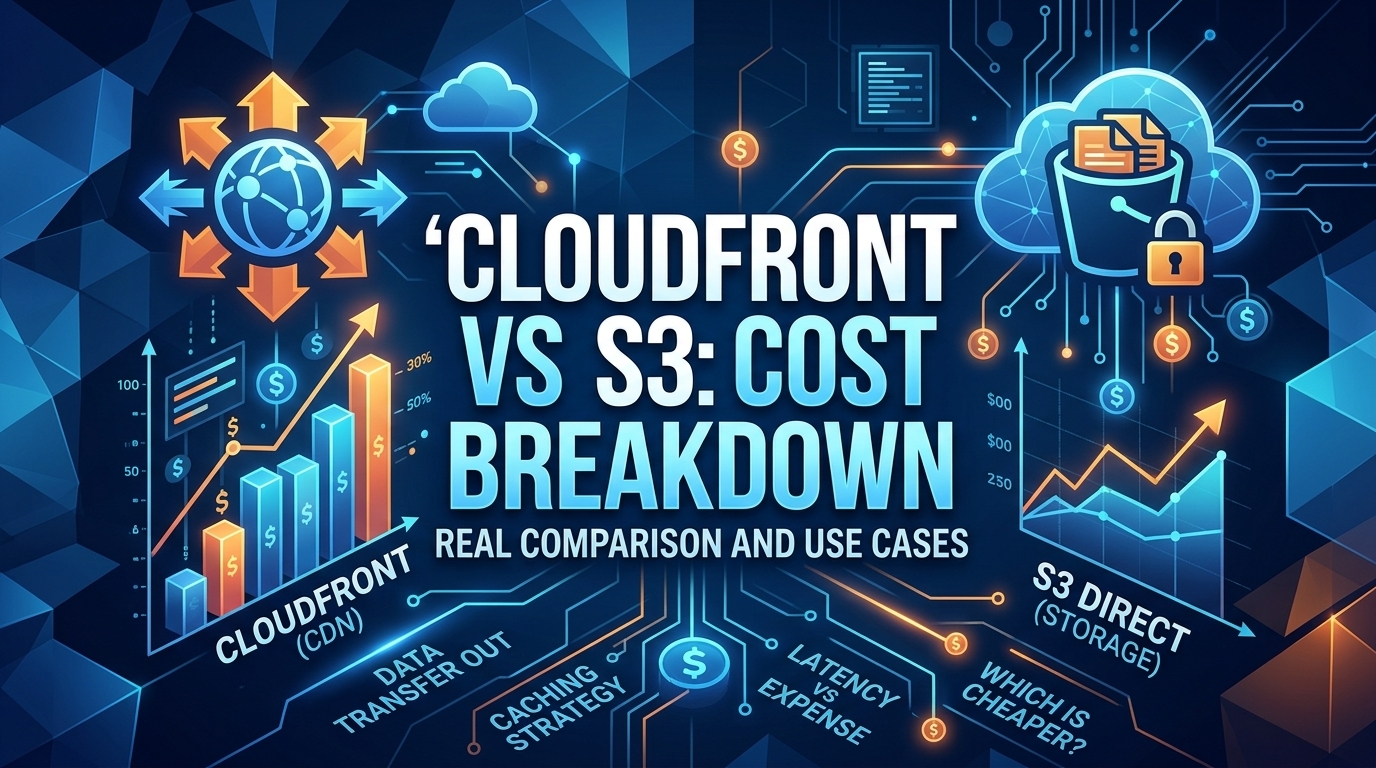
The CloudFront vs S3 decision depends more on object size than on traffic volume. At a 500 KB average response, 100 TB ...
Learn
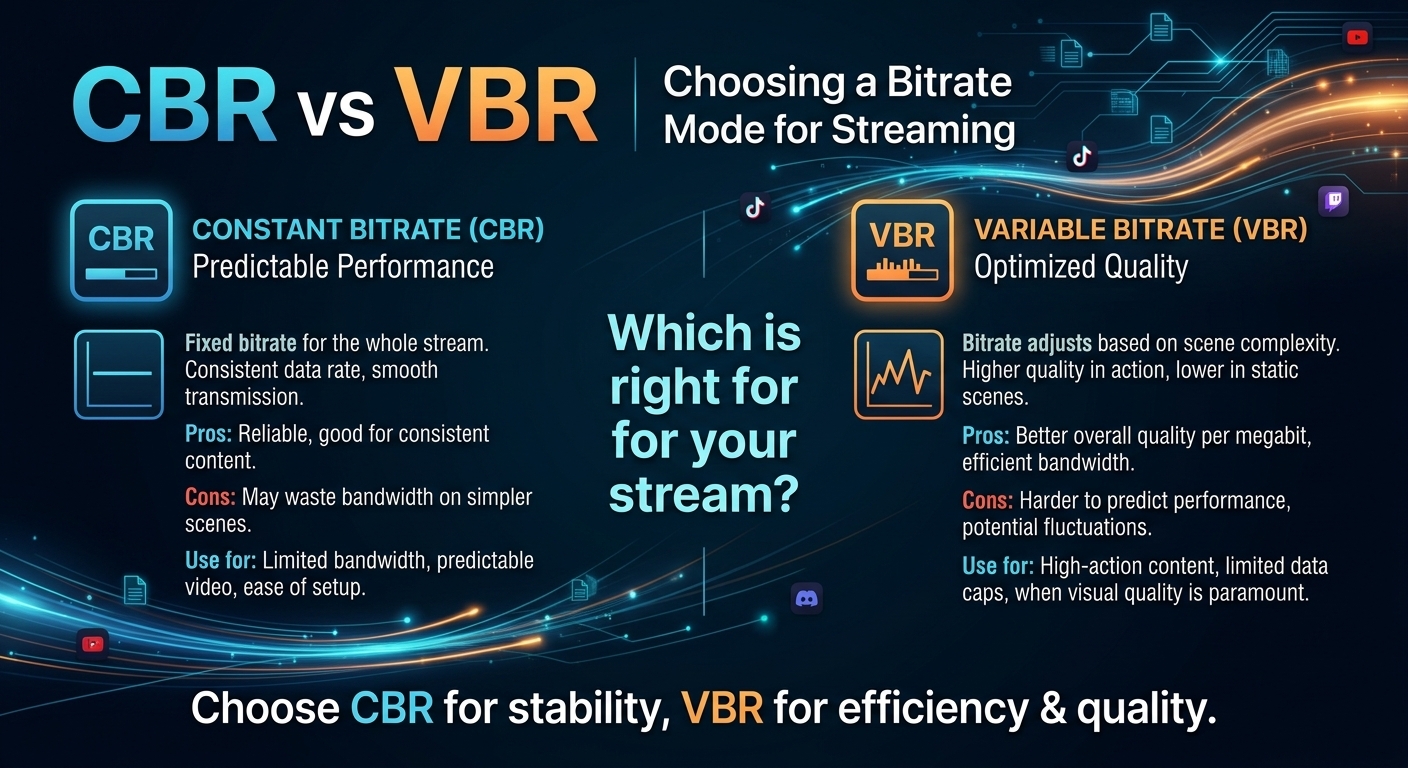
For most on-demand video, capped variable bitrate (VBR) wins the cbr vs vbr decision: it spends bits where the picture ...