

Learn
What Is a Keyframe? GOP Size and Keyframe Interval
In answer to what is a keyframe: a keyframe, or I-frame, is a video frame encoded without reference to any other frame, ...
A mid-size streaming platform disclosed in Q1 2026 that a single misconfigured cache-control header on their HLS manifest endpoint was responsible for 31% of their total origin egress bill—roughly $47,000 per month in unnecessary data transfer. The fix took eleven minutes. The waste had been compounding for two quarters. CDN cost optimization at scale is rarely about negotiating a better per-GB rate. It is almost always about the architecture between your origin and your edge, the decisions baked into cache keys and routing policies, and the operational discipline to measure what actually ships over the wire versus what should have been served from cache.
This article gives you five concrete levers to reduce CDN spend in 2026 without degrading p99 latency: cache hit ratio tuning with measurable thresholds, origin egress isolation, multi-CDN routing economics, workload-profile decision criteria, and a cost-model walkthrough comparing real pricing across tiers. If you are spending more than $2,000/month on content delivery, at least one of these will pay for the time you spend reading.
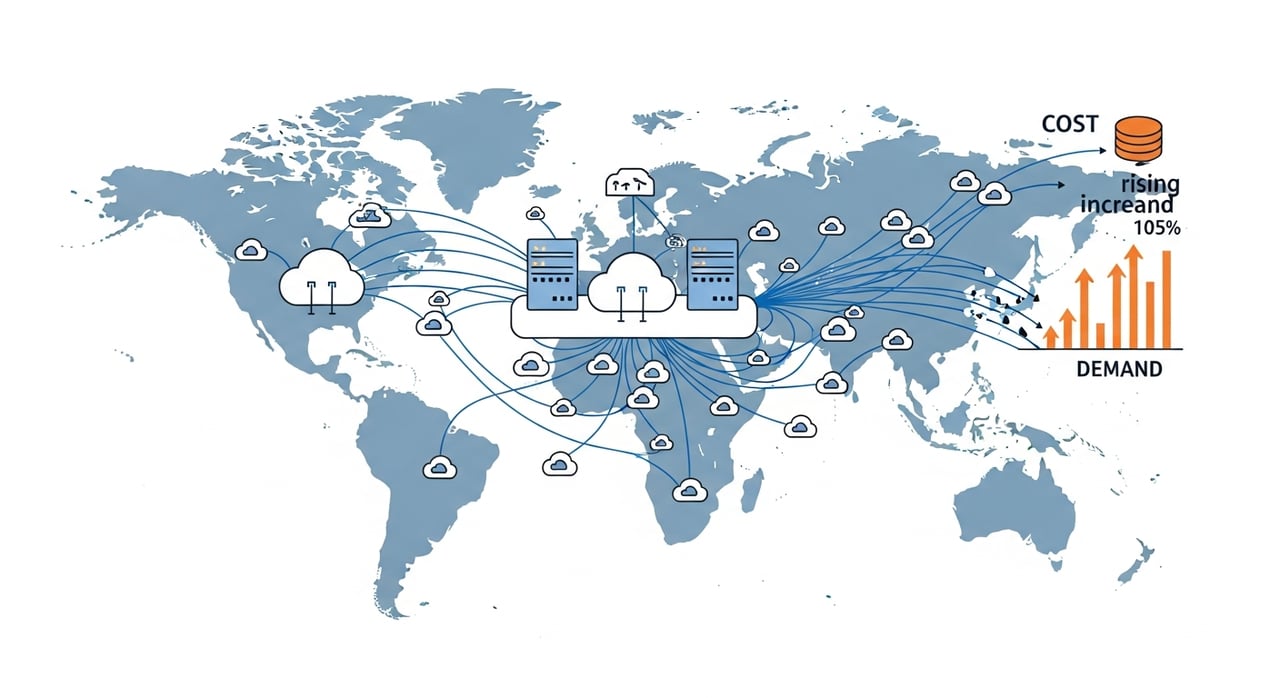
Global internet traffic is projected to exceed 540 exabytes per month by late 2026, up from roughly 490 EB/month at end of 2025. But traffic growth alone does not explain why CDN budgets are under pressure. Three structural shifts in 2026 are compressing margins simultaneously.
First, hyperscaler egress pricing has become less predictable. AWS reduced CloudFront egress for the first 10 TB to $0.085/GB in most regions as of early 2026, but introduced tiered surcharges for real-time log streaming and Lambda@Edge invocations that offset the headline rate. GCP followed a similar pattern. The effective per-GB cost depends heavily on your feature footprint, not just your traffic volume.
Second, video bitrates are climbing. AV1 adoption is accelerating, but many operators still dual-encode with HEVC for device compatibility, which means origin storage and edge bandwidth carry both codec variants. A 4K live stream with HEVC+AV1 renditions can push 18–22 Mbps aggregate per viewer before ABR adaptation, compared to 12–14 Mbps for a single-codec ladder two years ago.
Third, edge compute workloads are generating new cost line items—request-based billing for edge functions, KV store reads, and telemetry pipelines—that did not exist on 2024-era invoices. Teams that optimized their CDN costs in 2024 are finding those optimizations stale.
Every cache miss is a round trip to origin, and origin egress is where most CDN budgets bleed. The relationship is nonlinear: improving cache hit ratio (CHR) from 85% to 95% does not cut origin traffic by 10 percentage points—it cuts it by roughly two-thirds, because you are eliminating 10 out of every 15 misses.
For static assets (JS, CSS, images, fonts), a CHR below 95% in 2026 signals a configuration problem. For video segments (CMAF, HLS, DASH), aim for 92%+ on segments and 80%+ on manifests. If your manifest CHR is under 60%, check whether your packaging layer is injecting per-session query parameters or unique tokens into manifest URLs—this is the single most common cache-busting pattern in live streaming stacks.
Actionable steps that move CHR measurably:
Most teams track total CDN spend as a single line item. That obscures the real cost structure. Break your bill into three buckets: edge delivery (cache hits served to end users), origin egress (cache misses pulling from your origin), and ancillary charges (edge compute, logging, certificate management, request fees).
As of Q1 2026, origin egress from AWS S3 to a third-party CDN costs $0.09/GB in us-east-1, $0.09/GB in eu-west-1, and $0.12/GB in ap-southeast-1. If you serve 200 TB/month total and your CHR is 90%, that is 20 TB of origin pulls. In us-east-1 alone, that is $1,800/month in S3 egress before any CDN charges. Push CHR to 96% and origin pulls drop to 8 TB—saving $1,080/month on egress alone, plus the CDN's per-request cost reduction for fewer origin fetches.
For teams running origins on GCP or Azure, consider same-provider CDN for the zero-egress or reduced-egress path to that provider's edge, then route remaining traffic to a cost-optimized CDN for final-mile delivery. This dual-layer model is increasingly common in 2026 architectures.
The multi-CDN strategy conversation has matured. The question is no longer "should we go multi-CDN?" but "at what traffic profile does multi-CDN economics justify the operational overhead?" Here is the matrix we use for workload-profile assessment:
| Factor | Favor Single CDN | Favor Multi-CDN |
|---|---|---|
| Monthly traffic volume | Under 100 TB | Over 500 TB |
| Traffic pattern | Predictable, steady-state | Spiky, event-driven, or seasonal |
| Geographic reach | 1–2 primary regions | Global, with latency-sensitive users in 4+ regions |
| Availability SLA requirement | 99.9% | 99.99%+ (requires failover) |
| Engineering capacity for CDN ops | Limited (small platform team) | Dedicated CDN or edge delivery team |
| Vendor lock-in tolerance | Acceptable with commit discount | Low—needs portability |
Multi-CDN adds real complexity: cache fragmentation across providers, inconsistent edge logic behavior, the need for a DNS-based or client-side switching layer, and duplicated purge pipelines. If your monthly volume is between 100 TB and 500 TB, the most cost-efficient path in 2026 is often a single high-value CDN with a standby failover provider activated only during incidents or capacity events.
CDN pricing has never been more opaque. Headline rates from hyperscalers start around $0.085/GB for the first 10 TB (as of May 2026 AWS CloudFront pricing for North America), stepping down to $0.020/GB above 5 PB. But the effective rate includes request fees ($0.0075–$0.01 per 10K HTTPS requests), invalidation charges, and log delivery costs that can add 15–30% on top.
For comparison, BlazingCDN's volume-based pricing starts at $5 per TB and scales down to $2.50 per TB at volume (as of October 2026), with no request fees. For an operator pushing 500 TB/month, that translates to $1,815 per month, while Amazon CloudFront’s pay-as-you-go list price is about $6,965 at only 100 TB. That matters for enterprises where CDN is a top-three infrastructure line item.
Cost optimization has failure modes that are worth naming explicitly, because they show up in production postmortems more often than in planning docs.
If you push TTLs to 30 days but your deploy pipeline does not purge or version-stamp updated assets, users get stale content. The cost savings evaporate when you ship an emergency content fix and it takes 30 days to propagate. Before extending TTLs, verify your CI/CD pipeline either uses content-addressed filenames or triggers targeted purges on deploy.
Routing all edge misses through one shield region reduces origin load, but if that shield region goes down, your entire cache miss path fails simultaneously. Use a dual-shield topology—primary and fallback shield in separate regions—or accept the slightly higher origin load of direct-to-origin fallback.
Failing over to a standby CDN that has cold caches means 100% of requests become origin fetches for the duration of cache warming. On a 50 TB/day workload, that can saturate your origin in minutes. Pre-warm your standby CDN with synthetic fetches for your top 1,000 objects, or maintain a baseline traffic split (even 5%) to keep caches partially warm.
Start with cache hit ratio. Audit your cache keys for unnecessary fragmentation (query params, Vary headers, per-session tokens). Improving CHR from 90% to 96% typically reduces origin egress by 60%, which is the fastest cost reduction available without touching your CDN contract.
Normalize cache keys, extend TTLs on immutable assets, enable origin shield to consolidate edge-to-origin fetches, and eliminate Vary: User-Agent on static resources. Measure CHR per content type—manifests, segments, static assets—to find the largest gaps.
Multi-CDN is justified when you exceed 500 TB/month, require 99.99%+ availability with automated failover, or serve latency-sensitive users across four or more geographic regions. Below those thresholds, the operational overhead usually exceeds the savings.
Target 92%+ for video segments and 80%+ for manifests. If your manifest CHR is below 60%, investigate whether your packager injects unique tokens or session IDs into manifest URLs, which fragments the cache.
For a 200 TB/month workload at 90% CHR, origin egress from a major cloud provider costs roughly $1,800/month in North America. At 96% CHR, that drops to approximately $720/month. Origin egress often represents 15–25% of total delivery cost and is the most controllable variable.
Single CDN with a commit discount delivers the best per-GB rate for predictable workloads under 500 TB/month. Multi-CDN can reduce costs through competitive routing and burst absorption, but only if you have the engineering capacity to manage cache coherency and switching logic.
Pull your last 30 days of CDN logs and compute three numbers: cache hit ratio by content type (static, manifest, segment, API), origin egress volume in GB, and effective cost per GB delivered (total CDN bill divided by total bytes served from edge). If your CHR on any content type is more than 5 points below the thresholds listed above, that is your first optimization target. If your effective cost per GB exceeds $0.01 and you are above 100 TB/month, you are likely overpaying for the tier or feature set you are actually using. Run the numbers, then decide whether the fix is configuration, contract, or architecture.

Heavy traffic.
Light bill.
The CDN for video and large traffic
Learn
In answer to what is a keyframe: a keyframe, or I-frame, is a video frame encoded without reference to any other frame, ...
Learn
New Azure CDN deployments now go only one way: Microsoft stopped accepting new Azure CDN Standard from Microsoft ...
Learn
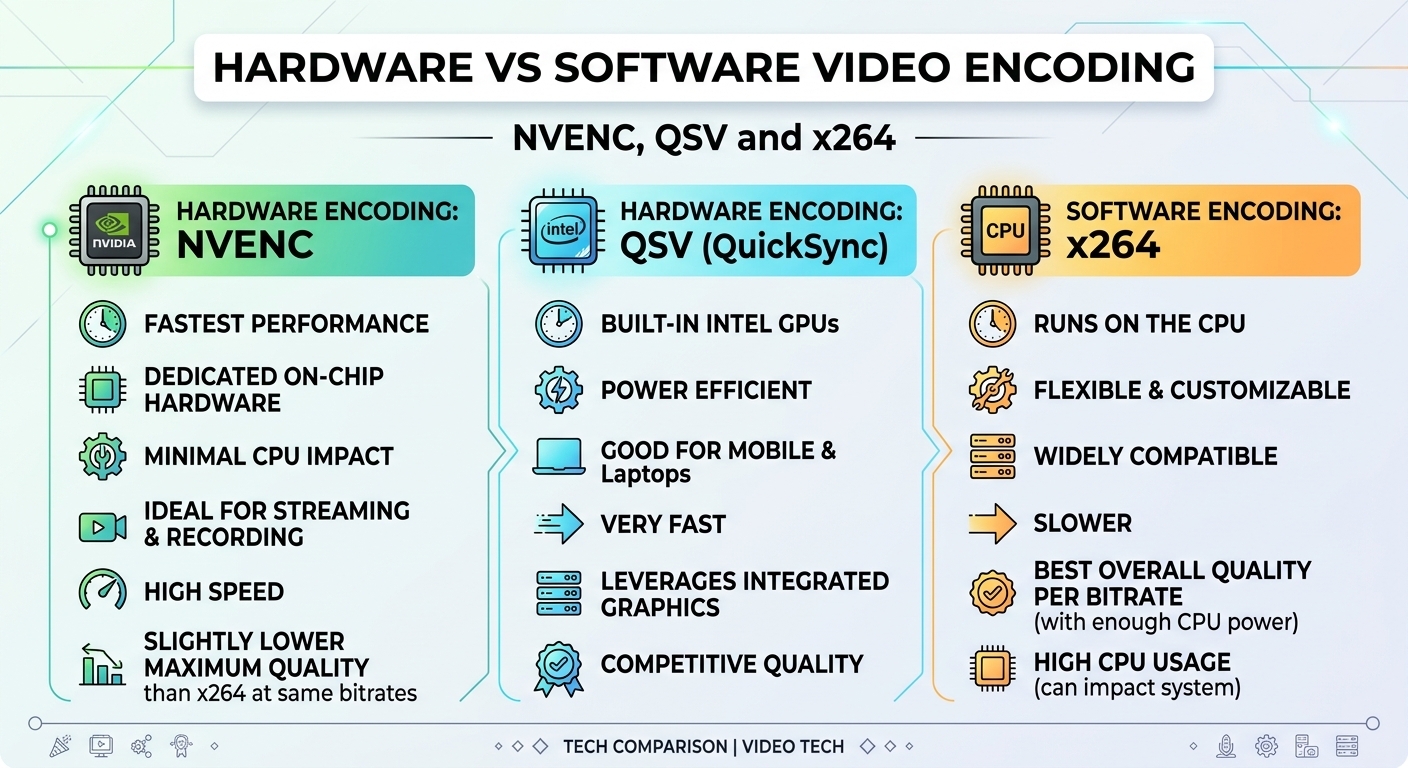
Evaluated October 2026: for live video, a modern GPU hardware encoder (NVIDIA NVENC on Turing or newer, Intel Quick ...