
Web Performance
Core Web Vitals Explained: LCP, INP and CLS in 2026
Core web vitals are three field metrics Google uses to score real-user page experience: Largest Contentful Paint (LCP) ...

Google scores page experience on the 75th percentile of real Chrome user visits, and Largest Contentful Paint (LCP) counts as good only at 2.5 seconds or less, a threshold that has not changed through 2026. A visitor 150 ms of round-trip time from your origin spends about 450 ms on TCP, the TLS 1.3 handshake and the request itself before the first HTML byte arrives (our estimate, worked below). That gap is where CDN SEO gains are made or lost.
A CDN helps SEO indirectly: it adds no ranking signal of its own, but it moves the signals Google already measures. By serving cached HTML and the LCP resource from an edge close to the user, a CDN can cut time to first byte (TTFB) from about 650 ms to under 100 ms for a visitor 150 ms from the origin (our 2026 estimate). Google's guidance treats 0.8 seconds or less at the 75th percentile as a good TTFB.
Below you get a TTFB budget you can rerun with your own round-trip times, a matrix of which site types gain what, and the canonical, cache-header, mixed-content and redirect failures that turn a CDN into a ranking liability.
Yes, but only through measurable proxies. A CDN lowers TTFB and LCP for distant and mobile users, keeps response times stable for Googlebot, and absorbs traffic spikes that would otherwise produce 5xx errors. It does not improve relevance, content quality or links, which still dominate ranking. Google states that good page experience alone does not guarantee rankings.
That framing matters for expectations. Core Web Vitals act as a tiebreaker between pages of similar relevance, so a CDN moves rankings most where competing pages are close on content and far apart on field performance. Claims of a fixed percentage ranking uplift from adding a CDN have no public evidence behind them.
A CDN is also not a substitute for technical SEO or mobile optimization. If the LCP element is a client-rendered image that waits on 400 KB of JavaScript, edge delivery shaves milliseconds off a multi-second problem.
A CDN cuts TTFB by moving connection setup to an edge a few milliseconds away and, when HTML is cached, by removing the origin round trip entirely. The gain depends on cache status: a cached HTML hit can drop TTFB by roughly 85%, while a miss over a cold origin connection can be slower than no CDN at all.
The model below assumes a user 20 ms from the edge, an edge 150 ms from the origin (the same distance as user to origin), 200 ms of backend time, TLS 1.3 without 0-RTT resumption, and DNS excluded. Three round trips cover TCP, TLS and the request.
| Request path | User to edge | Edge to origin | Backend | Estimated TTFB |
|---|---|---|---|---|
| No CDN, cold connection | 3 x 150 ms = 450 ms (direct) | none | 200 ms | about 650 ms |
| CDN, HTML cached at edge | 3 x 20 ms = 60 ms | none | none | about 65 to 80 ms |
| CDN miss, warm or shielded origin connection | 60 ms | 1 x 150 ms | 200 ms | about 410 ms |
| CDN miss, cold origin connection | 60 ms | 3 x 150 ms = 450 ms | 200 ms | about 710 ms |
Caching HTML at the edge delivers most of the TTFB gain, and a miss without connection reuse to the origin can be about 60 ms slower than serving with no CDN.
Two levers close the gap on misses: persistent, pooled connections from edge to origin, and an origin shield that concentrates misses on one warm path. For pages you cannot cache for long, a short TTL with stale-while-revalidate (RFC 5861) keeps most requests on the 65 to 80 ms row while the edge refreshes in the background.
A CDN moves LCP clearly, Interaction to Next Paint (INP) barely, and Cumulative Layout Shift (CLS) not at all. INP replaced First Input Delay as a Core Web Vital in March 2024, with good at 200 ms or less, and it is dominated by main-thread JavaScript work, which edge delivery does not touch. CLS good is 0.1 or less and depends on reserved dimensions in markup.
LCP is where the work pays. TTFB is a hard floor under LCP, and the LCP resource itself, usually a hero image, still has to be fetched, decoded and painted. Serving it from the edge with Brotli or zstd for text assets, HTTP/2 multiplexing, and an image resized to its rendered dimensions shortens the second half of that chain. If your LCP element is a large product or hero image, BlazingCDN's on-the-fly image processing handles crop, resize, resizefit and resizefill at the edge at no extra charge, alongside Brotli and zstd compression.
Field data is aggregated per origin and per form factor, and Google indexes mobile-first. Mobile links add latency and variance per round trip, so the three-round-trip setup cost in the model above grows on cellular networks, often to well over a second for distant users (estimate). A site with 30% of traffic from a continent far from its origin can fail LCP at the 75th percentile even when home-market users pass comfortably. Edge delivery flattens that geographic tail, which is the strongest case for a CDN in international SEO.
Google's crawl capacity limit rises when a host answers quickly and cleanly and falls when it sees slow responses, timeouts or 5xx errors. Google says crawl budget matters mainly for sites with about a million or more pages, or 10,000 or more pages that change daily. Below that, response stability matters more than raw speed.
Googlebot crawls mostly from US addresses, so an origin in Europe or Asia pays a long round trip on every uncached fetch. Googlebot also sends conditional requests using ETag and Last-Modified, so an edge that answers with 304 Not Modified saves both bandwidth and crawl capacity. Request coalescing protects the origin when a crawler burst hits many cold URLs at once.
Treat robots.txt as critical infrastructure: if it returns a 5xx, Google can pause crawling the whole host. Cache it at the edge with stale-if-error so an origin outage does not become a crawl outage.
Breaks: the CDN hostname or the raw origin hostname serves full HTML and gets indexed. Shows up: "Duplicate, Google chose different canonical than user" in the Search Console Page indexing report. Confirm: fetch a page through each hostname and check that the rel=canonical link points to the primary host. Fix by restricting the asset hostname to static paths, sending an X-Robots-Tag of noindex on it, and accepting origin traffic only from the CDN.
Breaks: Vary set to User-Agent fragments the cache until hit ratio collapses and TTFB returns to the origin row. Cached 404 or 5xx responses outlive the fix. A stale noindex or old canonical survives a launch because nobody purged. Pages carrying Set-Cookie get cached and leak sessions. Confirm: read Cache-Control, Age, Vary and the Cache-Status header (RFC 9211) or your provider's equivalent on HTML responses.
Breaks: the edge serves HTTPS but templates hardcode plain-HTTP asset URLs, so browsers block or upgrade them and LCP images fail. Worse, an edge that talks plain HTTP to an origin which redirects everything to HTTPS creates an infinite redirect loop that Googlebot reports as a redirect error. Chains of HTTP to HTTPS to www to trailing slash each cost a round trip, and Googlebot follows at most 10 hops. Confirm: run curl with the follow-redirects and verbose options against each hostname variant and count the hops. Avoid long max-age on 301 responses until the target is final, because browsers cache them aggressively.
Breaks: bot challenges or rate limits return 403, 429 or a challenge page to Googlebot. Shows up: falling crawl requests and rising non-200 shares in the Search Console Crawl Stats report. Confirm: match edge logs against Googlebot by reverse DNS lookup to googlebot.com or google.com, not by user agent string.
Breaks: a branded edge error page returns 200, or a geo-redirect gets cached and served to every visitor, including a US-based crawler. Confirm: request a missing URL and a non-home-market URL through the edge and check status codes.
Many CDN vendors bundle TLS termination, DDoS mitigation and a web application firewall (WAF). Their SEO value is availability: HTTPS has been a lightweight ranking signal since 2014, and sustained 5xx errors lower crawl rate and can eventually drop URLs from the index. For planned maintenance, Google recommends a 503 status for short windows rather than a 200 error page. Shared CDN IP addresses do not hurt rankings.
| Site type | Metric the CDN moves | Cache at the edge | Main SEO risk |
|---|---|---|---|
| Blogs and publishing | TTFB and LCP | Full HTML, purged on publish | Stale canonical or noindex after edits |
| E-commerce | LCP through product images | Images, CSS, JS; anonymous HTML on short TTL | Cached prices, stock or cookies |
| Education and documentation | TTFB for distant users | HTML, PDFs, video | Documents indexed on the CDN hostname |
| Local business with international visitors | TTFB outside the home region | Nearly the whole site | Cached geo-redirects served to Googlebot |
| Media and entertainment | LCP and 5xx rate during traffic spikes | Images, video segments, HTML with stale-while-revalidate | Vary fragmentation lowering hit ratio |
Sites whose HTML can be cached gain the most, while sites with personalized HTML gain mainly through asset delivery and must guard against caching what should stay private.
No, a CDN is not a ranking factor itself. It helps SEO by improving signals Google already uses: lower TTFB and LCP in field data, fewer 5xx errors during traffic spikes, and faster, steadier responses to Googlebot. The effect is largest for sites with distant or mobile-heavy audiences and smallest when relevance or content quality is the real gap.
Yes, a misconfigured CDN can hurt SEO. Common causes are an indexable CDN hostname that duplicates the site, cached error pages or stale noindex headers, redirect loops between edge and origin, mixed content on HTTPS pages, and bot protection that challenges Googlebot. Each shows up in Search Console indexing or Crawl Stats reports before rankings move.
A CDN reliably improves LCP and rarely moves the other two Core Web Vitals. LCP benefits because TTFB and the hero image both arrive from a nearby edge. INP depends on JavaScript execution on the main thread, and CLS depends on reserved element dimensions, so neither changes much when you add a CDN.
Expect roughly 65 to 80 ms TTFB for cached HTML when the user is about 20 ms from the edge, based on three round trips for TCP, TLS 1.3 and the request. Cache misses add the full origin round trip plus backend time, so uncached pages often land at 300 to 700 ms depending on origin distance.
Googlebot crawls whatever your DNS points to, which is normally the CDN edge. That means edge caching, edge errors and edge bot rules all shape what Google sees. Googlebot crawls mostly from US addresses, so a non-US origin benefits from edge caching, and edge rules must allow verified Googlebot traffic.
Pull your 75th percentile TTFB and LCP per country and form factor, then plug your real user-to-origin round-trip times into the four-row budget above. If the cached-HTML row would pull a failing market under 2.5 seconds of LCP, cache HTML for anonymous traffic with a short TTL and stale-while-revalidate, then check Cache-Status and Age on ten representative URLs and watch Crawl Stats for two weeks.
To compare edge latency from your own probes, the BlazingCDN performance metrics page publishes BlazingCDN's own measurements of a 100 MB HTTPS download, measured June 2026 (Europe 27 ms, North America 24 ms, Asia 47 ms), with a public test file you can run against your current provider.

Heavy traffic.
Light bill.
The CDN for video and large traffic
Web Performance
Core web vitals are three field metrics Google uses to score real-user page experience: Largest Contentful Paint (LCP) ...
Web Performance
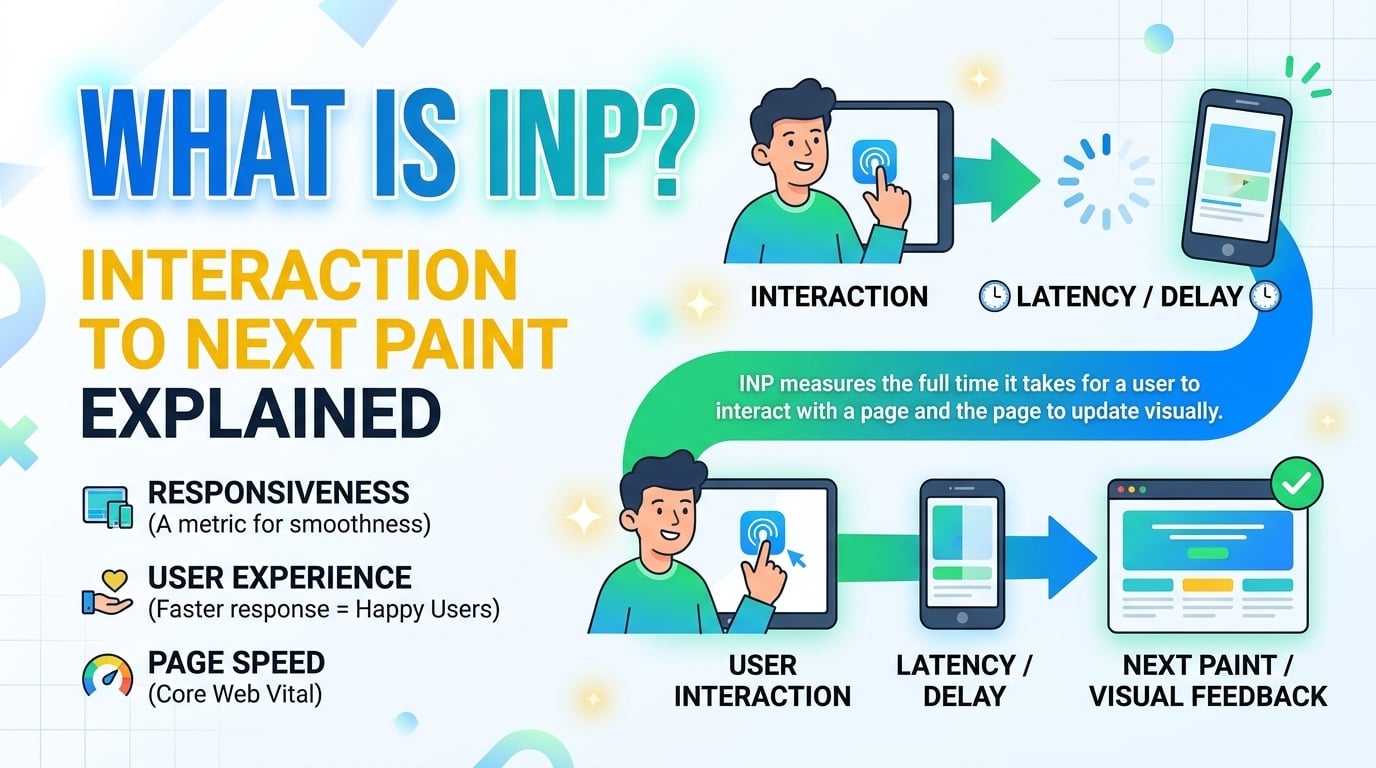
Interaction to Next Paint (INP) is a Core Web Vitals metric that measures how quickly a page visually responds to user ...

Web Performance
Cumulative Layout Shift (CLS) is the Core Web Vitals metric for visual stability: it scores how far visible content ...
Web Performance
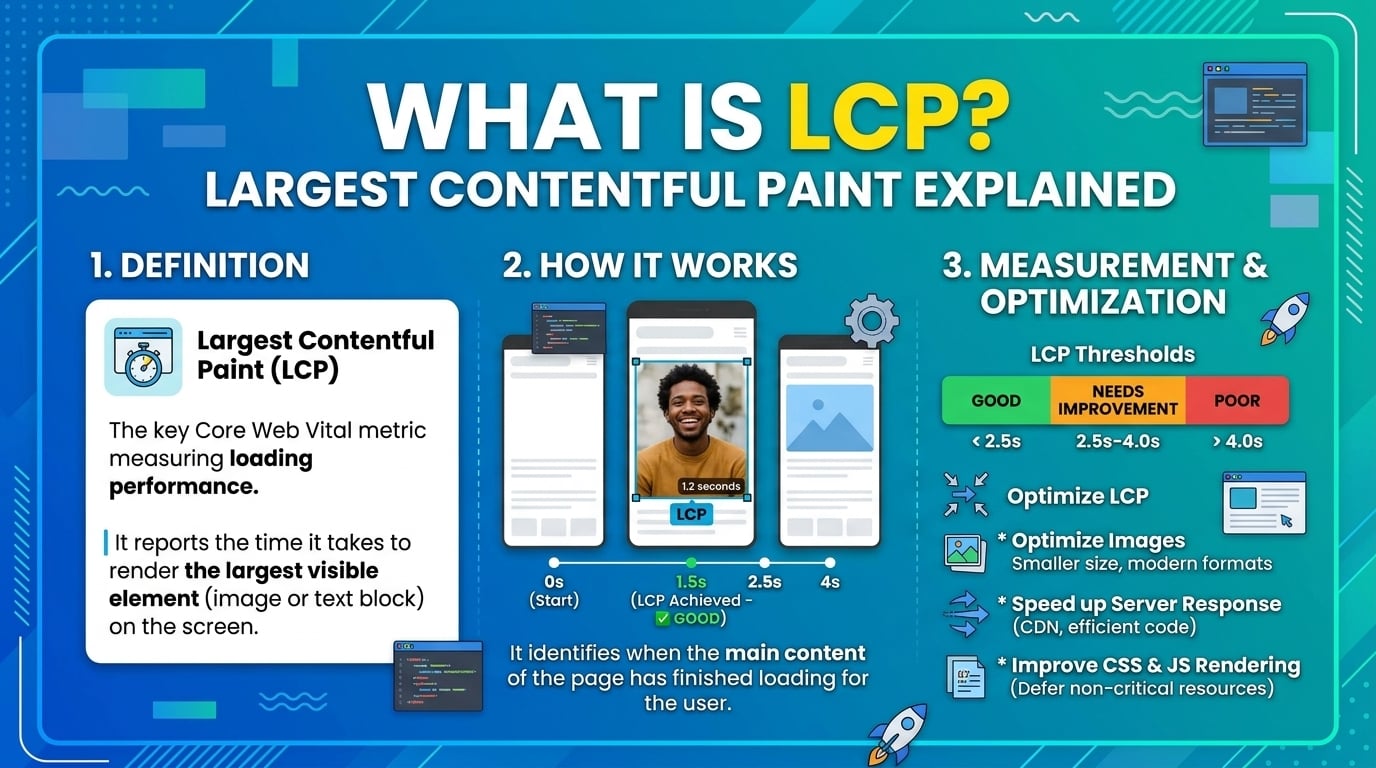
Largest Contentful Paint (LCP) is a Core Web Vitals metric. It reports the time, measured from the start of navigation, ...