

Learn
How a Multi-CDN Strategy Saved Us from Costly Downtime
In a recent survey, 60% of enterprises reported that a single hour of critical-application downtime costs them at least ...

According to research from Akamai, just a two-second increase in video start-up time can double viewer abandonment rates. For a subscription streaming platform or ad-supported OTT service, that’s millions in lost revenue riding on what feels like a tiny delay — and it only gets worse when viewers see the infamous buffering spinner mid-stream.
In this case-study-style deep dive, we’ll walk through how streaming platforms can realistically eliminate up to 80% of buffering by leaning on a video-optimized CDN, rethinking their architecture, and measuring the right QoE metrics. Along the way, you’ll see what changes matter most, which ones don’t, and how to translate technical improvements directly into business impact.
As you read, ask yourself a simple question: if your platform cut buffering by even 50–80%, what would that do to your watch time, churn, and infrastructure bill?
Most streaming teams know buffering is bad. Far fewer can quantify just how expensive it is.
Industry analyses repeatedly show the same pattern: when viewers experience buffering or slow start-up, they don’t just get annoyed — they leave. Conviva’s State of Streaming reports have consistently found that higher buffering correlates with lower engagement time and higher abandonment, particularly on mobile and connected TV devices. Viewers may not complain directly, but they silently churn to competitors that “just work.”
Three things happen when buffering creeps up:
Behind every buffering spinner is a measurable hit to ARPU, LTV, and retention. Treating buffering as a pure technical bug underestimates its impact; it’s really a monetization problem expressed as a UX symptom.
As you look at your own metrics, do you know how a 0.5% or 1% change in rebuffering affects your monthly revenue — or are you still guessing?
It’s tempting to blame buffering on last-mile ISPs or “slow Wi‑Fi,” but in most real-world streaming platforms, the root causes are distributed across the entire delivery chain.
When streams are pulled directly from centralized origins or cloud storage, a surge of concurrent viewers can overwhelm connections, leading to:
Even if you “scale up” origins, you’re often just pushing the bottleneck a little further out without fundamentally fixing delivery latency and variability.
Many platforms start with a generic CDN setup optimized for static assets (images, JS, CSS). That’s good enough for websites but suboptimal for long-running HLS/DASH video sessions, where:
A traditional CDN can deliver video, but a video CDN — architected around segment delivery, origin offload, and QoE — can deliver it far more consistently.
Even with a solid network, misconfigured adaptive bitrate (ABR) algorithms can trigger unnecessary buffering. Common issues include:
These “edge” problems are magnified when the underlying CDN response is inconsistent. When delivery is smooth, ABR has room to work intelligently; when it’s not, buffering becomes the fallback.
In your own stack, how much buffering do you attribute to the network vs. your player logic — and do you have the data to back that up?
Talking about “eliminating buffering” is abstract. To make the problem actionable, you need concrete QoE metrics and realistic targets. An “80% buffering reduction” typically means driving your rebuffering ratio down by a factor of five, for example from 1.5% of viewing time to 0.3%.
Key metrics that streaming teams track before and after shifting to a video-optimized CDN include:
Here’s what a realistic “before vs. after” might look like when a platform migrates from a generic delivery setup to a tuned video CDN and optimizes its player behavior around it:
| QoE Metric | Before Optimization | After Video CDN & Tuning |
|---|---|---|
| Rebuffering ratio | 1.5% of viewing time | 0.3% of viewing time (80% reduction) |
| Rebuffer events per hour | 3.0 | 0.6 |
| TTFF / join time | 3.0 seconds | 1.4 seconds |
| Average bitrate (HD-capable regions) | 3.2 Mbps | 4.0 Mbps |
| Playback failure rate | 1.0% | 0.4% |
These are plausible, industry-aligned numbers, not guarantees — but they illustrate the scale of improvement many platforms aim for when they talk about “fixing buffering.”
In the next section, we’ll step through the architecture changes that make this kind of improvement achievable, not theoretical.
Looking at your own dashboards, what would your “before” column look like — and which metric scares you the most?
The core of any serious buffering reduction is architectural: moving away from heavy reliance on centralized origins and generic CDNs toward a design where a video CDN is the default path for viewer traffic.
At a high level, the target architecture for both VOD and live streaming looks like this:
Player (HLS/DASH) → Video CDN edge → Video CDN mid-tier / shield → Origin (packager, storage)
The key change isn’t just inserting a CDN; it’s building your workflow so that video segments live as close as possible to the viewer, and origins are only touched when strictly necessary.
Visually, such an architecture can be summarized like this:
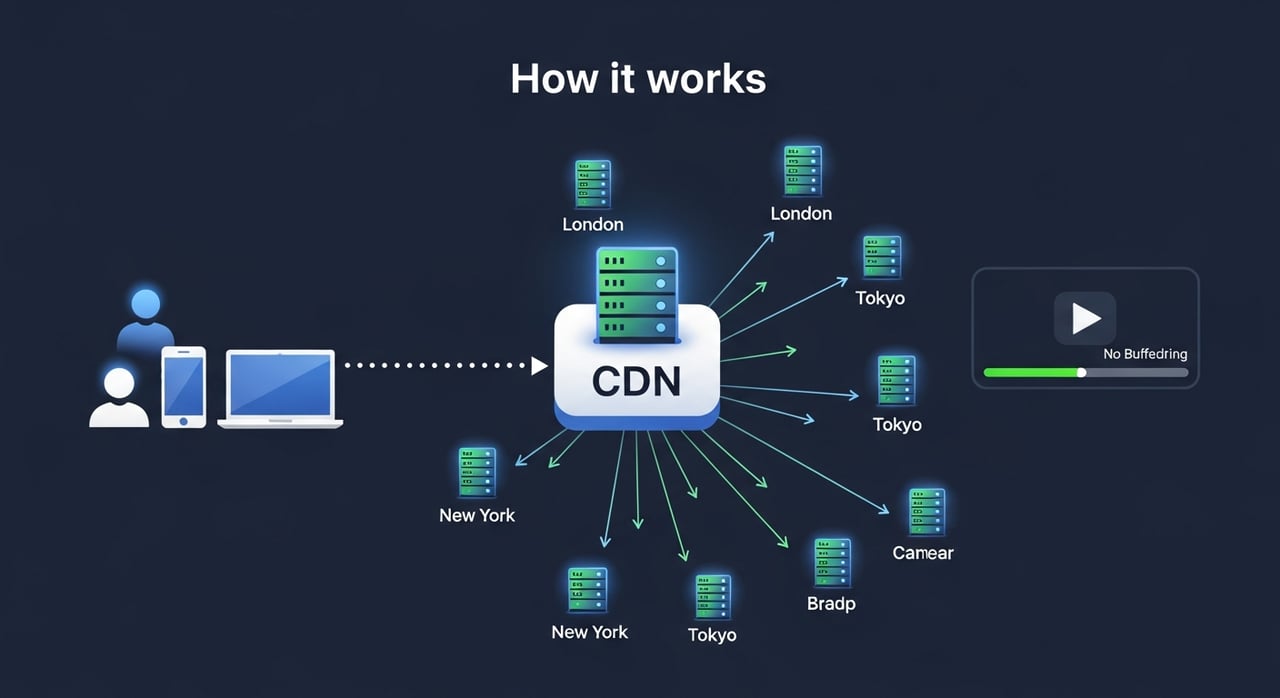
A video-focused CDN typically provides:
Compare a generic CDN setup with one built specifically for video delivery:
| Aspect | Generic CDN | Video-Optimized CDN |
|---|---|---|
| Caching strategy | File-based, static-asset oriented | Segment-based, tuned for HLS/DASH windows |
| Origin offload | Basic; frequent cache misses for live/long-tail | High; shield layers and live-aware policies |
| Connection management | Designed for bursts of short-lived HTTP requests | Optimized for continuous video segment flows |
| ABR support | Transparent but not QoE-aware | Telemetry and features built with ABR use-cases in mind |
| QoE visibility | Standard CDN logs, limited player context | Deeper metrics integration for streaming-specific KPIs |
In the next blocks, we’ll walk through how a typical streaming platform can transition to this model step by step — without breaking existing workflows.
Right now, is your CDN essentially a “black box” for video traffic, or do you understand precisely how it handles your HLS/DASH segments?
Before you can credibly claim an 80% buffering reduction, you need to know where you’re starting. That means measuring QoE where it actually happens: in the player.
Modern players and analytics SDKs let you capture:
Correlate this with CDN logs (cache hit/miss, TTFB, status codes) and origin metrics (CPU, I/O, egress) to see the end-to-end picture.
To build a real case-study-style before/after comparison, segment your metrics by:
This segmentation will reveal where buffering is truly concentrated. Many platforms find that a small number of regions, ISPs, or device types account for a large share of their QoE problems.
If you pulled a QoE report right now, could you confidently say which 10 ISPs or device types are responsible for most of your buffering complaints?
Once your metrics are in place, the first tangible move toward eliminating buffering is improving cache efficiency and reducing load on your origins. Video CDNs shine here.
Seemingly small configuration changes can dramatically increase your edge hit ratio:
Cache-Control and Expires headers.On a video CDN, these patterns are usually well-understood and easier to implement, because the platform is already designed around segment flows rather than arbitrary static files.
Shield layers (mid-tier caches) act as a buffer between edge nodes and your origins. With shields in place:
For live events or new season launches, this shielding is the difference between a smooth premiere and a failure that ends up trending on social media for all the wrong reasons.
For major events or highly anticipated releases, coordinate with your CDN to pre-warm edge and shield nodes by fetching key manifests and segments ahead of time. This eliminates the “cold cache” penalty exactly when you can least afford it.
How many of your peak issues could have been avoided if your origination layer had never seen the full brunt of those traffic spikes in the first place?
A video CDN can do a lot, but the player still controls what end users feel. To truly cut buffering by 80% or more, you must align ABR behavior, segmenting strategy, and retry logic with what your CDN is optimized to deliver.
Work with your CDN and analytics data to:
When the delivery path is stable and predictable — as with a well-architected video CDN — you can afford more aggressive quality without tipping users into buffering.
Long segments (e.g., 8–10 seconds) can make poor networks more painful, because a single stalled request blocks a large portion of buffer. Many platforms find that 2–6 second segments create a better balance between quality switching granularity, latency, and resilience.
A video CDN that efficiently handles many small segment requests lets you shorten segments without crushing your origin or adding overhead, enabling smoother playback and quicker recovery from transient congestion.
With high-quality CDN logs and telemetry, your player can distinguish between:
Even if you use multiple CDNs, having at least one that is deeply video-aware makes it easier to implement intelligent fallbacks instead of simple “retry the same broken request” loops.
When was the last time your player and CDN teams sat down together to design around a shared QoE target, rather than working in isolation?
After you’ve tuned your caching, origin strategy, and player behavior around a video CDN, you should see measurable changes within days or weeks. To turn this into a credible “80% buffering reduction” story, you need a rigorous before/after comparison.
Instead of flipping all traffic to the new configuration at once:
This approach lets you catch unexpected regressions early and build a strong internal case study with statistically meaningful data.
Don’t stop at technical metrics. Correlate buffering reductions and faster start-up times with:
These connections turn your technical migration into a business narrative that leadership understands: “By cutting buffering by 70–80%, we grew average viewing time by X% and reduced churn in our worst-performing region by Y%.”
If you presented your streaming improvements to your CFO today, would the story be about latency and segments — or about retention, ad fill, and revenue?
All of this hinges on a CDN that’s actually built to handle modern video workloads under real-world pressure. That means consistent low latency, predictable cache behavior, and the ability to scale during major live events or peak viewing hours without sacrificing QoE or exploding your budget.
BlazingCDN is designed with exactly these constraints in mind: a modern, high-performance CDN that matches the stability and fault tolerance you’d expect from giants like Amazon CloudFront, while remaining significantly more cost-effective — a critical factor for large streaming platforms handling petabytes of traffic each month. With 100% uptime and a starting cost of just $4 per TB ($0.004 per GB), it gives media companies and enterprise streaming providers room to grow aggressively without being crushed by bandwidth bills.
For OTT platforms, broadcasters, live sports services, and enterprise video portals, BlazingCDN has become a forward-thinking choice: it helps reduce infrastructure costs, supports rapid scaling for big releases or live events, and offers flexible configuration that adapts to complex workflows. It’s already trusted by globally recognized brands — for example, Sony is among the enterprises that rely on BlazingCDN — precisely because it delivers the blend of reliability, efficiency, and predictable economics they need.
If you’re responsible for a streaming platform in media, entertainment, or broadcasting, exploring how BlazingCDN approaches enterprise media and streaming workloads can give you a concrete blueprint for structuring your own CDN strategy around QoE and cost control.
Is your current CDN giving you the reliability and economics you’d expect at scale, or are you paying premium prices for inconsistent results?
Eliminating buffering isn’t just about happier viewers; it’s also about running a leaner, more predictable operation.
With a video CDN handling the majority of segment delivery, origin egress and compute usage can drop dramatically. That means:
On the revenue side, better QoE translates into more watch time, more ad impressions, and lower churn. When buffering is cut by 50–80% and start-up times drop, users intuitively feel that your platform is “faster” and more reliable, even if they don’t describe it in technical terms.
Over months and years, those small improvements compound into higher LTV and healthier unit economics, especially in competitive markets where switching services is easy.
As your audience grows, a video CDN absorbs the complexity of scaling delivery. Instead of scrambling to redesign your architecture for every new region or distribution partner, you can focus on content, product features, and business deals, confident that delivery will keep up.
When you plan your next year of growth, are you modeling delivery costs and QoE as strategic levers, or treating them as fixed constraints?
To turn these ideas into an actionable plan, use this checklist as a starting point for internal discussions across your video, infrastructure, and product teams:
Which of these checklist items could you tackle in the next 30 days — and which require a bigger strategic shift in how your organization thinks about streaming delivery?
Some streaming platforms still treat buffering as an unavoidable side effect of the open internet. The ones that win — especially in crowded markets — treat it as a solvable engineering and business challenge. They measure precisely, redesign around a video CDN, and relentlessly tune their player and encoding stack until buffering becomes the rare exception, not the rule.
If you’re running a streaming platform today, consider this your prompt to act:
Then share your findings: talk with your colleagues, compare notes with peers in the industry, and don’t hesitate to involve CDN experts who live and breathe streaming performance. The sooner you turn buffering from a chronic headache into a solved problem, the sooner your platform can compete on what truly matters — content, product experience, and customer loyalty.
And if you’re ready to see how a modern, cost-efficient video CDN can support that journey end-to-end, take the next step: bring your toughest streaming challenges, your highest-traffic events, and your most demanding regions to the table — and put your delivery stack on a path where “buffering” is no longer part of your viewers’ vocabulary.
Learn
In a recent survey, 60% of enterprises reported that a single hour of critical-application downtime costs them at least ...

Learn
When Deloitte analyzed billions of user sessions for major retailers, they found that shaving just 0.1 seconds off ...
Learn
Every extra second your site takes to load can drop mobile conversions by up to 20%—that’s the stark finding from a ...