
Learn
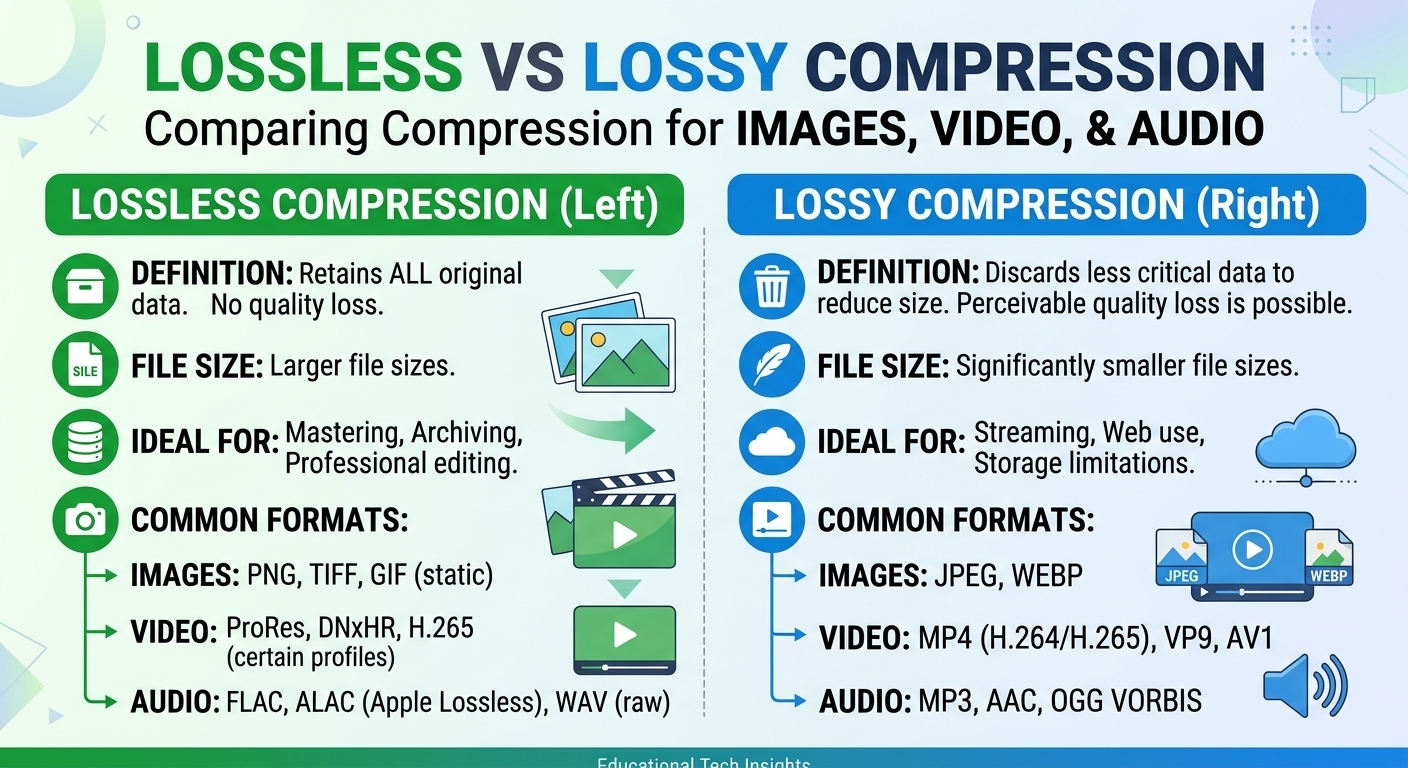
Lossy vs Lossless Compression: Images, Video and Audio
Lossy vs lossless compression comes down to one trade: lossless compression rebuilds every original bit and typically ...
In live streaming, a delay of just five seconds can cut viewer engagement by nearly half, according to multiple industry QoE studies—and yet many “live” streams still trail real-time by 30–90 seconds. If your audience is watching a goal, a stock spike, or an esports play on Twitter before it appears in your player, that’s not just annoying; it kills trust and retention. Choosing the best CDN for live streaming is no longer a minor infrastructure decision—it’s the difference between a real-time experience and a replay.
This article breaks down how to minimize lag for real-time video, what really separates a modern live streaming CDN from a generic web CDN, and how to evaluate providers with data, not promises. Along the way, you’ll see how leading platforms approach ultra-low latency—and how you can use similar strategies without enterprise-scale budgets.
Before you can pick the best CDN for live streaming, you need to define what “live” actually means for your use case. Not every stream needs sub-second latency, but every stream needs consistent, predictable delay.
Notice that “best” does not mean “fastest possible at any cost.” The right CDN for real-time video balances latency with stability, scalability, and cost for your specific industry and audience.
Ask yourself: if you measured glass-to-glass delay for your current live streams right now, would the number support the experience you’re selling to your users?
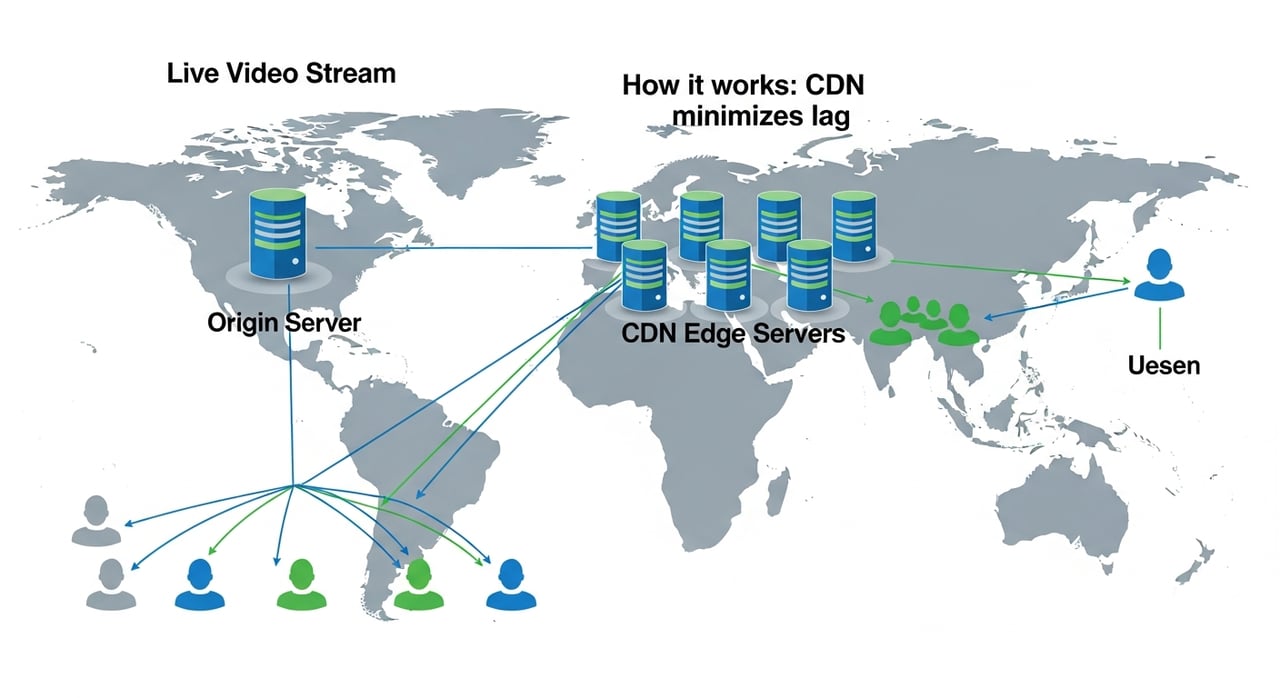
CDNs were originally built to cache static content—images, JS, CSS, downloads. Live streaming has a completely different traffic profile: continuous, time-sensitive chunks that can’t be served stale. That’s why the best CDN for live streaming often looks quite different from the best CDN for websites.
A simplified end-to-end pipeline looks like this:
Lag can grow at every hop. If the CDN is not optimized for real-time video, it can magnify upstream issues:
Traditional CDNs excel at delivering large, cacheable objects. For live, you need one that’s engineered around high request rates, small objects, and time-sensitivity—otherwise, your “live” stream turns into a delayed replay.
If you mapped your current delivery chain, where do you suspect most of your latency is born: in your encoder, your origin, or the CDN edge?
Once you know where lag can appear, you can define what to look for in a live streaming CDN. Here are the dimensions that matter most when you’re aiming to minimize lag for real-time video.
End users don’t care about your “max throughput.” They care that the stream starts quickly and stays close to live without stalling. A good live CDN should demonstrate:
Conviva’s State of Streaming reports have repeatedly shown that even a 1 percentage-point increase in buffering can significantly reduce viewing time. When you compare CDNs, ask for real QoE metrics under live loads, not synthetic web tests.
Modern live workflows rarely rely on a single protocol. Your CDN should support and handle:
If your current or future roadmap includes interactivity (live betting, auctions, co-watching, live shopping), make protocol support and flexibility a non-negotiable requirement.
Live events create heavy load bursts on your origin—especially right at kickoff or when a big moment happens. Without proper origin shielding, you can see traffic spikes from thousands of edge servers all hitting your origin simultaneously.
The best CDNs for streaming minimize origin hits by:
Ask your providers: how do you protect my origin during live spikes, and what tooling do you give me to see that behavior in real time?
Global audience distribution is uneven. Sports events, K-pop concerts, or major esports tournaments can concentrate millions of viewers in a handful of regions. If your CDN routes sub-optimally or has weak capacity in those areas, latency and buffering will spike.
Input you should request from CDN vendors:
Do you know where your next 100,000 live viewers are likely to come from—and does your CDN have the performance profile to match?
To minimize lag for real-time video, you must be able to see what’s happening while the event is live.
Look for:
If your CDN can’t surface live telemetry, you’re effectively flying blind during your most valuable events. How quickly could you detect and fix a latency regression right now?
Live traffic is spiky. You might see 10x differences between a normal day and a championship match. The best CDN for live streaming will:
If your finance team dreads every big event because of surprise CDN overages, your provider is working against you, not with you.
“Lag” is a loaded term. To pick and tune the right CDN, you need precise metrics. Major streaming platforms and analytics providers typically track at least four key indicators.
This is the time from when something happens in front of the camera to when it appears on the viewer’s screen. It includes encoding, packaging, CDN, and player buffer.
Time-to-first-frame (TTFF) is how long it takes for a viewer to see the first image after pressing play. Several studies show that users start abandoning a stream if it takes more than 2–3 seconds to start, and abandonment accelerates sharply beyond 5 seconds.
Rebuffering ratio is the percentage of total viewing time spent in buffering. Conviva’s State of Streaming reports have shown that higher rebuffering directly correlates with shorter viewing sessions and higher churn.
Live edge distance reflects how far behind “live” each viewer actually is. A player might intentionally stay a few seconds behind the encoder to avoid stalls, but an inefficient CDN or poorly tuned player can push this much higher.
When you evaluate CDNs, do you focus only on bandwidth price—or do you request data on these four QoE metrics under realistic live conditions?
Minimizing lag for real-time video is not just a CDN decision; it’s an end-to-end architecture decision. However, the right CDN can make or break your latency budget.
A live-aware CDN should let you:
Even with a perfect CDN, a conservatively configured player can add 10–20 seconds of buffer. Work with your player team to:
Have you run a full end-to-end latency budget for your workflow—from camera to viewer—and identified how many seconds each component is allowed to “spend”?
Major live events over the past decade have exposed the limits of poorly tuned streaming architectures. Viewers of global sports tournaments, high-profile TV finales, and major award shows have often complained that social media or traditional broadcast spoiled key moments 30–60 seconds before they appeared in OTT streams.
Several drivers contributed to these gaps:
At the same time, forward-looking platforms have shown that sub–5 second latency at global scale is feasible when all the pieces align. Some sports services have publicly described using CMAF-LL or LL-HLS combined with tuned CDNs and carefully calibrated players to keep OTT nearly in sync with broadcast feeds.
When your audience compares your live latency, they’re not comparing you to your competitors’ tech stack—they’re comparing you to the last great streaming experience they had. Are you on the right side of that comparison today?
Most engineering teams short-list a handful of well-known CDNs and then run trials. What matters is not the logo, but how each provider behaves under your traffic patterns. Still, it’s useful to understand general positioning and trade-offs.
| CDN | Typical Strengths | Considerations for Live Streaming |
|---|---|---|
| Amazon CloudFront | Deep AWS integration, global reach, mature ecosystem. | Excellent stability and tooling; pricing can become high at scale, especially for bandwidth-heavy live events. |
| Akamai | Long history with media & broadcast, strong enterprise presence. | Robust live capabilities; contracts and pricing often optimized for very large, long-term commitments. |
| Fastly | Developer-centric, powerful edge configuration, strong performance. | Great control for advanced teams; pricing and complexity may be overkill for some organizations. |
| Cloudflare | Broad feature set, strong security, competitive global performance. | Attractive for web properties; for specialized live streaming, you may need additional tuning or components. |
| BlazingCDN | High-performance delivery tailored for media, modern stack, aggressive pricing. | Pay-as-you-go pricing starting at $5 per TB (as of October 2026), down to $2.50 per TB at volume, making it cost-effective for sustained or spiky live traffic. |
Instead of asking “who is the biggest CDN?”, ask: “Which CDN can give me stable sub–X second latency with predictable pricing for my audience geography and event profile?”
For media companies, gaming platforms, and SaaS providers that rely on live video, BlazingCDN positions itself as a modern, performance-focused alternative to legacy CDNs. Architected with live traffic patterns in mind, it supports live HLS/DASH delivery at bandwidth cost starting at $5 per TB (as of October 2026), which can translate into substantial savings for large enterprises and corporate clients running frequent events or 24/7 channels.
BlazingCDN has been adopted by forward-thinking organizations that need to scale quickly for high-demand events while keeping infrastructure costs predictable. It is particularly well-suited to media broadcasters, live commerce platforms, esports and gaming ecosystems, and SaaS products that embed real-time webinars or support streams. With flexible configuration options and a focus on live and on-demand video, it helps engineering teams align technical performance with business efficiency.
If you are evaluating specialized delivery for sports, live news, concerts, or always-on channels, it’s worth reviewing how BlazingCDN’s live-optimized architecture and pricing map to your workflows—start with their dedicated CDN solutions for media companies to see real-world scenarios and configuration patterns.
Given your current live streaming roadmap, how much would it help to reclaim 20–40% of your CDN budget while staying at or above your existing reliability targets?
To avoid vendor lock-in or costly mistakes, treat CDN selection as an engineering experiment rather than just a procurement exercise. Here’s a practical checklist.
If you can’t write these down, you can’t fairly compare live CDN performance.
When you engage CDNs, explicitly ask for trials that allow:
Providers that are serious about live streaming will lean in during this phase; if they push you to generic HTTP benchmarks, that’s a red flag.
The goal is not only to see which CDN is “fastest,” but which delivers consistent, predictable real-time video under stress.
Bandwidth price is only one piece. Also consider:
If a slightly more expensive per-TB rate saves hours of firefighting per event, the overall ROI may still favor that provider.
Many large streaming platforms use multi-CDN strategies to ensure resilience and to optimize performance across regions and ISPs. Even if you start with a single CDN, design your workflow so you can add a second later without a full re-architecture.
Could your current workflow switch traffic between CDNs without viewers noticing, or would it require a major re-deployment?
Different industries experience live streaming constraints in very different ways. The “best CDN for live streaming” for a global sports broadcaster may not be the best for a SaaS webinar platform or a mobile-first live shopping app.
Live sports is where lag is most visible—fans compare streams across devices and social media in real time. Additionally, rights holders may require latency that’s comparable to broadcast for competitive reasons.
Key CDN needs:
Test whether your candidate CDN can keep your OTT stream within a few seconds of traditional broadcast during a real high-stakes match, not just a lab demo.
Esports and game streaming audiences are particularly sensitive to latency. Chat, reactions, and social streams all compete in parallel. If a big play appears on one platform before another, viewers notice immediately.
Key CDN needs:
Could your CDN sustain thousands of concurrent, always-on channels without making your bandwidth bill explode?
Enterprises increasingly use video for town halls, investor days, training, and customer webinars. The audience may be smaller than consumer platforms, but reliability and security expectations are very high, and viewers may be globally distributed.
Key CDN needs:
In this context, a CDN that offers enterprise-grade stability with straightforward per-TB pricing can simplify both technical and budget planning.
EdTech platforms rely on real-time video for virtual classrooms, exams, and tutoring sessions. Here, interactivity (questions, polls, breakout rooms) is as important as the video itself.
Key CDN needs:
Is your CDN helping you reach students smoothly on older hardware and variable networks, or does your “real-time” experience only work in ideal conditions?
Global internet usage patterns add another layer of complexity. Cisco’s Annual Internet Report projected that video would account for about 82% of all IP traffic by 2022, driven largely by streaming and live video consumption. This explosion makes efficient, scalable live delivery a necessity rather than a nice-to-have.
For CDNs and streamers, this means:
Linking your CDN decisions to macro trends helps justify investments: a few milliseconds shaven off per segment may not sound like much, but multiplied by millions of concurrent viewers over thousands of hours, it’s the difference between a nimble platform and one constantly in crisis mode.
As your total live hours grow over the next 12–24 months, are you confident your current CDN and architecture will scale linearly—both in performance and cost?
You now know what separates a generic CDN from the best CDN for live streaming: low and predictable latency, intelligent origin shielding, real-time observability, protocol flexibility, and pricing that doesn’t punish you for success. You’ve also seen how different industries—from sports and esports to SaaS and education—translate these principles into specific technical and business requirements.
The next step is to put this knowledge to work. Map your full live pipeline, set explicit latency and QoE targets, then run structured trials with one or two carefully chosen CDNs—including at least one modern, cost-efficient provider optimized for real-time video like BlazingCDN. Instrument your players, measure glass-to-glass delay, and compare total cost and effort, not just headline bandwidth rates.
If you’re serious about eliminating spoilers, keeping chat in sync, and delivering streams that feel truly live, start today: audit your current metrics, share this article with your team, and open a discussion about where your latency budget is really going. Then invite your engineers, product owners, and finance stakeholders to weigh in on what kind of streaming experience your brand wants to stand for—and choose a CDN strategy that makes that experience non-negotiable.

Heavy traffic.
Light bill.
The CDN for video and large traffic
Learn
Lossy vs lossless compression comes down to one trade: lossless compression rebuilds every original bit and typically ...
Pricing - Pricing & Costs
The CloudFront vs S3 decision depends more on object size than on traffic volume. At a 500 KB average response, 100 TB ...
Learn
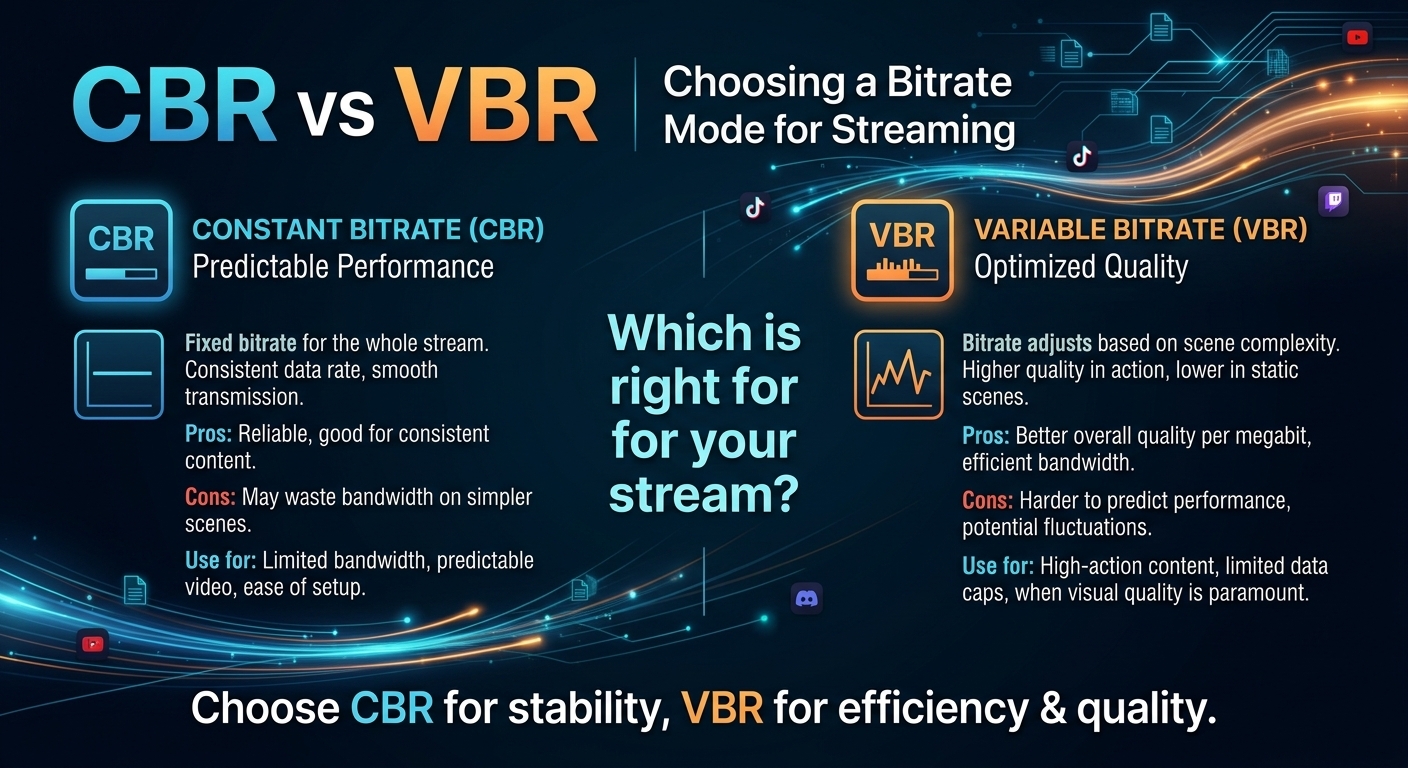
For most on-demand video, capped variable bitrate (VBR) wins the cbr vs vbr decision: it spends bits where the picture ...