
Learn
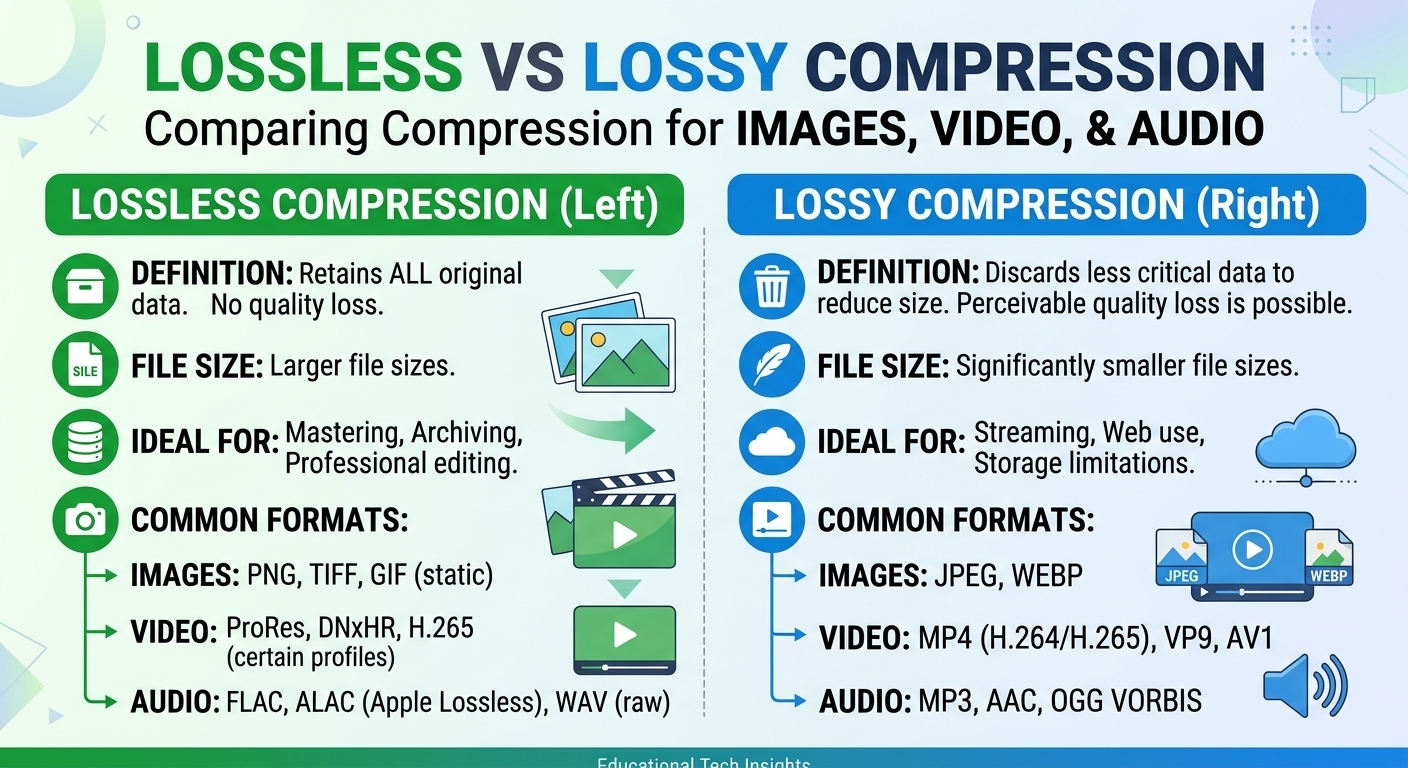
Lossy vs Lossless Compression: Images, Video and Audio
Lossy vs lossless compression comes down to one trade: lossless compression rebuilds every original bit and typically ...
During the 2026 ICC Champions Trophy final in February, one major OTT platform reported a 12% viewer drop within 90 seconds of a rebuffering spike — roughly 1.4 million concurrent viewers lost before the issue was mitigated by a secondary CDN failover. That single incident underscores why choosing the best CDN for live streaming is not an abstract capacity-planning exercise; it is a revenue and retention decision measured in seconds. This article gives you a concrete framework: the live-specific metrics that matter in 2026, a workload-profile decision matrix you will not find in the current top-10 results for this query, updated protocol benchmarks, and a realistic cost model that accounts for the expenses vendors hope you will overlook.
Two shifts redefined the landscape this year. First, Apple's LL-HLS refinements shipped in iOS 18.4 (March 2026) tightened partial-segment preload behavior, which means CDNs that previously faked LL-HLS compliance by simply reducing segment duration now expose measurably higher video start times on Safari — the dominant mobile browser for premium sports and entertainment audiences. Second, the growing adoption of CMAF-CTE (Common Media Application Format with chunk transfer encoding) by encoder vendors like Harmonic, Elemental, and MainConcept has made the CDN's ability to proxy chunked transfer in a cache-friendly way a hard differentiator, not a checkbox feature.
If your CDN evaluation criteria have not changed since 2024, you are optimizing against a stack that no longer matches real-world player behavior.
Glass-to-glass latency is the sum of five segments, and in 2026 the bottleneck has shifted. Capture-to-encode adds 30–80 ms (hardware encoders) or 150–400 ms (software). Transcoding and packaging, if done in the cloud, contributes 0.5–2 seconds depending on segment length and ladder complexity. CDN propagation from origin to edge is typically 50–200 ms. Player buffering is protocol-dependent: 2–6 seconds for LL-HLS, 1–4 seconds for LL-DASH, and sub-500 ms for WebRTC.
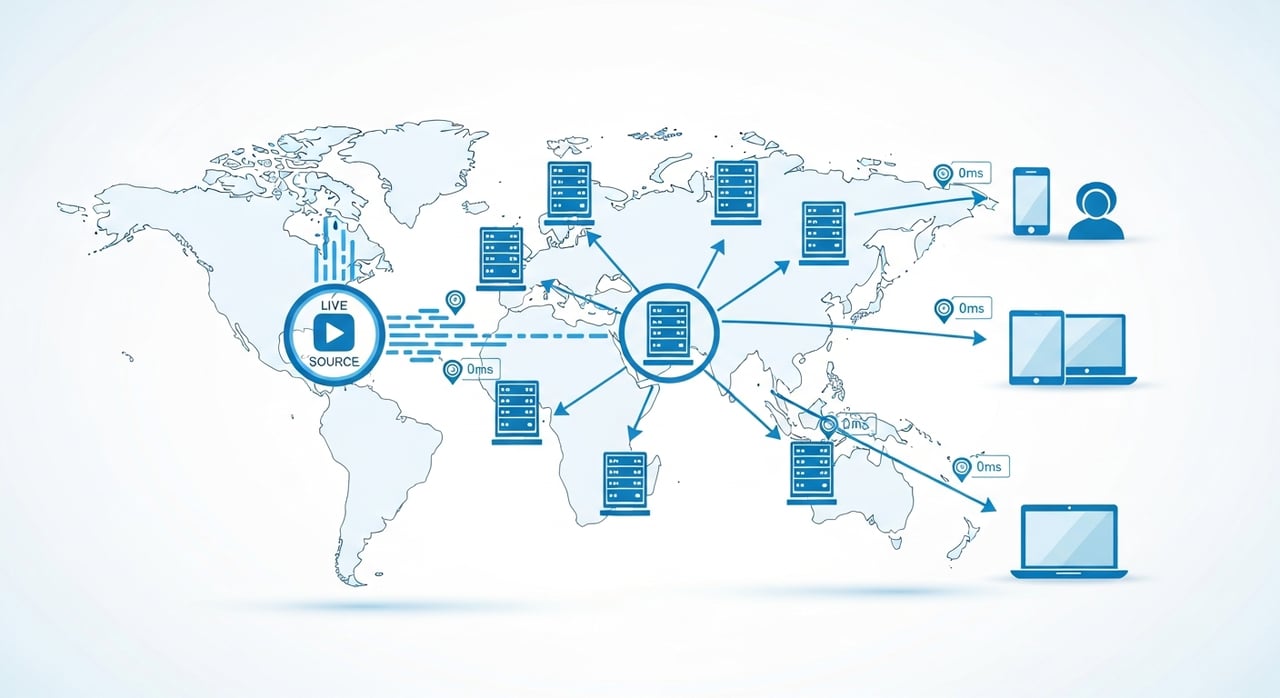
The CDN's share of total latency is often the smallest slice, but the CDN is the amplifier. A CDN that cannot coalesce simultaneous origin requests for the same partial segment during a flash crowd will hammer your packager, which cascades into encoding queue pressure, which raises latency across the entire pipeline. Origin shielding and request coalescing are not premium features — they are table stakes for any live streaming CDN operating at scale in 2026.
| Protocol | Typical Glass-to-Glass | Scalability Ceiling | Best Fit |
|---|---|---|---|
| Traditional HLS/DASH | 20–45 s | Millions of concurrent | VOD-like live, long-form |
| LL-HLS (2026 spec) | 2–6 s | Millions of concurrent | Sports, concerts, news |
| LL-DASH / CMAF-CTE | 1.5–4 s | Hundreds of thousands | Multi-platform OTT |
| WebRTC / WHEP | <500 ms | Tens of thousands | Betting, auctions, collab |
Forget feature-matrix bingo. Five capabilities separate a live-grade CDN from a generic file-delivery network:
This is the section the existing top-10 articles do not give you. Instead of ranking seven vendors in a generic list, map your workload to a profile and evaluate CDNs against the constraints that actually bind your architecture.
| Workload Profile | Binding Constraint | CDN Must-Haves | Strong Candidates (2026) |
|---|---|---|---|
| Tier-1 live sports (1M+ concurrent) | Flash-crowd scale + sub-5s latency | LL-HLS partial segments, request coalescing, multi-CDN support | Akamai, CloudFront, Fastly |
| Mid-market streaming (50K–500K concurrent) | Cost per TB at volume + reliability | Origin shielding, flexible scaling, real-time logs | BlazingCDN, Cloudflare, KeyCDN |
| Interactive / real-time (<1s latency) | Sub-second glass-to-glass | WebRTC/WHEP relay, edge compute for signaling | Cloudflare (Calls), Millicast, Limelight |
| Multi-region OTT (global audience, mixed protocols) | Geographic consistency + protocol flexibility | CMAF-CTE support, multi-origin, per-region config | Akamai, Fastly, BlazingCDN |
| UGC / creator platforms (high stream count, low per-stream viewers) | Per-stream origin cost + long-tail caching | Efficient cache fill for low-popularity streams, predictable pricing | Cloudflare, BlazingCDN, BunnyCDN |
A video streaming CDN priced at $0.02/GB looks expensive next to one priced at $0.005/GB until you account for what is not on the rate card. Three cost categories are routinely underestimated in live streaming CDN evaluations:
Origin egress. If the CDN has weak or no origin shielding, every edge POP fetches independently. For a live stream with 200 edge locations and 6-second segments, that is 200 origin fetches per segment per bitrate. At a six-rung ABR ladder, you are looking at 1,200 origin requests every 6 seconds for a single stream. On AWS origin, that origin egress alone can exceed the CDN delivery cost.
Operational overhead. A CDN with a 48-hour support SLA and no real-time diagnostics API will cost you engineering hours during every event. Price that at your team's loaded hourly rate and the "savings" evaporate.
Viewer churn from quality failures. As of Q1 2026, industry data shows that each 1% increase in rebuffering ratio correlates with roughly a 5.8% increase in session abandonment for ad-supported live streams. If your CDN saves $3,000/month but causes one additional rebuffering event per viewer per hour, the ad-revenue loss on a 100K-viewer stream dwarfs the savings.
For organizations running mid-market to large-scale live streams where cost efficiency matters as much as reliability, BlazingCDN's media delivery infrastructure offers live HLS/DASH delivery with Anycast routing and built-in failover, at pay-as-you-go rates starting at $5 per TB and down to $2.50 per TB at volume (as of October 2026). For live workloads that spike unpredictably, transparent volume-based pricing eliminates the surprise invoice problem that plagues many CDN contracts.
Synthetic load tests with uniform request patterns will tell you almost nothing about live streaming performance. Here is the evaluation protocol we recommend for any CDN shortlist in 2026:
Work backward from user experience. Sports betting requires sub-3 seconds glass-to-glass. A live concert tolerates 8 seconds. A town-hall webinar tolerates 15. Set the number, then allocate budget across the pipeline: encoder, packager, CDN, player. The CDN gets roughly 200 ms or less in a well-tuned LL-HLS stack.
Live events do not produce steady-state traffic. Model a 10x ramp in 60 seconds (kickoff), a 3x spike on top of plateau (goal scored), and a 70% drop in 30 seconds (halftime). Measure video start time and rebuffering ratio during the ramp, not during steady state.
Four metrics define a live streaming CDN's quality: glass-to-glass latency (measured at the player, not the edge), video start time (p50 and p95), rebuffering ratio (seconds of rebuffer per hour of play), and segment error rate (4xx/5xx per 1,000 segment requests). If the CDN vendor cannot provide these broken down by POP and by bitrate, their observability is not live-grade.
Inject a synthetic failure — block the primary CDN's edge responses for 10 seconds — and measure how long your player takes to recover via the secondary path. If the answer is more than two segment durations, your failover architecture needs work regardless of which CDN you choose.
There is no single answer. The best CDN for live streaming depends on your workload profile. For tier-1 sports at million-plus concurrency, Akamai and CloudFront remain dominant. For mid-market and cost-sensitive high-volume streaming, BlazingCDN and Cloudflare deliver strong reliability at lower per-TB rates. For sub-second interactive use cases, WebRTC-native platforms like Cloudflare Calls or Millicast are purpose-built.
Switch from traditional HLS/DASH to LL-HLS or LL-DASH with CMAF-CTE packaging. Ensure your CDN supports partial-segment relay rather than full-segment buffering. Tune player buffer settings to the minimum stable level for your audience's network conditions, and use origin shielding to prevent origin overload from cascading into increased latency.
WebRTC distribution beyond a few hundred viewers requires a selective forwarding unit (SFU) mesh or a WebRTC-to-HLS bridge. As of 2026, Cloudflare Calls and Millicast (now part of Dolby.io) offer the most mature WebRTC relay networks. For hybrid architectures where WebRTC feeds a low-latency HLS tier, any CDN with strong LL-HLS support can serve the broader audience.
For any event where a mid-stream outage has measurable business impact — paid PPV, ad-supported tentpole sports, regulated financial broadcasts — yes. Single-CDN delivery for critical live events is an unhedged risk. The cost of a secondary CDN path is typically 10–15% of primary CDN spend and eliminates the single-vendor failure mode.
Rates vary widely. Major hyperscaler CDNs (CloudFront, Google Cloud CDN) charge $0.02–$0.085/GB depending on region and commitment. Specialist and independent CDNs range from $0.0025/GB to $0.01/GB. BlazingCDN, for example, prices from $5/TB down to $2.50/TB at volume (as of October 2026). The real cost comparison requires factoring in origin egress, request fees, and support SLAs.
LL-HLS uses HTTP/2 push or blocking playlist reload with partial segments and is natively supported on Apple devices. LL-DASH relies on CMAF chunked transfer and availability-time offsets. In practice as of 2026, LL-HLS has broader device support due to iOS/Safari dominance, while LL-DASH can achieve marginally lower latency on Android and smart TV platforms. Most production stacks package both from a single CMAF source.
If you are evaluating a live streaming CDN this quarter, here is one concrete action worth taking this week: instrument glass-to-glass latency on your current stack using a reference player with an NTP-synced overlay against a known-time source. Most teams discover their actual latency is 30–60% higher than what their CDN dashboard reports, because the dashboard measures edge delivery time, not player presentation time. That delta is your optimization surface. Measure it before you negotiate your next CDN contract, and you will know exactly what you are buying — and what you are not.

Heavy traffic.
Light bill.
The CDN for video and large traffic
Learn
Lossy vs lossless compression comes down to one trade: lossless compression rebuilds every original bit and typically ...
Pricing - Pricing & Costs
The CloudFront vs S3 decision depends more on object size than on traffic volume. At a 500 KB average response, 100 TB ...
Learn
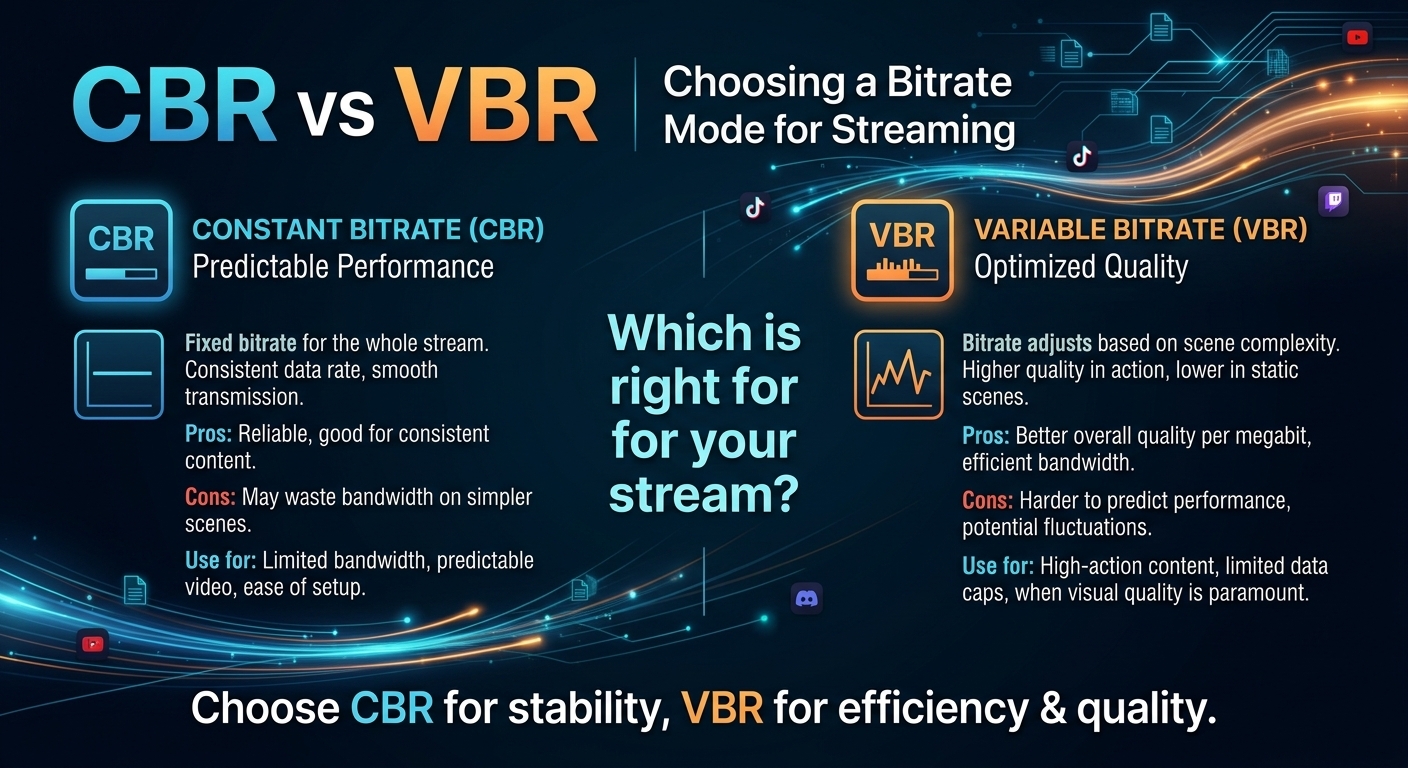
For most on-demand video, capped variable bitrate (VBR) wins the cbr vs vbr decision: it spends bits where the picture ...