
Learn
How a Multi-CDN Strategy Saved Us from Costly Downtime
In a recent survey, 60% of enterprises reported that a single hour of critical-application downtime costs them at least ...
When Amazon’s engineers discovered that every extra 100 milliseconds of latency cost about 1% in sales, it permanently changed how the industry thinks about speed. For e-commerce, those fractions of a second are not technical details — they are lost carts, abandoned checkouts, and millions in missed revenue.
If you’re serious about growth, choosing the best CDN for your e-commerce site is no longer optional. It’s one of the highest-leverage decisions you can make to improve conversion rates, average order value, and customer lifetime value — all by making your pages load faster, everywhere.
In this guide, we’ll break down how a CDN transforms e-commerce performance, what really matters when you’re choosing a provider, how to compare your options, and why the right platform can turn milliseconds into measurable revenue.
As you read, keep asking yourself: if your site became 30–50% faster this month, what would that be worth in sales?
Before we talk about CDNs, it’s worth pausing on what speed actually does to your bottom line. This isn’t about vague “user experience”. It’s about hard numbers.
Multiple independent studies have shown a direct link between page load time and revenue:
These are not edge cases reserved for tech giants. They reflect fundamental user behavior that affects every online store, whether you are doing 100 orders a day or 100,000.
Online stores are uniquely sensitive to slowness because they rely on:
Every extra second on any step of that journey is another chance for the shopper to lose interest, get distracted, or decide to “come back later” (and never do).
CDNs (Content Delivery Networks) exist for one primary reason: to make your website faster and more reliable for users all over the world. For e-commerce, this translates directly into:
The right CDN doesn’t just shave off milliseconds; it can cut seconds off load time for users in distant regions — especially on mobile connections.
Ask yourself: how many of your visitors are outside your primary hosting region, and how much latency are they silently paying for on every product page?
“CDN” is often used as a buzzword, but understanding the mechanics helps you make smarter choices and avoid overpaying for features you don’t need.
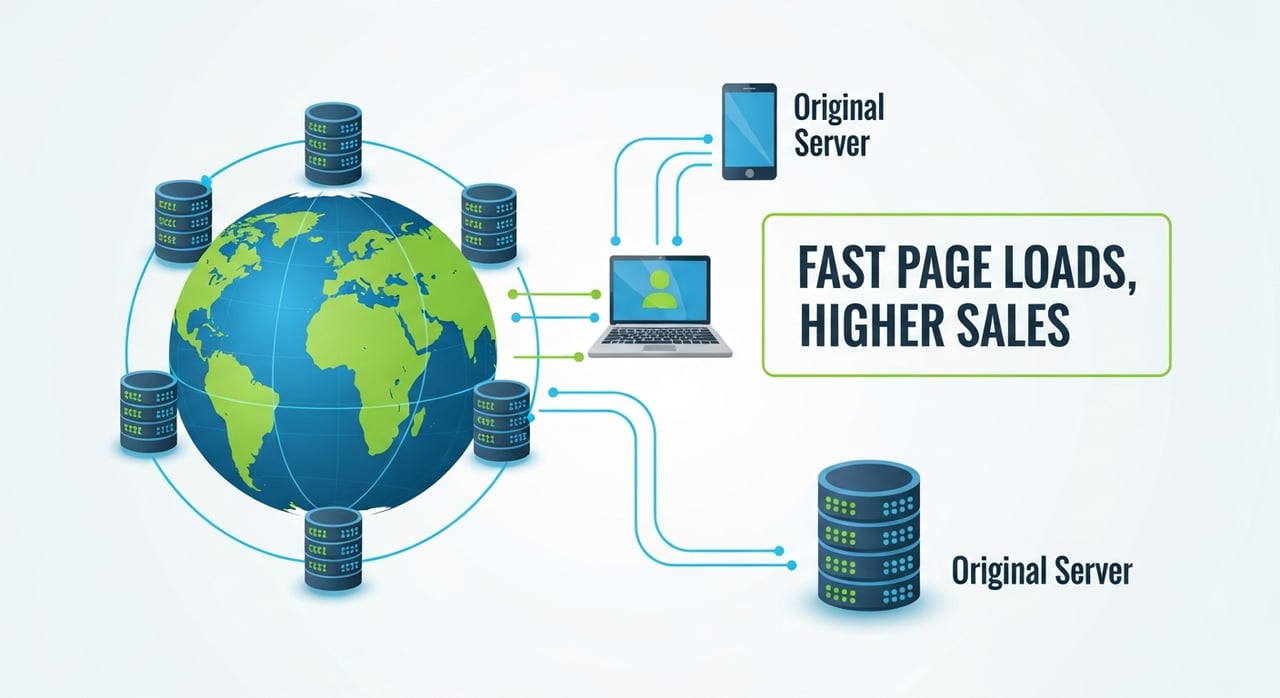
Without a CDN, every user request must travel all the way to your origin server (for example, a data center in Frankfurt or Virginia) and back. The further away the user is, the more latency they experience.
A CDN reduces this distance by storing copies of your static content — such as product images, CSS, JavaScript, and some HTML fragments — on servers that are geographically closer to your shoppers. When a user visits your site, most of the content is delivered from this closer location, dramatically reducing latency.
For an online store, the best CDNs deliver improvements in a few critical areas.
TTFB measures how long it takes from the moment a user’s browser requests a page until the first byte of data starts arriving. A good CDN improves TTFB by:
Why it matters: Lower TTFB improves perceived speed and boosts metrics like First Contentful Paint (FCP) and Largest Contentful Paint (LCP), both important Core Web Vitals that impact SEO and user satisfaction.
Product images and videos are conversion drivers, but also the biggest performance bottlenecks. A CDN optimized for e-commerce will:
This can cut image payload size by 30–70%, often translating into seconds saved on slower connections.
Not all content can be cached, but smart CDNs allow you to cache more than you’d expect. For example:
By carefully controlling cache headers, cache keys, and variations (e.g., by country or device type), you can achieve both personalization and speed.
Peak traffic is where many stores lose the most money. Launches, seasonal campaigns, or viral posts can triple or 10x your traffic in minutes. A robust CDN offloads the bulk of this traffic from your origin, preventing slowdowns and crashes.
Instead of scrambling to scale infrastructure at the last moment, you let the CDN absorb the surge gracefully.
If your next major promotion performs better than expected and traffic explodes, will your current stack keep up — or turn success into downtime?
Speed alone doesn’t make people buy — but it removes friction that stops them from buying. Understanding that conversion chain helps you prioritize where CDN gains matter most.
Most paid campaigns and organic traffic land on:
If these pages are slow, bounce rates spike. Visitors never even see your product details or offers.
A high-performance CDN accelerates the critical metrics on these pages:
Improving LCP from, say, 4 seconds to under 2 seconds can significantly increase the number of users who stay and browse, which naturally feeds more shoppers into your product pages and cart.
Once shoppers land on a product page, you want them to:
Every media asset and script that powers these features benefits from CDN acceleration. Optimized delivery here improves both conversion rate and average order value — because engaged users tend to explore more products and add more to their cart.
The worst place to lose a customer is at checkout. Even small delays here can feel risky to users entering card details or authorizing payments. A CDN helps by:
While some checkout steps are highly dynamic and not fully cacheable, the surrounding assets still benefit significantly from CDN distribution.
Look at your analytics: which step of your funnel has the biggest drop-off, and how much of that might be explained by speed or instability on that specific page?
Not all CDNs are created equal, and not every feature matters equally for online stores. Here’s what you should prioritize when evaluating providers.
Beyond generic “low latency” promises, ask how the CDN actually performs for:
Look for performance benchmarks relevant to real e-commerce traffic patterns, not just synthetic tests of a simple static file.
One of the strongest levers for speed is how you control caching. The best CDNs for e-commerce give you fine-grained tools:
Without these controls, you’ll either cache too aggressively (and risk stale content) or too conservatively (and lose performance).
Look for built-in capabilities such as:
Better yet, choose a CDN that can act as a central optimization layer so your developers don’t need to build and maintain complex media pipelines.
For international brands and marketplaces, local reliability is as important as raw speed. Look for:
Downtime during a major sale can wipe out the entire year’s margin gains from your optimization work.
Many enterprises discover the hard way that CDN bills can be as volatile as ad spend. For e-commerce, where margins are often tight, you need:
High, opaque pricing models can make it difficult to confidently expand into new markets or roll out richer experiences (like more video, AR try-ons, or high-res lookbooks).
Do you know your current cost per 1,000 pageviews for content delivery — and how much of that is pure overhead you could cut with a better-fit CDN?
The CDN market is crowded. Legacy giants, cloud-native options, and newer specialized providers all compete for e-commerce workloads. Instead of obsessing over brand names, compare them on the axes that matter most to your store: performance, reliability, and cost efficiency.
| Criteria | What to Look For | Why It Matters for E-Commerce |
|---|---|---|
| Performance | Low TTFB, strong Core Web Vitals, optimized routing | Direct impact on conversion rates and SEO across product, cart, and checkout pages |
| Reliability | Documented 100% uptime, robust SLAs, stable performance during peaks | Prevents revenue loss during promotions, holidays, and product launches |
| Caching & Controls | Configurable rules, instant purge, smart cache keys | Balances freshness (prices, inventory) with speed and scalability |
| Media Optimization | Image compression, format conversion, responsive delivery | Speeds up product pages without sacrificing visual quality |
| Pricing | Transparent per-GB/TB pricing, fair enterprise discounts | Helps predict infrastructure costs as traffic and media richness grow |
| Enterprise Fit | Account management, custom configs, integrations with e-commerce stacks | Shortens implementation time and ensures alignment with your architecture |
Cloud-native CDNs like Amazon CloudFront are deeply integrated into broader cloud ecosystems, which can be an advantage if you are all-in on that cloud. However, they are not always the most cost-effective or flexible for fast-growing e-commerce brands.
For example, in many regions, CloudFront’s published pricing for the first usage tiers sits in the range of a few cents per GB — acceptable for small volumes, but increasingly expensive as you scale into tens or hundreds of terabytes per month.
Specialized CDNs built with modern architectures can match or exceed these platforms in stability and performance, while offering more attractive pricing and simpler control for enterprise customers who want high performance without vendor lock-in.
If you benchmarked your current CDN against a specialized, cost-optimized provider today, how much performance and budget headroom might you discover?
For enterprises and high-growth online retailers, the ideal CDN combines the stability of cloud giants with more favorable economics and flexibility. This is where BlazingCDN is intentionally positioned.
BlazingCDN is engineered to deliver 100% uptime with performance and stability on par with leading platforms like Amazon CloudFront. For e-commerce, this means:
Large enterprises and corporate clients choose BlazingCDN because they need this level of reliability without paying a premium tax for the brand name alone.
One of BlazingCDN’s key advantages is its straightforward, aggressive pricing: starting at $4 per TB (that’s just $0.004 per GB). For e-commerce businesses pushing high traffic volumes, rich media, and international expansion, this can translate into substantial savings compared to traditional providers whose costs are often multiple times higher per GB.
Those savings can be reinvested into growth levers that move the needle more directly — marketing, UX improvements, product content, or further performance optimization.
BlazingCDN is an excellent match for modern e-commerce operations, including:
These businesses benefit from BlazingCDN’s ability to scale quickly with demand, support flexible configurations, and reduce infrastructure costs while maintaining or improving performance — a combination that has already made it a favored choice among enterprises that care about both reliability and efficiency.
If you want a clear view of how this pricing model compares to legacy CDNs, it’s worth exploring the detailed breakdown available on the BlazingCDN pricing page and mapping it against your current monthly data transfer.
Imagine reallocating 20–40% of your current CDN spend into performance testing, CRO, or content — what kind of compounding impact could that have over the next 12 months?
Choosing “the best CDN for e-commerce” isn’t about picking the loudest brand; it’s about aligning the platform with your current stack, growth plans, and performance goals. Here is a practical process you can follow.
Before switching or optimizing, capture a baseline. Measure:
Use tools like Chrome User Experience Report, your analytics platform, and RUM (Real User Monitoring) data if available.
Instead of listing technical features in isolation, tie them directly to business needs:
These statements guide which CDN features truly matter and which are optional for your use case.
Build a shortlist of 2–4 providers and compare them on:
Remember that “fastest in a synthetic test” doesn’t always translate to “best for our real traffic.” Look for providers willing to run realistic trials with your actual workloads.
Whenever possible, run an A/B or phased rollout test:
This allows you to quantify the impact in terms that matter: additional revenue, fewer failures, better user satisfaction.
After implementation, treat your CDN as a living part of your infrastructure, not a “set and forget” checkbox:
If you implemented a new CDN tomorrow but never tuned cache rules or media settings, how much of its potential value would you be leaving on the table?
Looking at what leading retailers have shared publicly provides a useful playbook for brands of all sizes.
As mentioned earlier, Walmart’s own engineering team has reported that faster load times correlated strongly with conversion improvements, with even 1-second gains translating into measurable revenue increases. Amazon famously observed that an additional 100 ms of latency led to roughly a 1% drop in sales.
Deloitte’s study of mobile site speed for retail and travel showed that modest improvements of just 0.1 seconds drove 8.4% higher conversion rates for retail sites and 10.1% for travel.1 These are improvements many CDNs can unlock simply by bringing content closer and optimizing delivery — especially for mobile shoppers on congested networks.
There’s also an emotional component to performance that data alone doesn’t fully capture:
These trust signals influence repeat purchase behavior and word-of-mouth, amplifying the direct revenue gains from speed.
When was the last time you checked your store’s performance from a real customer’s perspective — on a mid-range phone, over a 4G connection, in another country?
The most successful e-commerce brands treat their CDN not as an invisible utility but as a strategic growth lever. They understand that every millisecond and every dollar spent on delivery has an ROI attached to it.
If you want to move from theory to results, here’s a focused 30-day action plan:
This focused approach helps you cut through vendor marketing noise and see, in your own metrics, which CDN is truly best for your e-commerce business.
In 30 days, you could either still be guessing about the impact of a CDN — or be looking at dashboards that show exactly how much faster pages and higher sales you’re earning from a better choice.
Every serious e-commerce leader already knows that speed matters — the question is whether you’re using it as a competitive advantage or treating it as a background concern. The right CDN puts you firmly in the first group: faster loads, smoother journeys, and infrastructure costs that support, rather than constrain, your growth.
If your store is growing, expanding into new markets, or pushing richer product experiences, now is the time to re-evaluate whether your current CDN is truly the best fit. Benchmark your current performance, run a grounded trial with a modern, cost-effective provider like BlazingCDN, and measure the impact in your own revenue and customer satisfaction data.
Have you recently optimized your e-commerce performance or switched CDNs? Share your experiences, questions, and results — your insights can help other teams make smarter, faster decisions. And if you’re ready to see how much speed and savings you can unlock, start mapping your current traffic and delivery costs against a modern alternative and take the first step toward turning milliseconds into margin.
1 Deloitte, “Milliseconds Make Millions: Why Mobile Speed Can Impact Business Revenue”.
2 Google/SOASTA Research, “The State of Online Retail Performance”.
Learn
In a recent survey, 60% of enterprises reported that a single hour of critical-application downtime costs them at least ...

Learn
When Deloitte analyzed billions of user sessions for major retailers, they found that shaving just 0.1 seconds off ...
Learn
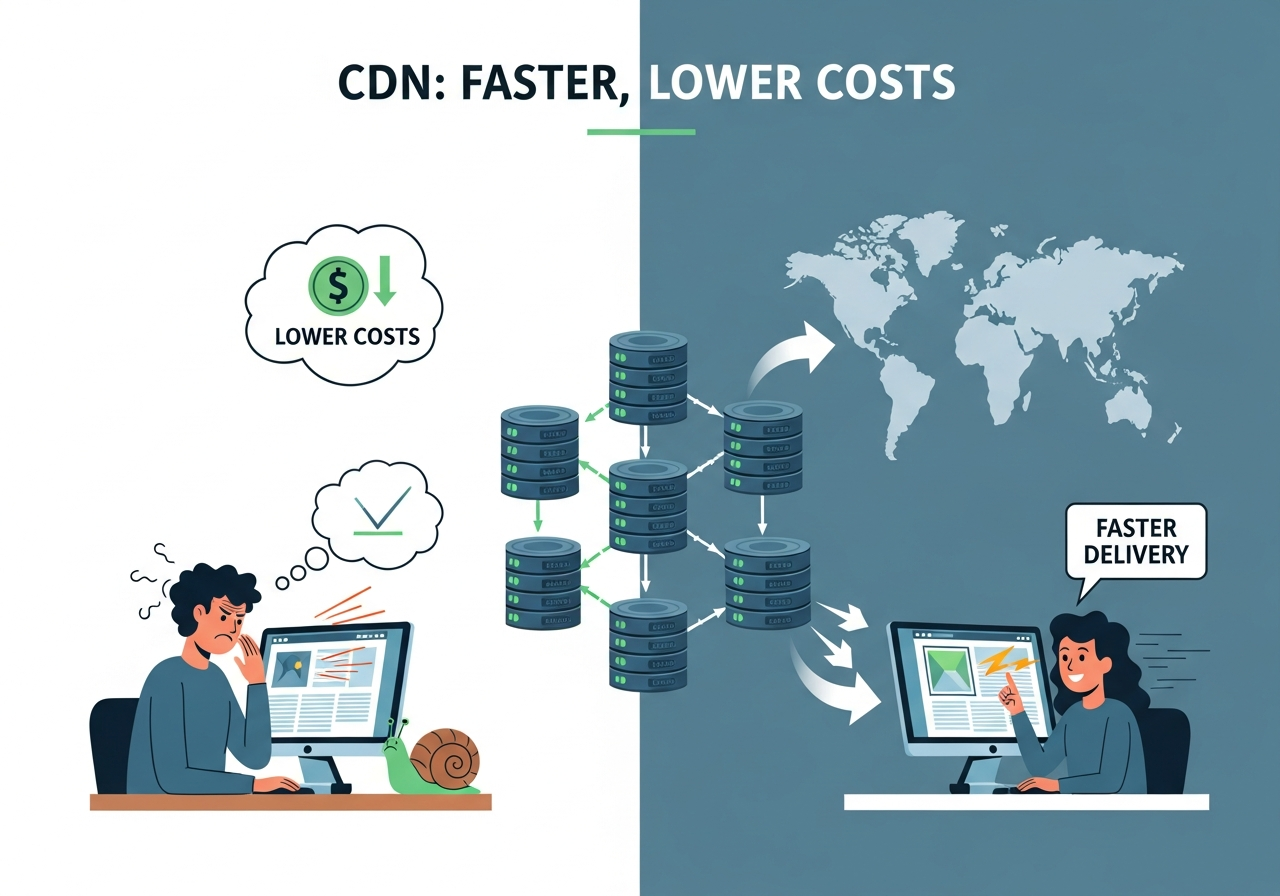
Every extra second your site takes to load can drop mobile conversions by up to 20%—that’s the stark finding from a ...