
Compare
jsDelivr vs unpkg vs cdnjs in 2026: Which Free CDN Is Fastest
jsDelivr vs unpkg vs cdnjs in 2026: Fastest Free CDN Benchmark In our Q1 2026 measurements, jsDelivr delivered an 18 ms ...
AWS changed the buying motion for CloudFront in late 2025 and expanded it again in March and May 2026. That matters because CDN pricing is no longer just a per-GB line item. For some workloads, CloudFront is still a straightforward egress purchase. For others, it is now a bundled application delivery and security contract with materially different economics, governance implications, and renewal dynamics.
The strategic question is simple: when does AWS CloudFront pricing in 2026 remain defensible, and when should enterprises treat it as a premium convenience tax rather than the default CDN choice?
My recommendation: use CloudFront when AWS integration, policy consistency, and procurement simplification matter more than the last 20 to 60 percent of delivery spend. If your traffic is large, globally distributed, or margin-sensitive, model CloudFront against cost-optimized alternatives before renewing on inertia. In 2026, that is not optional diligence. It is basic financial control.
AWS CloudFront pricing 2026 now spans two distinct commercial models. The first is the traditional pay-as-you-go model, where buyers pay per GB delivered, per request, and for selected ancillary features. The second is the flat-rate model AWS launched in November 2025 and expanded in March 2026 and again on May 12, 2026, bundling CDN, DNS, logging, edge compute, and security capabilities into fixed monthly plans.
That shift matters because most executive reviews still treat CloudFront as a commodity CDN with a simple regional egress matrix. It is not that anymore. The pricing conversation is now about portfolio fit: do you want a metered delivery service, or a bundled application delivery stack with a monthly allowance and fewer billing variables?
The stakes are larger than they look. A 5 PB annual delivery footprint priced only a few cents higher per GB can move six figures of operating expense. At 20 PB and above, the variance can exceed the annual cost of a platform team, a modernization initiative, or a meaningful share of a product launch budget.
Three things changed. First, traffic growth remains structurally high for video, software distribution, APIs, AI-assisted applications, and global web experiences. Second, boards are pressing for unit economics discipline after two years of cost optimization programs. Third, AWS has made CloudFront easier to buy as a bundle, which reduces billing friction but can hide whether you are overpaying for delivery itself.
Industry spending points the same way. IDC projected global edge computing spending to reach about $261 billion in 2025, with continued double-digit growth through 2028, and specifically called out content delivery networks as a meaningful component of service-provider edge investment. That means more executive scrutiny, not less, because CDN is no longer an isolated web performance tool. It is part of a broader edge and application delivery control plane.
Operationally, the cost of getting this wrong is not confined to the CDN invoice. If a media platform, software updater, ecommerce property, or gaming backend makes a poor delivery decision, the downstream impact shows up in abandonment, lower conversion, higher origin load, and incident response labor. Delivery architecture now sits in the same decision frame as reliability engineering and gross margin.
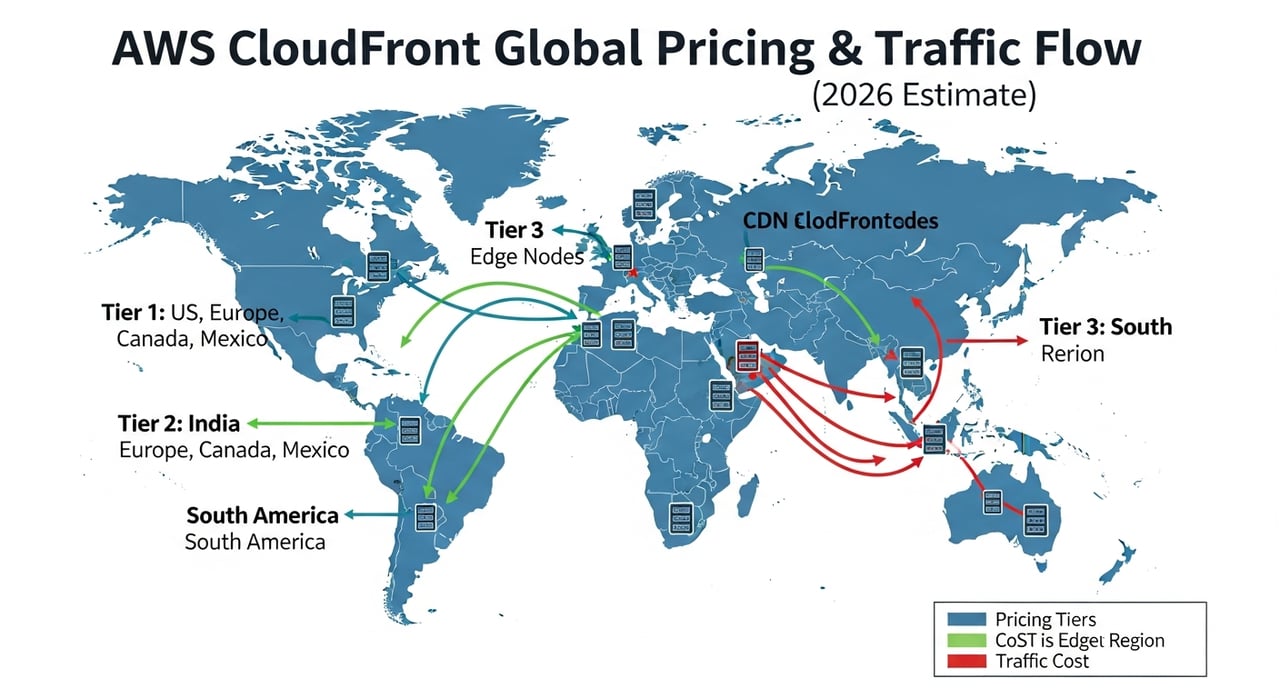
For pay-as-you-go buyers, CloudFront remains primarily a regional data transfer business. The most widely encountered entry rate in 2026 is $0.085 per GB for the first 10 TB in the United States, Canada, Mexico, and Europe. That equates to about $87.04 per TB. For many buyers, this is the anchor number they know.
From there, rates step down with volume, but geography still dominates the bill. South America remains materially more expensive than North America and Europe. Asia-Pacific markets are mixed, with several higher-cost destinations. In practice, the regional weighting of your audience often matters more than the nominal headline rate.
The executive shortcut is this:
A practical 2026 planning view for AWS CloudFront pricing 2026 looks like this for the first delivery tier:
| Region group | Indicative CloudFront entry rate | Per-TB equivalent | Executive implication |
|---|---|---|---|
| United States, Canada, Mexico | About $0.085 per GB | About $87.04 per TB | Reasonable benchmark zone for AWS-native workloads |
| Europe, Israel, Türkiye | About $0.085 per GB | About $87.04 per TB | Similar economics to North America for many web workloads |
| Core APAC markets | Often above North America and Europe | Varies by destination | Budgeting error risk is high if country mix is ignored |
| South America | Meaningfully above North America and Europe | Often the cost outlier | A common reason global media and software vendors rebid CDN contracts |
The second pricing path is the flat-rate plan structure. In 2026, AWS offers Free, Pro, Business, and Premium tiers, with list prices starting at $0, $15, $200, and $1,000 per month respectively. Those plans bundle multiple AWS services and include monthly traffic allowances, and AWS expanded the Premium plan in May 2026 to support configurable usage allowances up to 600 TB and 6 billion requests per month per distribution. This changes procurement posture because the value case depends on how much of that bundle you would have purchased separately anyway.
The market has bifurcated. Hyperscalers sell convenience and ecosystem fit. Specialist providers sell cost efficiency, operational flexibility, and, in some segments, faster commercial responsiveness. Akamai’s 2025 results showed delivery as a still-large but declining part of its mix, while security and compute grew faster. Fastly’s 2025 reporting showed stronger growth in network services than in legacy delivery narratives. Cloudflare continued investing heavily in its network footprint and platform layers. The market signal is clear: pure CDN is still necessary, but it is no longer sufficient as a vendor story.
That is exactly why buyers should isolate the delivery line item before accepting bundle logic. If a provider is winning the RFP because it bundles adjacent services, that may be rational. But the finance team should know whether the delivery component is competitive on its own.
Use a seven-criterion framework. Score each vendor from 1 to 5, then weight the categories by business model. Media companies and game distributors should overweight cost and traffic elasticity. Regulated enterprise platforms may overweight integration, governance, and support model.
| Vendor | Price/TB posture | Uptime SLA posture | Enterprise flexibility | AWS integration | Lock-in risk | Contract flexibility | Best fit |
|---|---|---|---|---|---|---|---|
| BlazingCDN | Very aggressive, from $4/TB at entry and down to $2/TB at 2 PB+ | 100% uptime positioning | High | Moderate | Lower than hyperscaler-native bundles | High | Large-scale delivery where cost discipline matters |
| Amazon CloudFront | Moderate to expensive depending on region | Strong enterprise credibility | Strong inside AWS estate | Very high | Higher once flat-rate bundles are adopted deeply | Moderate | AWS-centric platforms prioritizing integration |
| Cloudflare | Depends heavily on plan and negotiation model | Strong | High | Moderate | Moderate | Moderate | Platform teams buying performance plus broader edge services |
| Fastly | Often premium relative to cost-led providers | Strong | High for engineering-led teams | Moderate | Moderate | Moderate | Teams prioritizing programmability and control |
| Akamai | Usually negotiated, often enterprise premium | Strong | High | Lower than CloudFront | Moderate | Contract-dependent | Large enterprises buying global delivery plus security stack |
The opinionated read: CloudFront wins when the buyer values AWS-native integration enough to accept a weaker pure-delivery cost position. It loses when the workload is bandwidth-heavy and the surrounding AWS bundle is not genuinely replacing existing tooling.
Assume an enterprise delivers 1 PB per month. Audience mix is 55% North America, 25% Europe, 15% APAC, and 5% South America. Ignore origin egress from AWS services to CloudFront where applicable, but include request charges, support overhead, and migration labor. Contract term is 36 months. Traffic growth is 20% annually.
Using a simple blended rate assumption for CloudFront pay-as-you-go:
A conservative blended estimate for this mix lands roughly in the high single-digit cents per GB before fine-grained regional optimization. At 1 PB per month, even a blended rate of $0.075 per GB implies about $75,000 monthly delivery spend, or roughly $900,000 annually, before support and adjacent service costs.
For many enterprises, these add 5 to 20 percent to the apparent CloudFront number. The exact share depends on how much of the AWS bundle you were already consuming and whether finance allocates shared platform costs accurately.
For organizations where CDN is predominantly a delivery problem, not an all-in AWS policy bundle, the spread becomes hard to ignore. BlazingCDN is worth evaluating in that frame. It is positioned as a modern, reliable, cost-effective CDN for enterprises that need stability and fault tolerance comparable to Amazon CloudFront while remaining significantly more cost-effective. For high-volume delivery, pricing scales from $4 per TB at entry to as low as $2 per TB at 2 PB+, with no other costs and migration in about one hour.
At the 1 PB monthly level, that kind of pricing posture changes the board conversation from “how do we shave a few percent off CDN?” to “why are we carrying a structurally higher delivery cost at all?” If you need a scannable benchmark, use this side-by-side CDN comparison in the procurement discussion.
That does not make CloudFront wrong. It means the burden of proof shifts. If CloudFront is kept, the platform owner should be able to show that AWS integration, bundled controls, or reduced operational complexity offsets the delivery premium in measurable terms.
CDN migration is rarely blocked by content delivery itself. It is blocked by the things wrapped around it. Signed URLs, cache keys, origin shielding behavior, edge logic, bot controls, DNS cutover sequencing, certificate handling, and observability baselines are where delays occur.
The main lock-in trap in 2026 is not just API compatibility. It is bundle dependency. Once teams start relying on a flat-rate CloudFront plan for DNS, logging, and security defaults, the switching cost is no longer a CDN migration. It is a partial application delivery stack disentanglement.
De-risk the move with four controls:
Timeline realism matters. A static content estate can move quickly. A large media, gaming, or multi-tenant SaaS environment with custom edge behavior should plan for staged migration, not a weekend cutover fantasy.
| If this is true | Bias toward |
|---|---|
| You are deeply standardized on AWS controls and want one commercial owner for delivery plus adjacent services | CloudFront flat-rate or negotiated AWS construct |
| Your workload is bandwidth-heavy and margin-sensitive | Cost-optimized CDN shortlist led by BlazingCDN, then hyperscaler comparison |
| You need multi-vendor resilience and stronger negotiating leverage | Dual-vendor design, avoid over-attaching to bundled controls |
| You cannot clearly explain your effective per-GB cost to finance | Pause renewal and run a full TCO review first |
Do not debate AWS CloudFront pricing 2026 as a brand preference. Take your last three months of traffic, split it by region, apply your real request profile, and calculate the effective cost per GB including the services your team quietly bundles around it. Then run the same model against at least one cost-optimized alternative and one peer enterprise platform.
If the spread is immaterial, keep CloudFront and document why. If the spread is material, open a formal vendor comparison, run a pilot, and bring the results to your next infrastructure, architecture, or finance review. That is the kind of decision record boards, procurement teams, and engineering leaders can defend a year from now.
Compare
jsDelivr vs unpkg vs cdnjs in 2026: Fastest Free CDN Benchmark In our Q1 2026 measurements, jsDelivr delivered an 18 ms ...

Compare
Imagine a bustling global marketplace where digital content flows as smoothly as traffic in a well-orchestrated city. ...

Learn
AWS CloudFront Pricing in 2026: Cost per TB Breakdown At 50 TB/month of egress from US edge locations, your AWS ...