
Learn
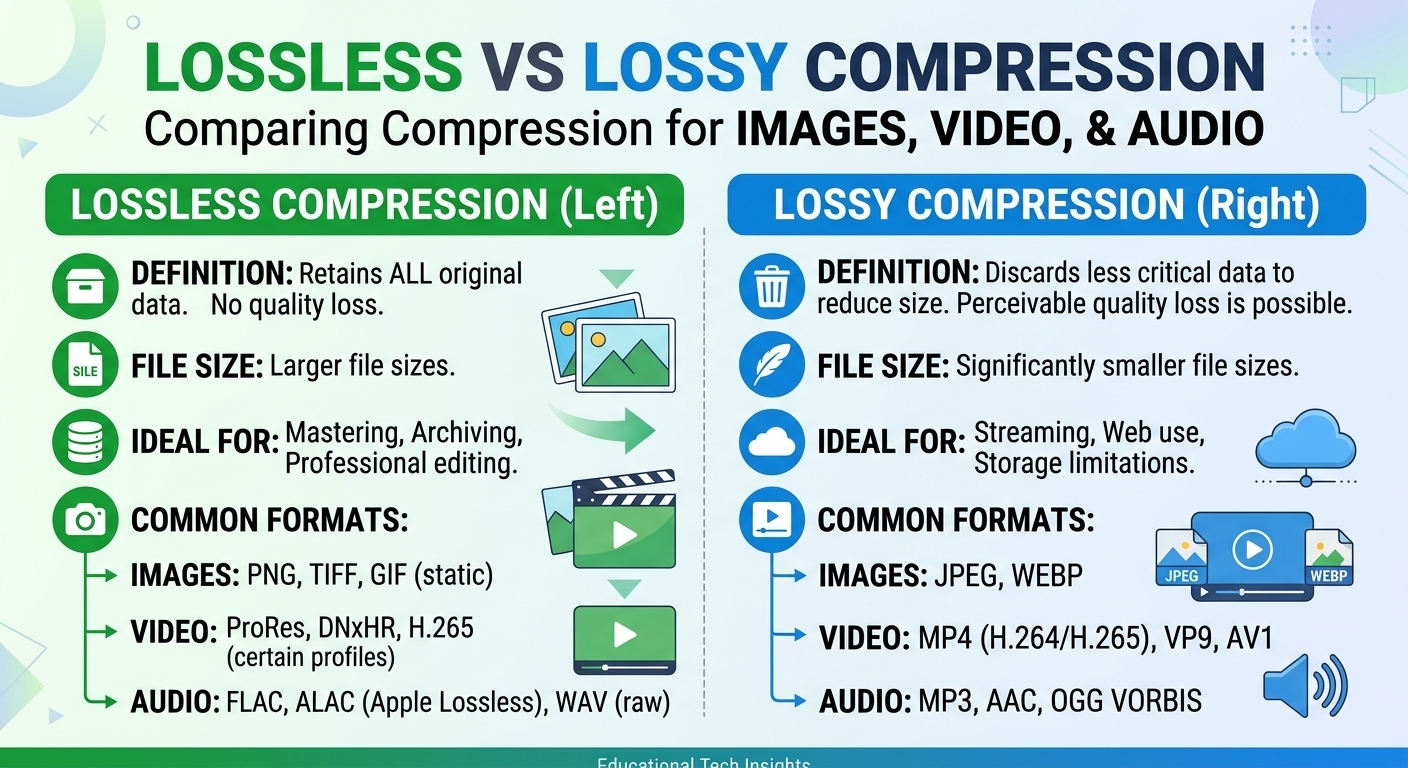
Lossy vs Lossless Compression: Images, Video and Audio
Lossy vs lossless compression comes down to one trade: lossless compression rebuilds every original bit and typically ...
Evaluated January 2026. AV1 cuts delivery bitrate by roughly 30–40% versus H.264 and 15–25% versus HEVC at production encoder presets, not the 50% headline figure you see quoted from slow-preset lab runs. The catch is arithmetic: AV1 pays for its extra encode cost only when a title is watched a lot, or when your delivery price per TB is high. At $2/TB egress, a 1080p title needs roughly 2,000 viewing hours per source hour to break even. At $85/TB, about 47. The AV1 codec is a top-of-catalog decision, not a catalog-wide default.
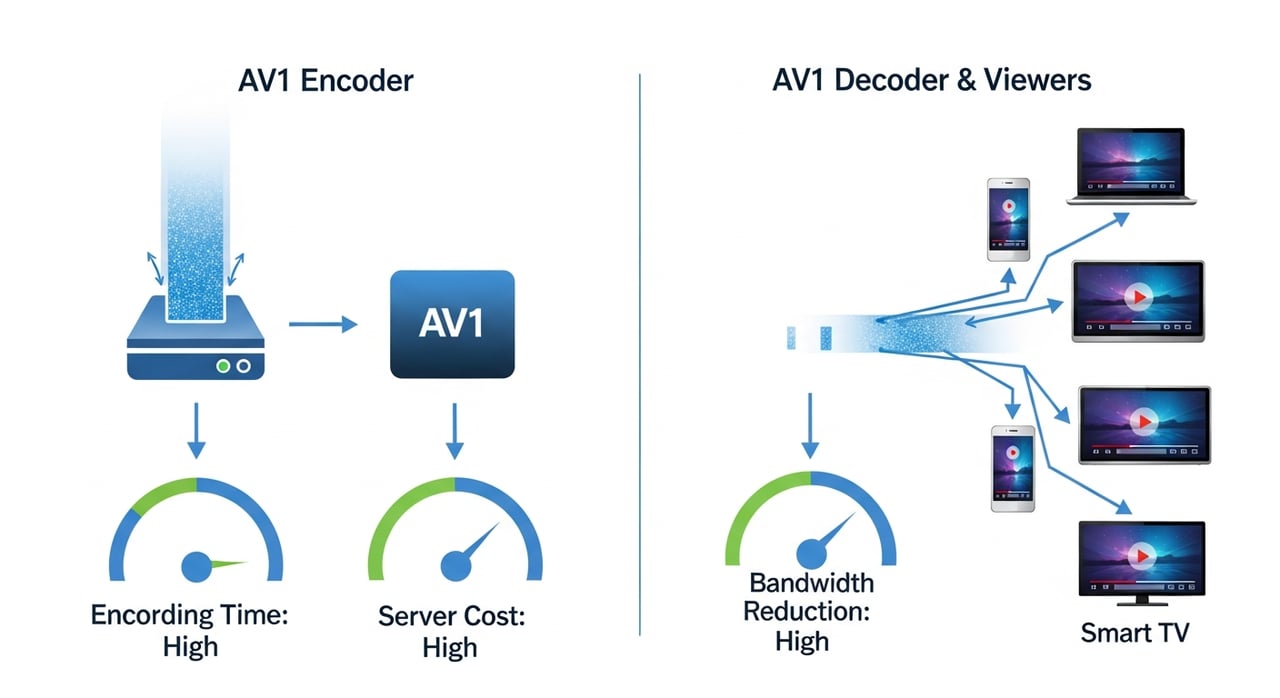
The criteria that decide this evaluation are not the ones vendor decks lead with. Compression efficiency matters only relative to what you pay per GB delivered. Encode cost matters only relative to how many times each encoded second is watched. Device reach decides whether you can retire a fallback ladder or must carry two. Everything else is secondary.
Assumptions for the table below: software encoders on modern x86 server cores, quality matched by VMAF rather than PSNR, 1080p and 2160p mixed content, and hardware decode reach estimated across a general consumer OTT audience (mobile, browser, connected TV) rather than a single platform.
| Codec | Bitrate at equal VMAF vs H.264 | Encode CPU vs x264 medium (est.) | Hardware decode reach, 2026 (est.) | Licensing | Honest limitation |
|---|---|---|---|---|---|
| AV1 (SVT-AV1, preset 6–8) | −30% to −40% | 1.5× to 4× | 45–65% of sessions | Royalty-free (AOMedia) | Still needs an H.264 fallback ladder; software decode drains mobile battery |
| AV1 (libaom, slow presets) | −40% to −50% | 20× to 60× | Same as above | Royalty-free | Economically irrational outside evergreen catalog top titles |
| HEVC / H.265 (x265 medium) | −20% to −30% | 2× to 5× | 75–85% of sessions | Multiple patent pools | Licensing exposure varies by distribution model; weak in browsers |
| VP9 | −20% to −25% | 3× to 6× | 70–85% of sessions | Royalty-free | Strictly dominated by AV1 for new pipelines; no reason to start here in 2026 |
| H.264 (x264 medium) | baseline | 1× | Effectively universal | Mature pool, low rates | Costs the most bandwidth; no 10-bit HDR path on many decoders |
The single conclusion from this video codec comparison: AV1 buys you the largest bitrate reduction of any broadly deployable codec in 2026, but it is the only one on the list that still requires you to keep a full fallback ladder in production.
Between 30% and 40% against H.264 at presets you would actually run in a VOD pipeline, and 15–25% against HEVC. Published AOMedia-era figures near 50% come from slow-preset, long-GOP encodes on standardized test sequences, which is a legitimate compression measurement and a misleading capacity-planning input.
The gain is not uniform across the ladder. AV1's advantage widens at low bitrates and small resolutions: on 360p–540p rungs, 40–50% reductions at equal VMAF are common, which is why short-form and mobile-first services in bandwidth-constrained markets see the strongest returns. On a 2160p HDR rung at 12–16 Mbps, the delta narrows toward 20–25%.
SVT-AV1 changed the arithmetic. At presets 6–8, encode time lands within roughly 1.5–4× x264 medium on modern server cores while still delivering most of the compression win. That is a manageable multiplier. libaom at quality presets is 20–60× and belongs only on catalog titles with millions of expected viewing hours.
Hardware AV1 encoders on current data-center GPUs and accelerators do real-time multi-rung ladders, but give back roughly 10–20% of the compression advantage compared with software at preset 6. For live, that trade is usually correct. For VOD, it usually is not.
Two costs get forgotten in every AV1 business case. First, per-title or per-shot rate control, which is where much of the real-world saving comes from, adds analysis passes on top of the encode itself. Second, adding an AV1 ladder alongside H.264 and HEVC multiplies your object count at the edge, which fragments cache and can push origin fetch volume up several percent until the new ladder warms.
The framework is one line. AV1 wins when viewing hours per source hour exceed the incremental encode cost divided by the delivery saving per viewing hour:
Break-even viewing hours = incremental encode cost per source hour ÷ (bitrate saving fraction × GB per viewing hour × price per GB)
Worked example, assumptions stated: a 1080p H.264 stream at 5 Mbps consumes 2.25 GB per viewing hour; AV1 saves 45% of that on the mid-ladder rungs where most sessions sit, or about 1.01 GB per hour; the incremental cost of adding an AV1 ladder is $4 per source hour (estimate, SVT-AV1 preset 8 across five rungs on commodity cloud compute).
| Delivery price | Per GB | Saving per viewing hour | Break-even viewing hours per source hour |
|---|---|---|---|
| $2 / TB (2 PB+ committed tier) | $0.002 | $0.0020 | ~1,980 |
| $5 / TB (entry pay-as-you-go) | $0.005 | $0.0051 | ~790 |
| $20 / TB (mid-tier commercial) | $0.020 | $0.0202 | ~198 |
| $85 / TB (list-price hyperscaler egress) | $0.085 | $0.0859 | ~47 |
The decisive variable is not the codec, it is your price per TB: a service paying list-price hyperscaler egress justifies AV1 on 40× more of its catalog than a service already delivering at $2/TB.
That cuts both ways when you pick a delivery vendor. As of October 2026, BlazingCDN prices streaming delivery on pay-as-you-go tiers starting at $5 per TB and reaching $2.50 per TB at volume. At those rates, a 30% AV1 bitrate reduction on 1 PB of monthly egress saves about $900 per month, so an operator already on cost-optimized pay-as-you-go CDN pricing per TB should treat AV1 as a quality-per-bitrate and mobile-experience play rather than a bandwidth-cost play.
BlazingCDN's honest limitation here: it is delivery infrastructure with NVMe SSD edge storage and roughly one-hour onboarding, not a transcoding platform, so the AV1 ladder still lives in your pipeline. Bunny.net and CDN77 price competitively in the same league at mid volumes, and Fastly remains the stronger pick if you manipulate manifests at the edge per request. The comparison worth running is uptime and origin-offload behavior under spike load at your actual $/TB, not the marketing tier chart.
Hardware AV1 decode arrived on Apple silicon with the A17 Pro and M3 generation, on flagship Android chipsets from 2022 onward, on 2020-and-later premium smart TV platforms, and across current-generation streaming sticks. Chrome, Edge and Firefox decode AV1 in software on desktop with acceptable CPU cost at 1080p.
Estimated blended reach across a general consumer audience in 2026 is 45–65% of sessions with hardware decode. The remainder splits into software-decode-capable devices where 4K AV1 is a battery and thermal problem, and older TVs and set-top boxes that will never play AV1. Plan for a three-codec world through at least 2028: AV1 for capable devices, HEVC for the connected TV middle, H.264 as the floor.
| Workload | Best fit | Why |
|---|---|---|
| Short-form and user-generated video, mobile-first | AV1, hardware or SVT-AV1 preset 9–10 | 40–50% gains on low-bitrate rungs; extreme replay ratios repay encode instantly |
| Premium VOD catalog, long tail | AV1 on the top 5–10% of titles only | Long-tail titles rarely clear the break-even viewing hours |
| Live sports, sub-5-second latency | HEVC now, hardware AV1 as a parallel rendition | Real-time AV1 gives back 10–20% of its advantage; concurrency is what pays |
| Enterprise and internal video | H.264 | Volumes are too small for any codec migration to clear its engineering cost |
| Emerging-market OTT on constrained networks | AV1 aggressively | Value is rebuffer reduction and start-up time, not the egress line item |
Across every workload in this matrix, replay ratio decides the AV1 verdict more than resolution, content type, or codec benchmarks do.
Roughly 30–40% at equal perceptual quality when using production encoder presets, rising to 40–50% on low-bitrate rungs below 720p. Lab figures near 50% come from slow presets that cost 20–60× more CPU than x264. Use the production range for capacity planning and the lab range only for archive-grade encodes.
Yes, with hardware encoders or SVT-AV1 at presets 10–12, but compression efficiency drops 10–20% versus software at preset 6. For sub-5-second latency live sports, HEVC remains the pragmatic primary while AV1 runs as an additional rendition for capable devices. Verify encoder throughput at your concurrency before committing.
An estimated 45–65% of consumer streaming sessions reach a device with hardware AV1 decode, varying widely by region and device mix. Apple silicon from the A17 Pro and M3 generation, flagship Android chipsets from 2022 onward, and 2020-and-later premium smart TVs decode in hardware. Keep an H.264 fallback ladder.
Run both through at least 2028. HEVC still covers the connected TV middle that AV1 hardware has not reached, and AV1 delivers 15–25% lower bitrate on devices that do support it. Retire HEVC only when your own player telemetry shows AV1-capable sessions above roughly 85%.
AV1 is published royalty-free by the Alliance for Open Media, which removes the per-unit and distribution-model licensing questions that follow HEVC. Independent patent-pool claims against AV1 have been asserted but have not produced the layered licensing regime HEVC carries. Treat royalty-free status as a genuine but secondary advantage behind compression and device reach.
Take ten titles that represent your catalog by genre and motion complexity. Encode each with x264 medium, x265 medium, and SVT-AV1 preset 8. Match VMAF at each rung rather than matching bitrate, then record actual encoder wall-clock cost per source hour. Pull viewing hours per source hour for those same ten titles from your analytics, and put both numbers into the break-even formula with your real contracted price per TB. If fewer than three of the ten clear break-even, AV1 belongs on your top decile only. Publish the spreadsheet internally; it will settle the argument faster than any benchmark chart.

Heavy traffic.
Light bill.
The CDN for video and large traffic
Learn
Lossy vs lossless compression comes down to one trade: lossless compression rebuilds every original bit and typically ...
Pricing - Pricing & Costs
The CloudFront vs S3 decision depends more on object size than on traffic volume. At a 500 KB average response, 100 TB ...
Learn
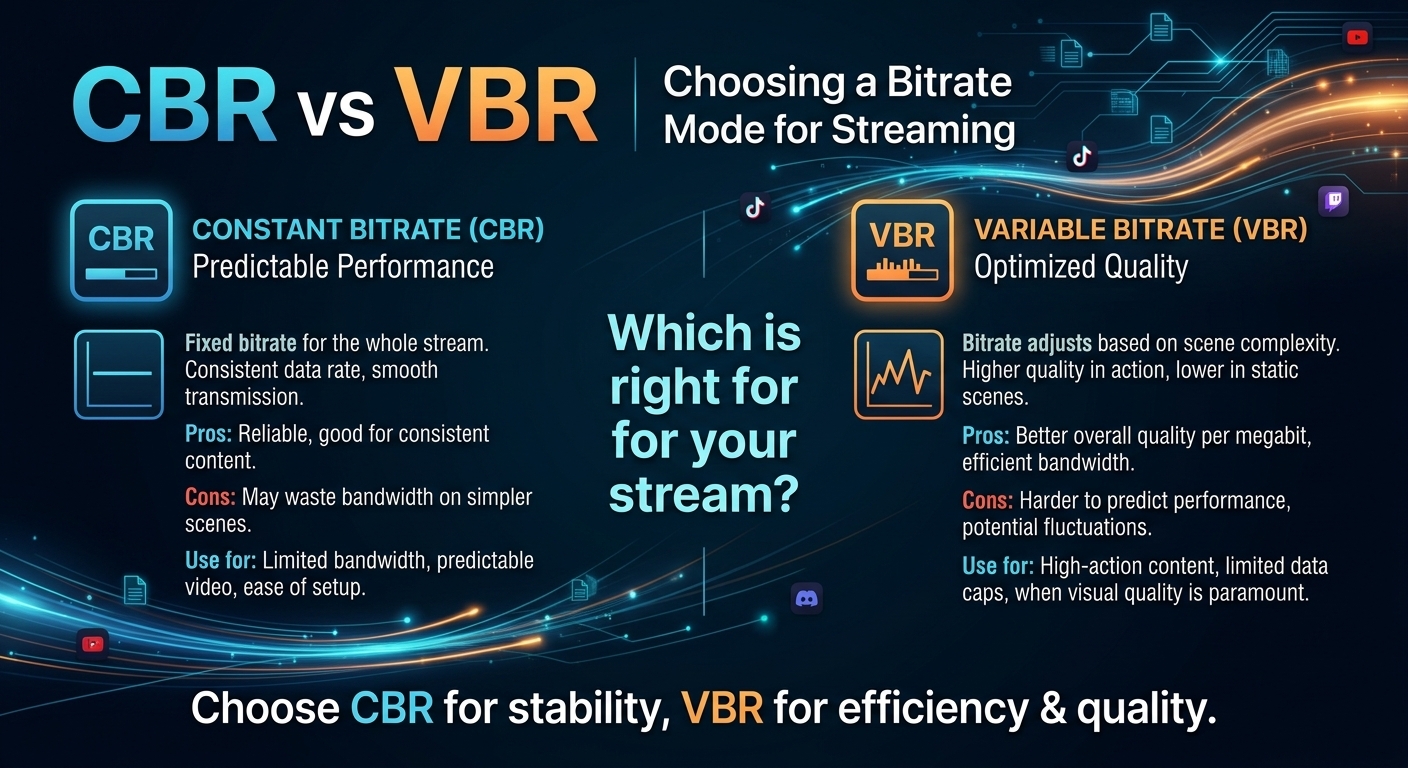
For most on-demand video, capped variable bitrate (VBR) wins the cbr vs vbr decision: it spends bits where the picture ...