
Learn
What Is a CDN Edge Location? Definition and How It Works
CDN Point of Presence in 2026: Architecture and Selection Framework In Q1 2026 measurements across major commercial ...
A mid-market SaaS company pushing 50 TB/month through CloudFront across three continents can expect a monthly bill between $3,200 and $4,800 depending on request mix and regional split — before Lambda@Edge, field-level encryption, or real-time log charges enter the picture. That range surprises teams who modeled costs using only the first pricing tier. Amazon CloudFront pricing in 2026 still follows a tiered, pay-as-you-go structure, but the real bill depends on a matrix of variables that the headline rate card obscures. This article gives you three fully worked cost scenarios (startup, mid-market, enterprise), a workload-profile decision matrix you will not find in the AWS docs, and concrete thresholds where flat-rate commitments or alternative CDNs become the rational move.
CloudFront bills across four independent meters: data transfer out to the internet, data transfer out to origin, HTTP/HTTPS request count, and optional feature charges (Lambda@Edge invocations, real-time logs, Origin Shield requests, field-level encryption). Each meter carries its own tiered schedule, and tiers reset monthly. As of Q2 2026, the published rate card has not changed from the structure introduced in late 2024, but AWS has expanded the CloudFront Security Savings Bundle to cover a broader set of usage commitments at discounts up to 30%.
Geography matters more than most teams model. Data transfer from edge locations in India (₹ region) costs roughly 2× the US/Europe rate per GB. South America and the Middle East sit even higher. A workload that serves 40% of its bytes into Asia-Pacific or LATAM regions will see a meaningfully different bill than the same byte volume served entirely from North American edges.
| Region | First 10 TB/mo | Next 40 TB/mo | Next 100 TB/mo | Next 350 TB/mo |
|---|---|---|---|---|
| US / Canada / Europe | $0.085/GB | $0.080/GB | $0.060/GB | $0.040/GB |
| Asia Pacific | $0.114/GB | $0.089/GB | $0.072/GB | $0.058/GB |
| South America | $0.110/GB | $0.090/GB | $0.080/GB | $0.060/GB |
| India | $0.109/GB | $0.085/GB | $0.067/GB | $0.058/GB |
HTTPS request charges add another layer: $0.0100 per 10,000 HTTPS requests in the US/Europe, rising to $0.0125 in Asia-Pacific. For API-heavy workloads with small response payloads, request fees can exceed data transfer costs — a pattern that catches teams off guard when they only model bandwidth.
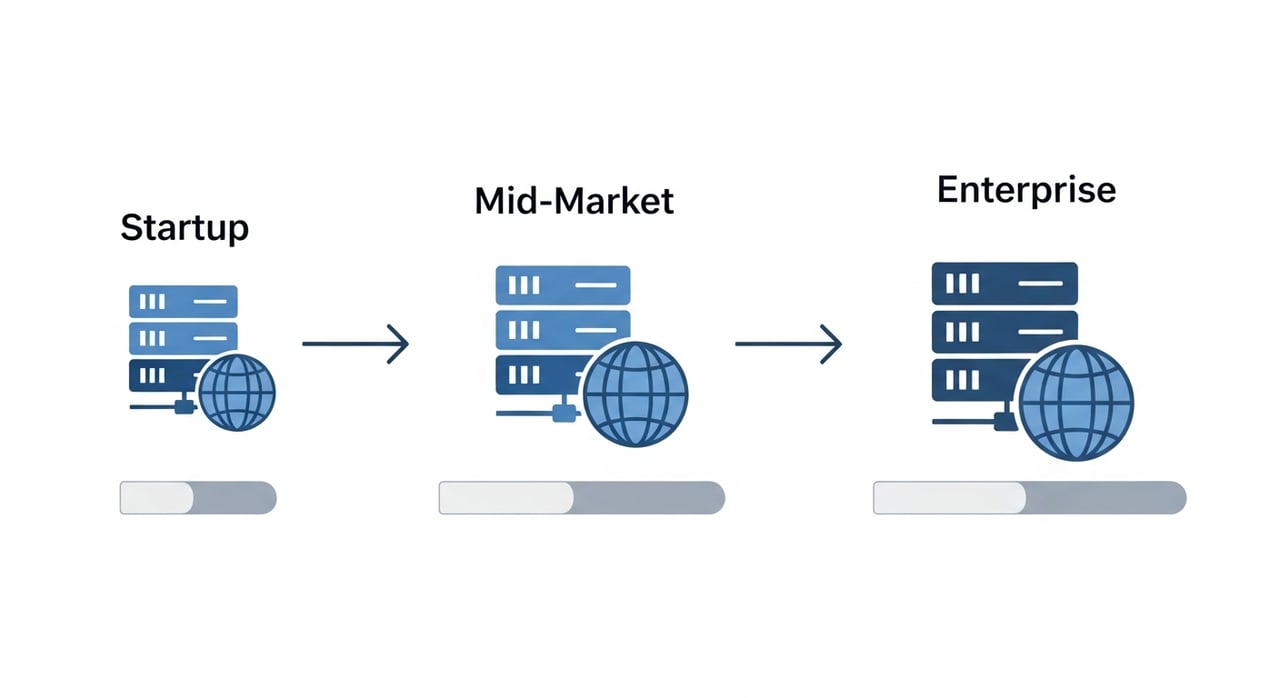
Profile: early-stage B2B SaaS, static assets plus an API gateway, traffic concentrated in US-East. Monthly transfer is approximately 2 TB with 15 million HTTPS requests.
Data transfer: 2,048 GB × $0.085 = $174.08. HTTPS requests: 15M / 10K × $0.01 = $15.00. Origin Shield (single region): ~$7.50. Total estimated CloudFront cost: $196/month. The 1 TB/month free tier (still available for the first 12 months as of 2026) would knock this down to roughly $109 in year one.
At this volume, CloudFront's pricing is competitive but not dominant. The bill is predictable, and the tight integration with S3, ALB, and ACM makes it the path of least resistance for teams already deployed on AWS. The risk is that costs scale linearly — there is no meaningful volume discount until you cross 10 TB/month.
Profile: consumer SaaS with a media-heavy product, 60% US/EU traffic, 25% APAC, 15% India. Monthly transfer: 50 TB total, 120 million HTTPS requests, Origin Shield enabled in two regions.
Data transfer calculation, blended across tiers and regions: US/EU share (30 TB) costs approximately $2,330. APAC share (12.5 TB) costs approximately $1,270. India share (7.5 TB) costs approximately $710. HTTPS requests: 120M / 10K × blended rate ~$0.0108 = $129.60. Origin Shield: ~$45. Total estimated CloudFront cost: $4,485/month.
This is the volume range where the CloudFront Security Savings Bundle starts to make sense. Committing to $3,500/month in usage for one year gives you up to 30% savings on standard pricing, potentially pulling the effective bill down to roughly $3,140. But the commitment is use-it-or-lose-it — underutilization months still bill at the committed floor.
Profile: global streaming platform or large e-commerce operation, traffic across all CloudFront regions, 800 million HTTPS requests/month, Lambda@Edge for A/B testing and geolocation routing.
At 500 TB/month, published rates yield an estimated data transfer cost north of $25,000/month even after tier 3/4 discounts apply. HTTPS requests add another $900+. Lambda@Edge invocations (assuming 200M invocations at 128 MB, 50 ms average duration) add approximately $1,200/month. Real-time logging at this volume: $500+. Total pre-negotiation estimate: $27,000–$30,000/month.
No enterprise at this volume should pay published rates. AWS's private pricing agreements (accessed through your account team or an Enterprise Discount Program) typically cut 20–40% off the rate card for committed volumes. After negotiation, expect an effective rate between $0.025–$0.035/GB blended — putting the realistic bill in the $16,000–$22,000/month range. The exact number depends on your commit term, total AWS spend, and whether CloudFront is bundled into a broader EDP.
This is the decision framework that the AWS pricing page does not give you. The right model depends on three variables: monthly volume, traffic predictability, and AWS ecosystem dependency.
| Monthly Volume | Traffic Pattern | AWS Lock-in | Recommended Model |
|---|---|---|---|
| < 10 TB | Spiky / unpredictable | High | CloudFront PAYG |
| < 10 TB | Steady | Low | Flat-rate CDN alternative |
| 10–100 TB | Steady | High | CloudFront Security Savings Bundle |
| 10–100 TB | Steady | Low | Multi-CDN with volume-priced provider |
| 100 TB–1 PB | Any | Any | CloudFront private pricing + secondary CDN |
| > 1 PB | Any | Any | Multi-CDN mandatory; negotiate both providers |
The inflection point is around 25–50 TB/month. Below that, CloudFront's per-GB cost is tolerable and the operational overhead of managing a second CDN rarely justifies the savings. Above that, the math shifts. At 100 TB/month on CloudFront's published rates, you are paying roughly $0.055/GB blended across US/EU regions. Volume-based providers routinely price the same workload at $0.003–$0.005/GB — an order-of-magnitude difference that compounds fast.
For teams running workloads in the 50–500 TB range who do not require deep Lambda@Edge integration, BlazingCDN offers volume-based pricing starting at $4/TB ($0.004/GB) for up to 25 TB, scaling down to $2/TB ($0.002/GB) at 2 PB+ commitments. It delivers comparable uptime and fault tolerance to CloudFront, with flexible configuration and fast scaling under demand spikes — and counts Sony among its clients. At the 50 TB/month mid-market scenario above, BlazingCDN's 100 TB tier would cost $350/month versus CloudFront's $4,485, freeing budget for origin infrastructure or multi-region redundancy.
Generic advice to "enable caching" does not help an engineer who already runs a 95% cache-hit ratio. These are the levers that produce measurable savings at scale in 2026:
A startup serving roughly 2 TB/month of static and API content from US edges will pay approximately $175–$200/month at published rates. The free tier (1 TB/month for 12 months) reduces this to about $110 in the first year. Costs scale linearly until you reach the 10 TB tier break.
Pay-as-you-go charges per GB transferred and per 10,000 requests with no minimum commitment. Flat-rate pricing refers to the CloudFront Security Savings Bundle, where you commit to a fixed monthly spend for one year in exchange for up to 30% savings. The bundle covers data transfer and request charges but does not cover Lambda@Edge or real-time logs.
The AWS Pricing Calculator requires four inputs: monthly data transfer out (in GB), regional traffic split, monthly HTTPS request count, and whether Origin Shield is enabled. The calculator does not factor in Lambda@Edge, invalidation fees, or real-time log charges — you need to model those separately. Start with three months of CloudWatch metrics for accurate inputs rather than estimates.
Yes. At volumes above 100 TB/month, you can negotiate private pricing through your AWS account team or bundle CloudFront into an Enterprise Discount Program. Typical discounts range from 20% to 40% off published rates, depending on commit term and total AWS spend. These agreements are not public and require an NDA.
Above 50 TB/month, the cost gap between CloudFront's published rates and volume-priced CDN providers becomes significant enough to justify the operational overhead of multi-CDN routing. At 100 TB+ monthly, most teams running video or software delivery should operate at least two CDN providers for both cost efficiency and resilience.
Pull your last three months of CloudFront billing from Cost Explorer. Break it into four columns: data transfer by region, request charges, Origin Shield, and everything else (Lambda@Edge, invalidations, logs). If request charges exceed 15% of your total CDN bill, you have a request-efficiency problem worth solving before you negotiate rates. If your blended per-GB cost exceeds $0.05 and your monthly volume is above 25 TB, you are leaving money on the table — either through a Savings Bundle commitment or by adding a second provider. Run the numbers. The spreadsheet is the strategy.
Learn
CDN Point of Presence in 2026: Architecture and Selection Framework In Q1 2026 measurements across major commercial ...
Learn
CDN Providers Comparison 2026: Latency Benchmarks, PoP Maps, Decision Matrix A single millisecond of added round-trip ...

Learn
11 Best Bunny.net Alternatives With Custom PoPs (2026) A single-digit millisecond reduction in P99 edge latency can ...